
What is the Hierarchy Like at a Venture Capital Firm and How Long Does It Take to Reach Each Level


Venture capital firms are known for their dynamic and fast-paced environments, where professionals navigate a structured hierarchy to drive investment decisions and support portfolio companies. The organizational structure typically includes roles such as analysts, associates, principals, and partners, each with distinct responsibilities and progression timelines. Climbing the ladder in a venture capital firm requires a combination of financial acumen, industry expertise, and networking skills. This article explores the hierarchy within a venture capital firm, detailing the responsibilities at each level and the average time it takes to advance. Understanding this career trajectory can provide valuable insights for aspiring professionals aiming to thrive in the competitive world of venture capital.
-
What is the Hierarchy Like at a Venture Capital Firm and How Long Does It Take to Reach Each Level?
- 1. What Are the Entry-Level Positions in a Venture Capital Firm?
- 2. What Does a Senior Associate Do in a Venture Capital Firm?
- 3. What Is the Role of a Principal or Vice President in a VC Firm?
- 4. How Do You Become a Partner in a Venture Capital Firm?
- 5. What Are the Key Factors That Influence Career Progression in VC?
- What is the hierarchy of a venture capital firm?
- What are the tiers of venture capital?
- What is the career path of venture capital?
- What are the positions in a VC firm?
- Frequently Asked Questions by our Community
What is the Hierarchy Like at a Venture Capital Firm and How Long Does It Take to Reach Each Level?
The hierarchy at a venture capital (VC) firm is typically structured in a way that allows professionals to grow from entry-level positions to senior roles over time. Each level requires a combination of experience, performance, and networking skills. Below, we break down the hierarchy and the estimated time it takes to reach each level.
See Also Why is Ltv Supposed to Be at Least 3x of Cac Wouldnt Ltv of 1 5x Cac Mean 50 Irr for the Investor Assuming Lifetime is 12 Months
1. What Are the Entry-Level Positions in a Venture Capital Firm?
Entry-level positions in a VC firm are often referred to as Analysts or Associates. These roles are typically filled by recent graduates or individuals with 1-3 years of experience in fields like investment banking, consulting, or startups. Analysts and Associates are responsible for market research, due diligence, and supporting senior team members in deal sourcing and execution. It usually takes 2-3 years to move up from this level.
2. What Does a Senior Associate Do in a Venture Capital Firm?
A Senior Associate is a mid-level position that requires 3-5 years of experience in venture capital or related fields. Senior Associates take on more responsibility, such as leading due diligence processes, building financial models, and managing relationships with portfolio companies. This role often serves as a stepping stone to becoming a Principal or Vice President (VP).
See Also How Many Pitch Decks Does a Venture Capital Firm Usually Get Within a Year
3. What Is the Role of a Principal or Vice President in a VC Firm?
Principals or VPs are senior professionals who play a key role in deal sourcing, negotiations, and investment decisions. They often have 5-8 years of experience and are responsible for mentoring junior team members and representing the firm at industry events. This level is critical for those aiming to become Partners.
4. How Do You Become a Partner in a Venture Capital Firm?
Becoming a Partner is the pinnacle of a VC career. Partners are responsible for setting the firm’s investment strategy, leading fundraising efforts, and making final investment decisions. This role typically requires 8-12 years of experience and a proven track record of successful investments. Partners often have equity stakes in the firm and are deeply involved in portfolio management.
See Also Where Do Venture Capital Firms Get Their Money?
5. What Are the Key Factors That Influence Career Progression in VC?
Career progression in venture capital depends on several factors, including performance, networking, industry knowledge, and deal-making skills. Building a strong reputation and track record is essential for advancing to higher levels. Additionally, mentorship from senior professionals can significantly accelerate career growth.
| Role | Experience Required | Key Responsibilities |
|---|---|---|
| Analyst/Associate | 1-3 years | Market research, due diligence, deal support |
| Senior Associate | 3-5 years | Leading due diligence, financial modeling, portfolio management |
| Principal/VP | 5-8 years | Deal sourcing, negotiations, mentoring |
| Partner | 8-12 years | Investment strategy, fundraising, final decisions |
What is the hierarchy of a venture capital firm?
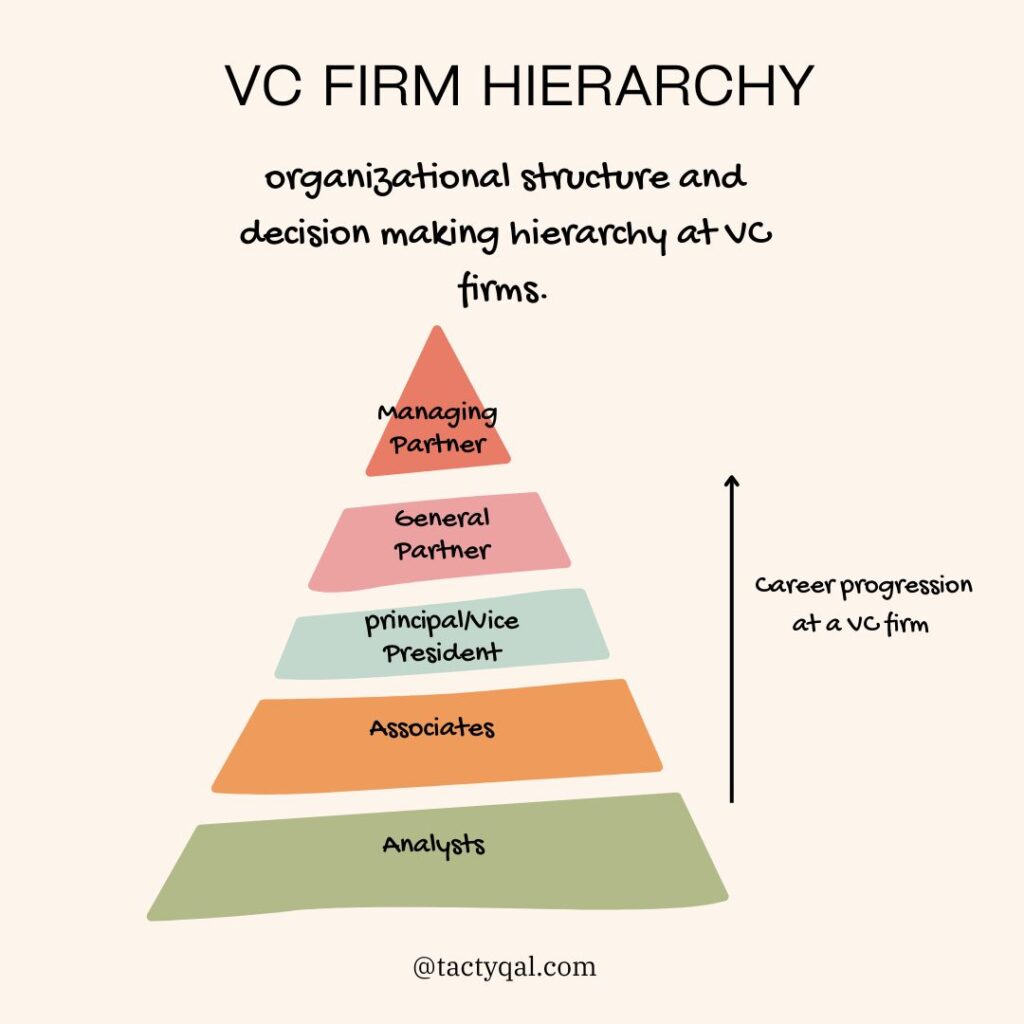
Overview of Venture Capital Firm Structure
The hierarchy of a venture capital (VC) firm is typically structured to ensure efficient decision-making and effective management of investments. The structure varies slightly between firms but generally includes the following key roles:
- Analysts/Associates: Entry-level positions responsible for market research, due diligence, and supporting senior team members.
- Principals/Senior Associates: Mid-level professionals who manage deals, interact with startups, and assist in investment decisions.
- Venture Partners: Experienced individuals who bring in deals and provide strategic guidance but are not full-time employees.
- Partners: Senior members who lead investment decisions, manage portfolios, and represent the firm externally.
- Managing Partners/General Partners: The top executives who oversee the firm’s operations, fundraising, and overall strategy.
Role of Analysts and Associates in VC Firms
Analysts and Associates form the foundation of a VC firm, handling critical tasks that support the investment process. Their responsibilities include:
- Conducting market research to identify emerging trends and potential investment opportunities.
- Performing due diligence on startups, including financial analysis and competitive benchmarking.
- Assisting in the preparation of investment memos and presentations for senior team members.
Responsibilities of Principals and Senior Associates
Principals and Senior Associates play a pivotal role in managing deals and fostering relationships with startups. Their duties include:
- Leading deal sourcing and evaluating potential investment opportunities.
- Negotiating term sheets and structuring deals with startup founders.
- Providing mentorship and strategic advice to portfolio companies.
Function of Venture Partners in VC Firms
Venture Partners are typically seasoned professionals who contribute to the firm’s success on a part-time or project basis. Their roles involve:
- Bringing in deal flow through their extensive networks and industry expertise.
- Offering strategic insights and guidance to portfolio companies.
- Assisting in fundraising efforts and representing the firm at industry events.
Leadership Roles: Partners and Managing Partners
Partners and Managing Partners are the decision-makers and leaders within a VC firm. Their responsibilities include:
- Making final investment decisions and approving deals.
- Managing the firm’s portfolio and ensuring the success of investments.
- Leading fundraising efforts and maintaining relationships with limited partners (LPs).
What are the tiers of venture capital?
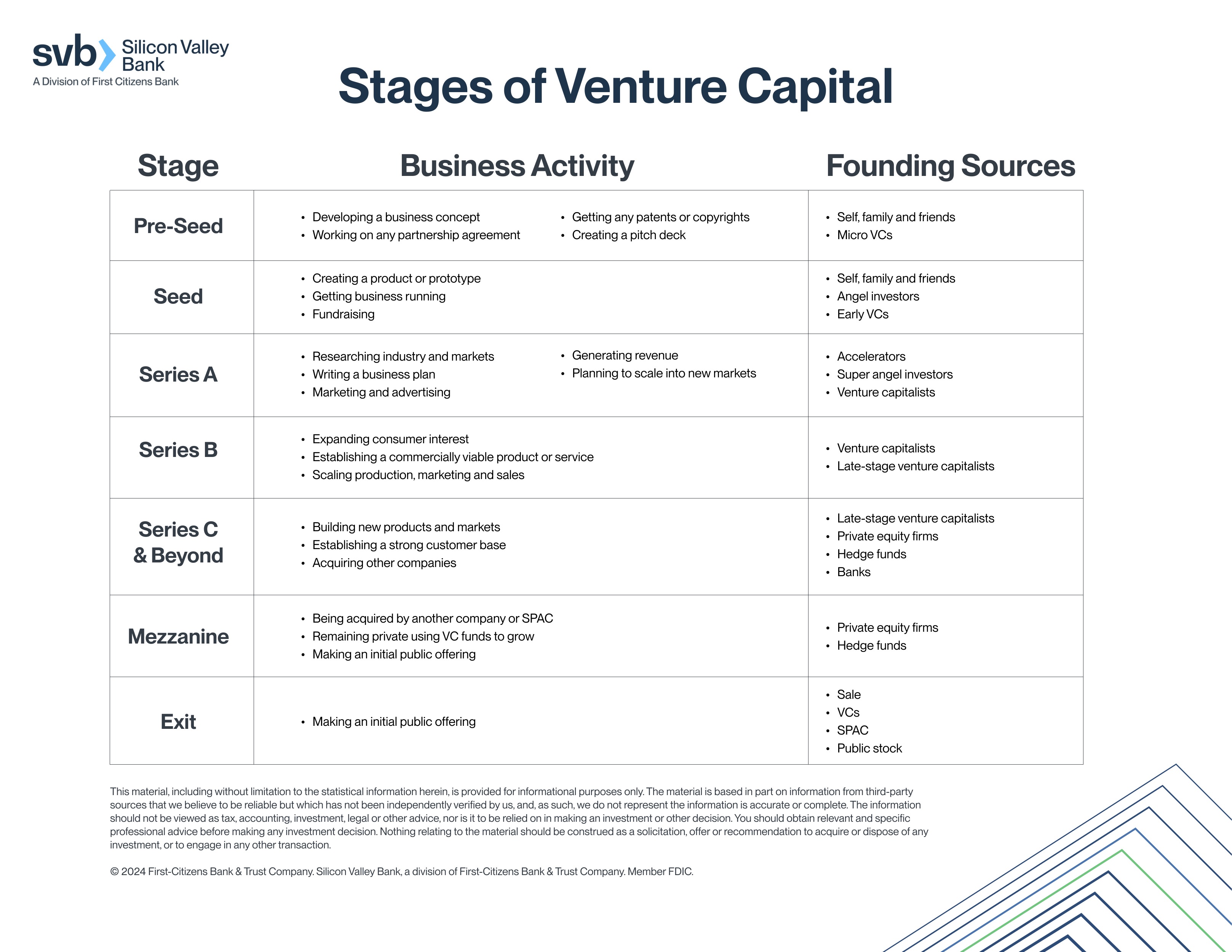
What is Pre-Seed Funding?
Pre-seed funding is the earliest stage of venture capital, typically used to validate an idea or build a prototype. This stage involves smaller amounts of capital and is often provided by angel investors or the founders themselves. Key characteristics include:
- Small investments: Usually ranging from $50,000 to $500,000.
- High risk: Investors are betting on the potential of an unproven idea.
- Focus on validation: Funds are used to test the market and develop a minimum viable product (MVP).
What is Seed Funding?
Seed funding is the next stage, where startups receive capital to develop their product and begin operations. This stage often involves venture capital firms and accelerators. Key aspects include:
- Larger investments: Typically between $500,000 and $2 million.
- Product development: Funds are used to refine the product and build a customer base.
- Early traction: Investors look for signs of market interest and growth potential.
What is Series A Funding?
Series A funding is the first major round of venture capital, aimed at scaling the business. Startups at this stage have a proven product and some market traction. Key features include:
- Significant investments: Ranging from $2 million to $15 million.
- Focus on scaling: Funds are used to expand operations, hire talent, and increase market share.
- Metrics-driven: Investors expect clear growth metrics and a solid business plan.
What is Series B Funding?
Series B funding is for startups that have achieved significant growth and are ready to expand further. This stage involves larger investments and more established investors. Key points include:
- Larger rounds: Typically between $15 million and $50 million.
- Market expansion: Funds are used to enter new markets or develop new products.
- Proven success: Investors look for strong revenue streams and a scalable business model.
What is Series C Funding and Beyond?
Series C funding and later stages are for mature companies looking to scale globally or prepare for an IPO. These rounds involve substantial capital and institutional investors. Key characteristics include:
- Massive investments: Often exceeding $50 million.
- Global expansion: Funds are used to enter international markets or acquire other companies.
- IPO preparation: Companies may use this funding to position themselves for a public offering.
What is the career path of venture capital?

What is Venture Capital?
Venture capital (VC) is a form of private equity financing that investors provide to early-stage, high-potential, and often high-risk startups. The goal is to support these companies in their growth phases in exchange for equity or ownership stakes. Venture capitalists typically seek high returns on their investments, often through an eventual exit strategy such as an IPO or acquisition.
Entry-Level Roles in Venture Capital
Starting a career in venture capital often begins with entry-level positions. These roles are crucial for gaining foundational knowledge and experience in the industry.
- Analyst: Analysts conduct market research, evaluate potential investments, and assist in due diligence processes. This role is ideal for recent graduates or those transitioning from related fields like investment banking or consulting.
- Associate: Associates take on more responsibility, including deal sourcing, financial modeling, and portfolio management. They often work closely with senior team members to identify promising startups.
- Intern: Internships provide hands-on experience and networking opportunities. Interns may assist with research, data analysis, and administrative tasks, offering a glimpse into the VC world.
Mid-Level Roles in Venture Capital
As professionals gain experience, they progress to mid-level roles that involve greater responsibility and decision-making.
- Senior Associate: Senior associates lead deal execution, manage relationships with portfolio companies, and mentor junior team members. They play a key role in shaping investment strategies.
- Principal: Principals are involved in high-level decision-making, including investment approvals and fund management. They often have a significant say in which startups receive funding.
- Venture Partner: Venture partners are experienced professionals who bring industry expertise and networks to the firm. They may work on a part-time or project basis, focusing on specific sectors or deals.
Senior-Level Roles in Venture Capital
Senior roles in venture capital require extensive experience and a proven track record of successful investments.
- Partner: Partners are responsible for overall fund strategy, fundraising, and managing investor relationships. They have significant influence over the firm's direction and success.
- General Partner (GP): GPs are the top decision-makers in a VC firm. They oversee all aspects of the fund, from sourcing deals to managing exits, and often have a personal stake in the fund's performance.
- Managing Director: Managing directors lead the firm's operations, set strategic goals, and represent the firm in high-level negotiations and public engagements.
Skills Required for a Career in Venture Capital
Success in venture capital demands a unique combination of skills and attributes.
- Analytical Skills: The ability to evaluate startups, assess market potential, and perform financial modeling is critical.
- Networking: Building and maintaining relationships with entrepreneurs, investors, and industry experts is essential for deal sourcing and portfolio management.
- Risk Management: Understanding and mitigating risks associated with early-stage investments is a key part of the job.
Challenges in the Venture Capital Career Path
While rewarding, a career in venture capital comes with its own set of challenges.
- High Competition: The field is highly competitive, with limited positions available at top firms.
- Long Hours: The demanding nature of the job often requires long hours, especially during deal negotiations or fundraising periods.
- Uncertain Outcomes: Early-stage investments carry significant risk, and not all deals will yield positive returns, requiring resilience and adaptability.
What are the positions in a VC firm?

What are the key roles in a VC firm?
In a venture capital (VC) firm, the key roles are structured hierarchically to manage investments, operations, and strategic decisions. Below are the primary positions:
- Analyst: Entry-level role focused on market research, due diligence, and supporting senior team members.
- Associate: Mid-level position responsible for sourcing deals, analyzing startups, and assisting in investment decisions.
- Principal: Senior role involved in deal execution, portfolio management, and mentoring junior staff.
- Partner: High-level decision-maker who leads investments, builds relationships with founders, and shapes the firm’s strategy.
- Managing Partner: Top executive overseeing the firm’s operations, fundraising, and overall direction.
What does an Analyst do in a VC firm?
An Analyst in a VC firm is typically an entry-level position focused on supporting the investment team. Their responsibilities include:
- Conducting market research to identify emerging trends and industries.
- Performing due diligence on potential investment opportunities.
- Creating financial models and presentations for internal and external use.
- Assisting Associates and Principals in deal sourcing and evaluation.
What is the role of an Associate in a VC firm?
An Associate plays a critical role in the deal-making process. Their duties include:
- Sourcing deals by networking with startups, accelerators, and other investors.
- Analyzing startups’ business models, financials, and growth potential.
- Supporting the due diligence process and preparing investment memos.
- Building relationships with founders and other stakeholders.
What responsibilities does a Principal have in a VC firm?
A Principal is a senior role with significant responsibilities, including:
- Leading deal execution and negotiating terms with startups.
- Managing portfolio companies and providing strategic guidance.
- Mentoring Analysts and Associates to develop their skills.
- Contributing to the firm’s investment strategy and decision-making processes.
What is the role of a Partner in a VC firm?
A Partner is a high-level position with a focus on leadership and strategy. Their key responsibilities include:
- Leading investment decisions and approving deals.
- Building and maintaining relationships with founders, co-investors, and limited partners.
- Representing the firm at industry events and conferences.
- Shaping the firm’s overall strategy and vision.
What does a Managing Partner do in a VC firm?
The Managing Partner is the top executive in a VC firm, responsible for:
- Overseeing the firm’s operations and ensuring its success.
- Leading fundraising efforts to secure capital from limited partners.
- Setting the firm’s strategic direction and long-term goals.
- Representing the firm in high-level negotiations and partnerships.
Frequently Asked Questions by our Community
What are the typical levels in the hierarchy of a venture capital firm?
The hierarchy at a venture capital firm typically starts with entry-level positions such as Analyst or Associate. These roles involve conducting market research, analyzing startups, and supporting senior team members. The next level is Senior Associate or Principal, where professionals take on more responsibility, including deal sourcing and portfolio management. Above this is the Vice President (VP) or Director level, where individuals focus on leading deals and managing relationships with founders. The top tiers include Partner and Managing Partner, who oversee the firm's strategy, make final investment decisions, and represent the firm externally.
How long does it take to move from an Analyst to a Partner role?
The timeline to progress from an Analyst to a Partner role in a venture capital firm can vary widely. On average, it takes about 10 to 15 years, depending on performance, firm size, and opportunities. Starting as an Analyst, one might spend 2-3 years before advancing to an Associate role. From there, it could take another 3-5 years to become a Principal or Vice President. Reaching the Partner level often requires demonstrating a strong track record of successful investments and leadership, which can take an additional 5-7 years.
What skills are required to advance in a venture capital firm?
Advancing in a venture capital firm requires a combination of technical expertise, networking skills, and leadership abilities. Early on, strong analytical skills and the ability to evaluate startups are crucial. As one progresses, deal-making skills, such as negotiating term sheets and structuring investments, become more important. Building a robust network within the startup ecosystem and demonstrating strategic thinking are key to reaching senior roles like Principal or Partner. Additionally, mentorship and the ability to guide portfolio companies are highly valued at the top levels.
What factors influence the speed of career progression in venture capital?
The speed of career progression in venture capital depends on several factors. Performance is critical, as consistently identifying and supporting successful startups can accelerate advancement. The size and structure of the firm also play a role; smaller firms may offer faster progression but with fewer resources, while larger firms may have more defined hierarchies. Networking and building relationships with founders, co-investors, and industry leaders can open doors to new opportunities. Additionally, market conditions and the overall health of the startup ecosystem can impact the availability of roles and promotions within the firm.
Leave a Reply
Our Recommended Articles