
Venture Capital Are Any Vc Firms Using Machine Learning or Ai to Help in Deal Sourcing


The venture capital (VC) industry is undergoing a transformative shift as firms increasingly adopt machine learning (AI) and artificial intelligence (AI) to enhance deal sourcing. Traditionally reliant on networks and intuition, VCs are now leveraging advanced technologies to identify promising startups, analyze market trends, and predict investment outcomes. By harnessing vast datasets and sophisticated algorithms, these tools enable firms to uncover hidden opportunities and make data-driven decisions with greater precision. This article explores how VC firms are integrating AI and machine learning into their workflows, the benefits and challenges of this approach, and its potential to reshape the future of venture capital investment strategies.
Are Venture Capital Firms Leveraging Machine Learning or AI for Deal Sourcing?
Venture capital (VC) firms are increasingly adopting machine learning (ML) and artificial intelligence (AI) to enhance their deal sourcing processes. These technologies enable firms to analyze vast amounts of data, identify promising startups, and make more informed investment decisions. By leveraging AI-driven tools, VC firms can streamline their workflows, reduce manual effort, and uncover hidden opportunities in the market.
See Also Who Are the Best Vc Investors in Luxury Goods and Premium Food Market
How AI and Machine Learning Are Transforming Deal Sourcing
AI and ML are revolutionizing the way VC firms source deals by automating the identification of potential investment opportunities. These technologies can analyze startup data, such as funding history, team composition, and market trends, to predict which companies are likely to succeed. For example, platforms like SignalFire and InReach Ventures use AI to scan millions of data points and provide actionable insights to investors.
Key Benefits of Using AI in Venture Capital
The integration of AI in VC offers several advantages, including:
- Efficiency: Automating repetitive tasks like data collection and analysis.
- Accuracy: Reducing human bias and improving decision-making.
- Scalability: Analyzing large datasets that would be impossible to process manually.
- Competitive Edge: Identifying high-potential startups before competitors.
Examples of VC Firms Using AI for Deal Sourcing
Several VC firms have embraced AI to enhance their deal sourcing capabilities. For instance:
- SignalFire: Uses AI to track startup performance and market trends.
- InReach Ventures: Leverages machine learning to identify early-stage startups in Europe.
- Correlation Ventures: Employs predictive analytics to assess investment opportunities.
Challenges in Implementing AI for Deal Sourcing
While AI offers significant benefits, VC firms face challenges in its implementation, such as:
- Data Quality: Ensuring the accuracy and relevance of data used for analysis.
- Cost: High initial investment in AI tools and infrastructure.
- Expertise: Requiring skilled professionals to manage and interpret AI outputs.
 What Are Some of the Films Financed by Silicon Valley Vcs?
Future Trends in AI-Driven Venture Capital
The future of AI in VC looks promising, with trends like:
- Advanced Predictive Models: More accurate forecasting of startup success.
- Natural Language Processing (NLP): Analyzing unstructured data like news articles and social media.
- Integration with Blockchain: Enhancing transparency and security in deal sourcing.
| VC Firm | AI Tool/Platform | Key Functionality |
|---|---|---|
| SignalFire | AI-Driven Analytics | Tracks startup performance and market trends |
| InReach Ventures | Machine Learning Algorithms | Identifies early-stage startups in Europe |
| Correlation Ventures | Predictive Analytics | Assesses investment opportunities |
How is AI used in venture capital?

How AI Enhances Deal Sourcing in Venture Capital
AI is revolutionizing deal sourcing in venture capital by automating the identification of promising startups. Here’s how:
- Data mining: AI algorithms analyze vast amounts of data from news, social media, and industry reports to identify emerging trends and startups.
- Predictive analytics: By leveraging historical data, AI predicts which startups are likely to succeed based on patterns and correlations.
- Network analysis: AI maps out connections between entrepreneurs, investors, and industries to uncover hidden opportunities.
AI-Powered Due Diligence in Venture Capital
AI streamlines the due diligence process, making it faster and more accurate. Key applications include:
- Document analysis: AI tools review legal documents, financial statements, and contracts to identify risks and inconsistencies.
- Sentiment analysis: AI evaluates public sentiment about a startup by analyzing online reviews, news, and social media.
- Competitor benchmarking: AI compares a startup’s performance metrics with industry peers to assess its competitive position.
AI for Portfolio Management in Venture Capital
AI assists venture capitalists in managing their portfolios more effectively. Here’s how:
- Performance tracking: AI monitors portfolio companies in real-time, providing insights into financial health and growth metrics.
- Risk assessment: AI identifies potential risks by analyzing market conditions and internal company data.
- Resource allocation: AI recommends optimal investment strategies based on portfolio performance and market trends.
AI in Predicting Startup Success
AI plays a crucial role in predicting the success of startups by analyzing various factors. Key methods include:
- Machine learning models: AI uses historical data to predict which startups are likely to achieve high growth or fail.
- Market trend analysis: AI identifies emerging markets and industries with high growth potential.
- Team evaluation: AI assesses the strength of a startup’s founding team by analyzing their backgrounds and past performance.
AI-Driven Investor Relations and Communication
AI improves investor relations by enhancing communication and transparency. Applications include:
- Automated reporting: AI generates detailed reports on portfolio performance, saving time and ensuring accuracy.
- Chatbots: AI-powered chatbots provide instant responses to investor queries, improving engagement.
- Personalized updates: AI tailors communication to individual investors based on their preferences and interests.
How do venture capital firms source deals?

Networking and Referrals
Venture capital firms often source deals through networking and referrals from trusted sources. These sources can include:
- Entrepreneurs who have previously worked with the firm.
- Other investors in the industry who share deal flow.
- Industry experts and advisors who have insights into emerging startups.
Cold Outreach and Inbound Deal Flow
Some venture capital firms proactively reach out to startups through cold outreach or rely on inbound deal flow. This involves:
- Identifying promising startups through market research and industry reports.
- Receiving pitches directly from entrepreneurs who submit their business plans.
- Using technology platforms like AngelList or Crunchbase to discover new opportunities.
Participation in Startup Events and Competitions
Venture capital firms frequently attend startup events and competitions to source deals. These events include:
- Pitch competitions where startups present their ideas to investors.
- Demo days hosted by accelerators like Y Combinator or Techstars.
- Industry conferences that bring together entrepreneurs and investors.
Collaboration with Accelerators and Incubators
Many venture capital firms partner with accelerators and incubators to access early-stage startups. This collaboration involves:
- Building relationships with program managers who recommend startups.
- Participating in mentorship programs to identify promising teams.
- Investing in startups that graduate from these programs.
Leveraging Online Platforms and Databases
Venture capital firms use online platforms and databases to source deals efficiently. These tools include:
- AngelList for discovering startups and connecting with founders.
- Crunchbase for tracking funding rounds and company growth.
- LinkedIn for identifying key players and emerging trends in the industry.
What is the 2 6 2 rule of venture capital?
Understanding the 2 6 2 Rule in Venture Capital
The 2 6 2 rule is a framework used in venture capital to evaluate the potential success of a startup portfolio. It suggests that out of every 10 investments:
- 2 investments will yield significant returns, often referred to as home runs.
- 6 investments will either break even or result in moderate returns.
- 2 investments will fail entirely, resulting in a total loss.
Why the 2 6 2 Rule is Important for Venture Capitalists
This rule helps venture capitalists manage risk and set realistic expectations. By understanding that not all investments will succeed, they can:
- Diversify their portfolio to mitigate potential losses.
- Focus on high-potential startups that could deliver outsized returns.
- Prepare for inevitable failures and allocate resources accordingly.
How the 2 6 2 Rule Impacts Startup Funding
For startups, this rule highlights the competitive nature of venture capital funding. It emphasizes the importance of:
- Demonstrating strong growth potential to attract investors.
- Building a scalable business model to increase the chances of being one of the 2 successful investments.
- Understanding investor expectations and aligning with their risk tolerance.
Applying the 2 6 2 Rule to Portfolio Management
Venture capitalists use this rule to structure their investment strategies. Key steps include:
- Identifying high-risk, high-reward opportunities that align with the 2 successful investments.
- Balancing the portfolio with safer, moderate-return investments to cover potential losses.
- Monitoring performance and reallocating resources as needed to maximize returns.
Limitations of the 2 6 2 Rule in Venture Capital
While the rule provides a useful framework, it has its limitations, such as:
- Overgeneralization of investment outcomes, which may not account for unique market conditions.
- Dependence on accurate forecasting, which is challenging in the unpredictable startup ecosystem.
- Potential for bias in selecting investments based on past trends rather than future potential.
What is the largest AI VC fund?
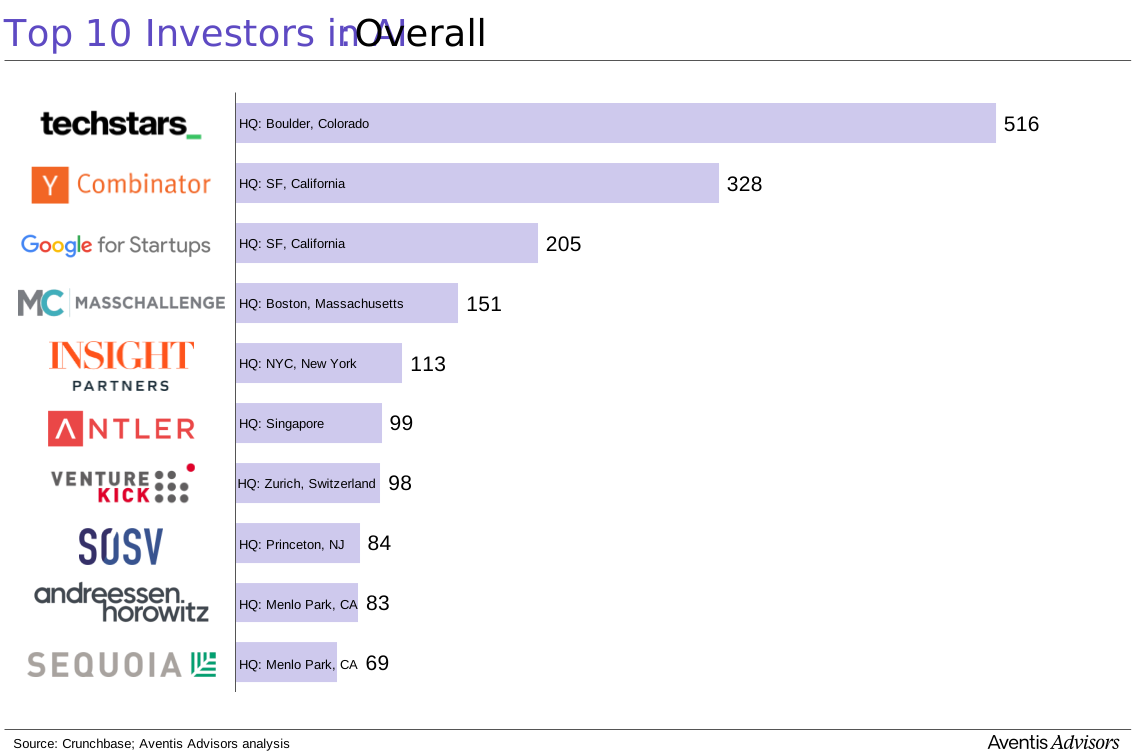
The largest AI-focused venture capital (VC) fund is the $1.5 billion AI Fund launched by Andrew Ng, a prominent figure in the AI industry. This fund is dedicated to investing in early-stage startups that leverage artificial intelligence to solve complex problems across various industries. The fund aims to accelerate the development and deployment of AI technologies globally.
Who is behind the largest AI VC fund?
The largest AI VC fund is spearheaded by Andrew Ng, a renowned AI expert and co-founder of Coursera and Google Brain. His vision is to support innovative AI-driven startups that have the potential to transform industries. The fund is backed by a team of experienced investors and AI specialists who provide strategic guidance to portfolio companies.
- Andrew Ng is the founder and driving force behind the fund.
- The team includes AI researchers, venture capitalists, and industry experts.
- They focus on early-stage investments in AI startups.
What industries does the largest AI VC fund target?
The fund targets a wide range of industries where AI can have a transformative impact. These include healthcare, finance, education, automotive, and retail. By investing in startups across these sectors, the fund aims to drive innovation and create solutions that address real-world challenges.
- Healthcare: AI for diagnostics, drug discovery, and personalized medicine.
- Finance: AI for fraud detection, risk assessment, and algorithmic trading.
- Education: AI for personalized learning and educational tools.
- Automotive: AI for autonomous vehicles and smart transportation systems.
- Retail: AI for customer experience, inventory management, and supply chain optimization.
How does the largest AI VC fund support its portfolio companies?
The fund provides more than just capital; it offers strategic support, technical expertise, and access to a global network. Portfolio companies benefit from mentorship, resources, and connections that help them scale their operations and achieve their goals.
- Mentorship: Guidance from AI experts and industry leaders.
- Technical expertise: Access to cutting-edge AI research and development tools.
- Global network: Connections to potential partners, customers, and investors worldwide.
What are the key investment criteria for the largest AI VC fund?
The fund focuses on startups with strong AI capabilities, scalable business models, and high growth potential. They prioritize companies that demonstrate a clear understanding of their target market and have a competitive edge in their respective industries.
- Strong AI capabilities: Startups must have a robust AI-driven product or service.
- Scalable business models: Potential to grow and expand across markets.
- High growth potential: Ability to achieve significant market impact and returns.
What are some notable investments by the largest AI VC fund?
The fund has invested in several high-profile AI startups, including those in autonomous vehicles, AI-powered healthcare solutions, and enterprise AI platforms. These investments highlight the fund's commitment to supporting groundbreaking AI innovations.
- Autonomous vehicles: Startups developing self-driving technologies.
- AI-powered healthcare: Companies revolutionizing diagnostics and treatment.
- Enterprise AI platforms: Solutions for businesses to optimize operations using AI.
Frequently Asked Questions (FAQs)
How are VC firms using machine learning and AI for deal sourcing?
Venture capital firms are increasingly leveraging machine learning (ML) and artificial intelligence (AI) to enhance their deal sourcing processes. These technologies help analyze vast amounts of data from various sources, such as startup databases, news articles, social media, and financial reports, to identify promising investment opportunities. By using predictive analytics, VC firms can spot trends, evaluate startup potential, and prioritize deals that align with their investment criteria. This approach not only saves time but also increases the likelihood of discovering high-growth startups early in their lifecycle.
What specific AI tools are VC firms using for deal sourcing?
VC firms are adopting a range of AI-powered tools to streamline deal sourcing. Some popular tools include platforms like Crunchbase, PitchBook, and CB Insights, which use AI to provide insights into startup performance and market trends. Additionally, firms are developing proprietary algorithms to analyze unstructured data, such as founder backgrounds, product reviews, and customer feedback. These tools enable VCs to make data-driven decisions and identify startups with strong growth potential, even in niche or emerging markets.
What are the benefits of using AI in venture capital deal sourcing?
The use of AI in deal sourcing offers several key benefits for VC firms. First, it significantly reduces the time and effort required to sift through large volumes of data, allowing investors to focus on high-potential opportunities. Second, AI enhances the accuracy of investment decisions by providing data-driven insights and reducing human bias. Third, it enables VCs to identify startups in untapped or emerging markets that might otherwise go unnoticed. Overall, AI empowers VC firms to stay competitive in a fast-paced and data-rich environment.
Are there any challenges or limitations to using AI in VC deal sourcing?
While AI offers numerous advantages, there are also challenges and limitations to its use in deal sourcing. One major concern is the quality of data, as AI models rely heavily on accurate and comprehensive datasets. Incomplete or biased data can lead to flawed conclusions. Additionally, AI tools may struggle to capture the intangible qualities of startups, such as founder vision or team dynamics, which are often critical to investment decisions. Finally, the reliance on AI may create a competitive disadvantage for firms that lack the technical expertise or resources to implement these technologies effectively.
Leave a Reply
Our Recommended Articles