
LLC Operating Agreement: Nevada

When forming a limited liability company (LLC) in Nevada, drafting a comprehensive operating agreement is a critical step to establish clarity and legal protection. Nevada’s business-friendly environment, known for its tax advantages, privacy protections, and flexible regulations, makes it a popular choice for entrepreneurs. While the state does not legally require an LLC to file an operating agreement, creating one ensures that member roles, profit-sharing arrangements, management structures, and dispute-resolution processes are clearly defined. This document not only safeguards personal assets but also reinforces operational efficiency by aligning member expectations. Tailoring the agreement to Nevada’s specific statutes can further enhance legal safeguards, making professional guidance advisable during its creation.
- Understanding the Essentials of a Nevada LLC Operating Agreement
- Does Nevada require an operating agreement for LLC?
-
Can I write my own operating agreement for my LLC?
- Is It Legally Permissible to Draft Your Own LLC Operating Agreement?
- What Are the Benefits of Creating Your Own Operating Agreement?
- What Risks Are Involved in Self-Drafting an Operating Agreement?
- What Key Clauses Should Your Operating Agreement Include?
- When Should You Consult an Attorney for an Operating Agreement?
-
Does an LLC always have an operating agreement?
- Is an Operating Agreement Legally Required for an LLC?
- Why Should an LLC Have an Operating Agreement Even If Not Required?
- What Happens If an LLC Operates Without an Operating Agreement?
- Key Elements to Include in an LLC Operating Agreement
- How Do State Laws Influence the Need for an Operating Agreement?
- What are the pitfalls of an LLC operating agreement?
- Frequently Asked Questions About LLCs (FAQs)
Understanding the Essentials of a Nevada LLC Operating Agreement
A Nevada LLC Operating Agreement is a critical legal document that outlines the ownership structure, management rules, and operational procedures for a limited liability company (LLC) in Nevada. While Nevada does not legally require LLCs to have an operating agreement, creating one ensures clarity among members, reinforces liability protection, and helps avoid disputes. This agreement customizes governance according to the LLC’s needs, covering profit distribution, voting rights, and procedures for adding or removing members. It also ensures compliance with Nevada’s business-friendly laws, such as asset protection and tax advantages.
See AlsoArizona LLC Operating AgreementKey Provisions to Include in a Nevada LLC Operating Agreement
A well-drafted Nevada LLC Operating Agreement should include specific provisions to ensure legal and operational efficiency. Membership interests, management structure, and profit-sharing ratios must be clearly defined. Additionally, outline procedures for dispute resolution, dissolution, and member withdrawal. Including indemnification clauses protects members from personal liability, while voting rights and meeting protocols ensure organized decision-making.
| Provision | Description |
| Management Structure | Specifies if the LLC is member-managed or manager-managed. |
| Profit Distribution | Defines how profits/losses are allocated among members. |
| Dissolution Process | Outlines steps for winding down the LLC. |
| Dispute Resolution | Details methods like mediation or arbitration. |
| Amendment Procedures | Explains how to modify the agreement. |
Nevada LLC Asset Protection and Operating Agreements
Nevada is renowned for its robust asset protection laws, which an LLC Operating Agreement can strengthen. By clearly separating personal and business assets, the agreement helps shield members from creditors. Nevada’s charging order protection limits creditors to claiming only distributions, not ownership interests. Including fiduciary duty waivers in the agreement further reduces liability risks for members.
See AlsoNew Mexico LLC Operating Agreement| Feature | Impact |
| Charging Order Protection | Creditors cannot seize LLC assets or membership rights. |
| Fiduciary Duty Waivers | Reduces legal obligations among members. |
| Series LLC Options | Allows isolating liabilities across different divisions. |
Member-Managed vs. Manager-Managed Nevada LLCs
A Nevada LLC can choose between member-managed or manager-managed structures. In a member-managed LLC, all members participate in daily decisions, ideal for small businesses. A manager-managed LLC delegates authority to appointed managers, suitable for passive investors. The Operating Agreement must specify the chosen structure to avoid confusion.
| Structure | Key Traits |
| Member-Managed | All members vote on operations; flexibility in control. |
| Manager-Managed | Managers handle decisions; members act as investors. |
Tax Benefits of a Nevada LLC Operating Agreement
Nevada LLCs enjoy no state income tax, no franchise tax, and no personal income tax. The Operating Agreement can optimize tax treatment by specifying pass-through taxation, where profits/losses report on members’ individual returns. Properly structuring distributions and allocations in the agreement ensures compliance with IRS regulations.
See AlsoLouisiana LLC Operating Agreement| Benefit | Description |
| Pass-Through Taxation | Avoids double taxation at the corporate level. |
| No State Taxes | Nevada imposes no corporate or personal income tax. |
| Flexible Profit Allocation | Allows customized distribution ratios. |
Amending a Nevada LLC Operating Agreement
Amending a Nevada LLC Operating Agreement requires adherence to procedures outlined in the original document. Typically, amendments need majority or unanimous member approval. Changes might involve updating ownership percentages, adding members, or revising management roles. Document amendments in writing and file them with the LLC’s records.
| Step | Requirement |
| Proposal | Members submit amendment details for review. |
| Voting | Approval per the agreed threshold (e.g., 75% vote). |
| Documentation | File revised agreement with internal records. |
Does Nevada require an operating agreement for LLC?
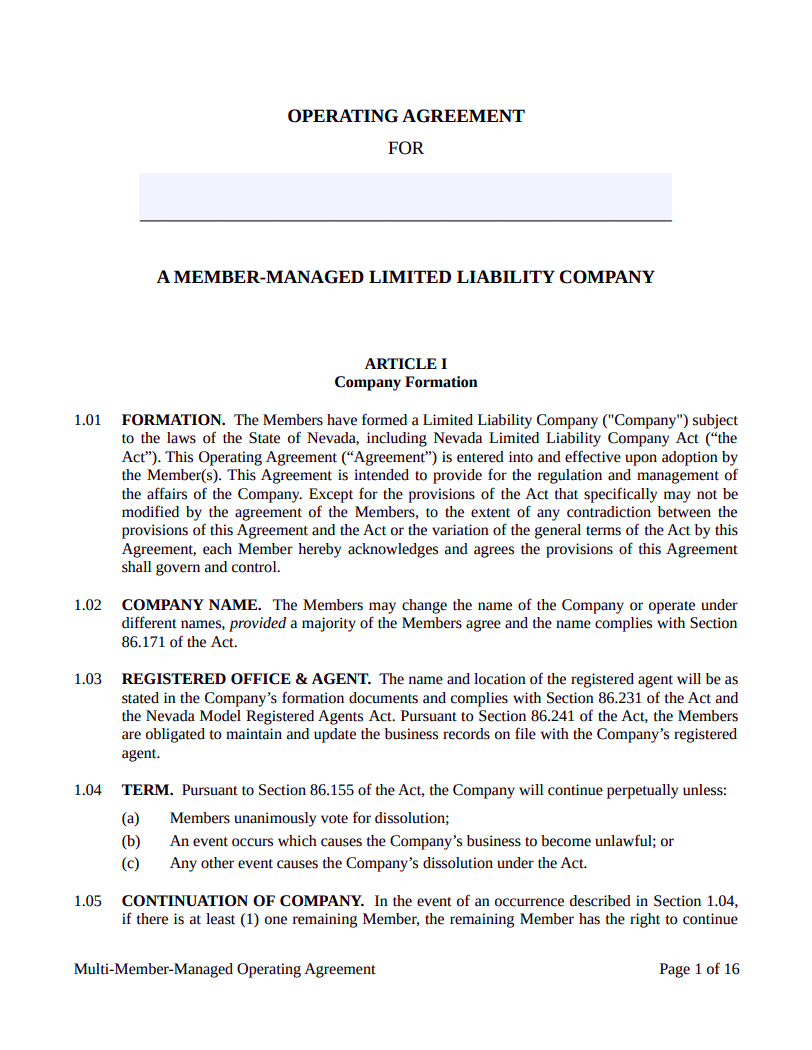
Is an Operating Agreement Mandatory for Nevada LLCs?
While Nevada does not legally require an LLC to have an operating agreement, it is highly recommended by legal and business experts. The state’s statutes (NRS Chapter 86) allow LLCs to govern their internal affairs through such agreements, but they are not a formal filing requirement.
- Nevada law does not mandate an operating agreement for LLC formation.
- Operating agreements help establish legal clarity and protect members’ rights.
- Without one, default state rules under NRS Chapter 86 will govern the LLC.
Benefits of Having an Operating Agreement for a Nevada LLC
An operating agreement provides legal protection and operational structure for LLC members. It ensures the business operates smoothly and minimizes disputes.
- Defines ownership percentages and profit/loss distribution.
- Clarifies management roles (member-managed vs. manager-managed).
- Strengthens the LLC’s limited liability status by separating personal and business assets.
Potential Risks of Not Having an Operating Agreement in Nevada
Without an operating agreement, Nevada LLCs may face unintended legal and financial consequences due to default state rules.
- State law determines decision-making authority, which may not align with members’ intentions.
- Disputes among members may lead to costly litigation without predefined resolution processes.
- The LLC’s asset protection could be weakened in legal challenges.
Key Clauses to Include in a Nevada LLC Operating Agreement
A well-drafted operating agreement should address critical operational and legal aspects specific to the LLC.
- Membership interests and procedures for adding/removing members.
- Voting rights and procedures for major decisions.
- Dissolution terms and protocols for winding up the business.
How to Draft an Operating Agreement for a Nevada LLC
While templates are available, customizing the agreement to the LLC’s needs is crucial.
- Use Nevada-specific templates to ensure compliance with state laws.
- Consult a business attorney to address complex clauses or unique requirements.
- Review and update the agreement annually or when membership changes occur.
Can I write my own operating agreement for my LLC?
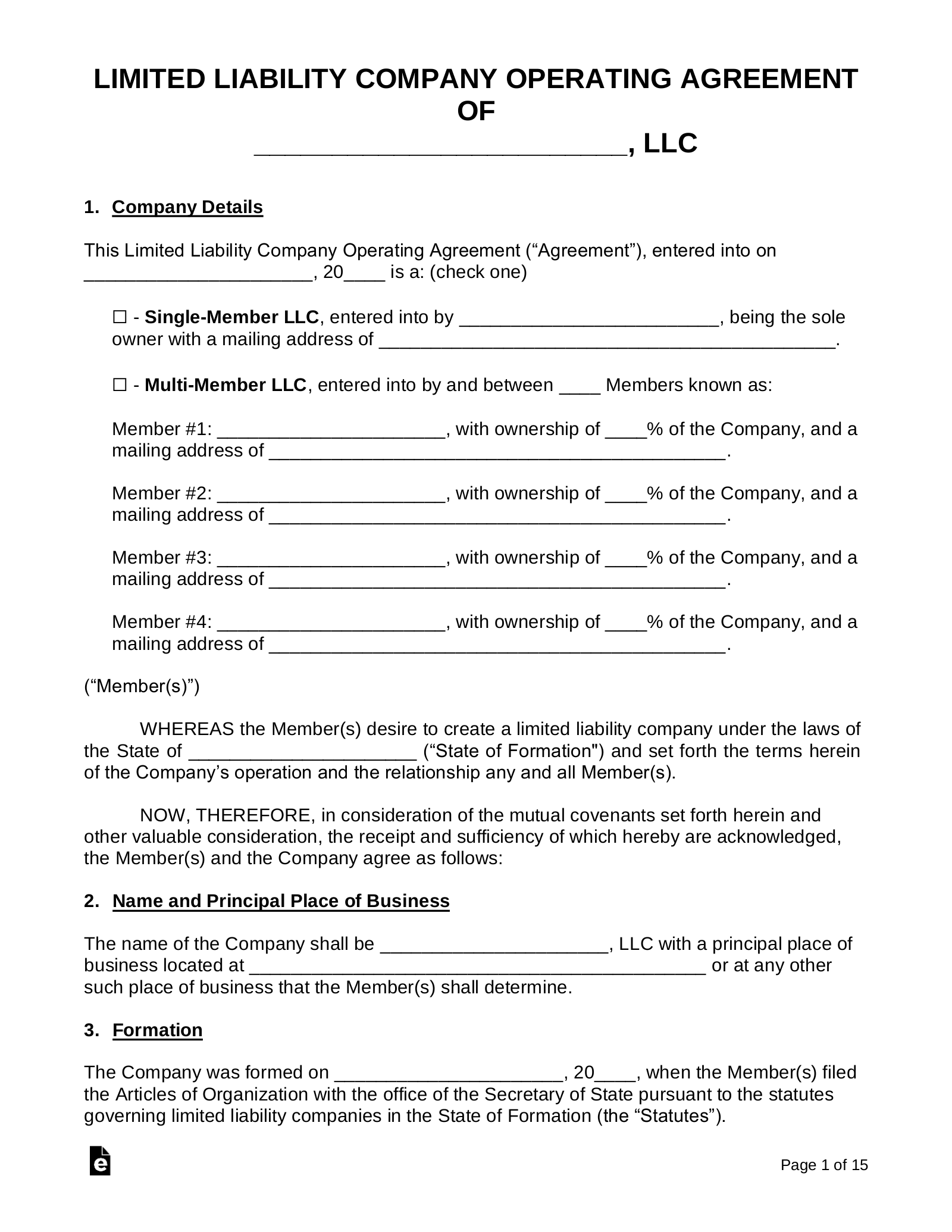
Is It Legally Permissible to Draft Your Own LLC Operating Agreement?
Yes, you can write your own operating agreement for your LLC. Most states do not legally require an attorney to draft this document, though it must comply with your state’s LLC regulations. However, self-drafting requires thorough research to ensure all critical clauses are included and enforceable.
- State-specific rules: Verify your state’s requirements for operating agreements.
- Flexibility: Tailor terms to your LLC’s structure and member roles.
- Legal validity: Ensure the agreement adheres to contract law principles.
What Are the Benefits of Creating Your Own Operating Agreement?
Drafting your own agreement offers cost savings and customization. It allows you to define profit-sharing, management roles, and dispute-resolution processes without relying on generic templates.
- Cost-effective: Avoid attorney fees for basic drafting.
- Control: Design rules that align with your business goals.
- Clarity: Prevent misunderstandings by outlining member expectations.
What Risks Are Involved in Self-Drafting an Operating Agreement?
While possible, self-drafting carries risks like oversights or unenforceable terms. Missing critical clauses could lead to disputes or legal challenges.
- Incomplete provisions: Omitted clauses about dissolution or member exit strategies.
- State compliance: Errors in adhering to mandatory state laws.
- Ambiguity: Vague language creating loopholes.
What Key Clauses Should Your Operating Agreement Include?
A robust operating agreement must address management structure, profit distribution, and dispute resolution. These clauses protect members and ensure smooth operations.
- Member roles: Define voting rights and responsibilities.
- Capital contributions: Detail initial investments and future funding.
- Dissolution terms: Outline steps for closing the LLC.
When Should You Consult an Attorney for an Operating Agreement?
Seek legal advice for complex scenarios, such as multi-member LLCs, foreign operations, or unique ownership structures. Attorneys ensure compliance and mitigate risks.
- Multi-state operations: Navigating varying state laws.
- High-risk industries: Addressing liability concerns.
- Dispute prevention: Legal review to avoid future conflicts.
Does an LLC always have an operating agreement?
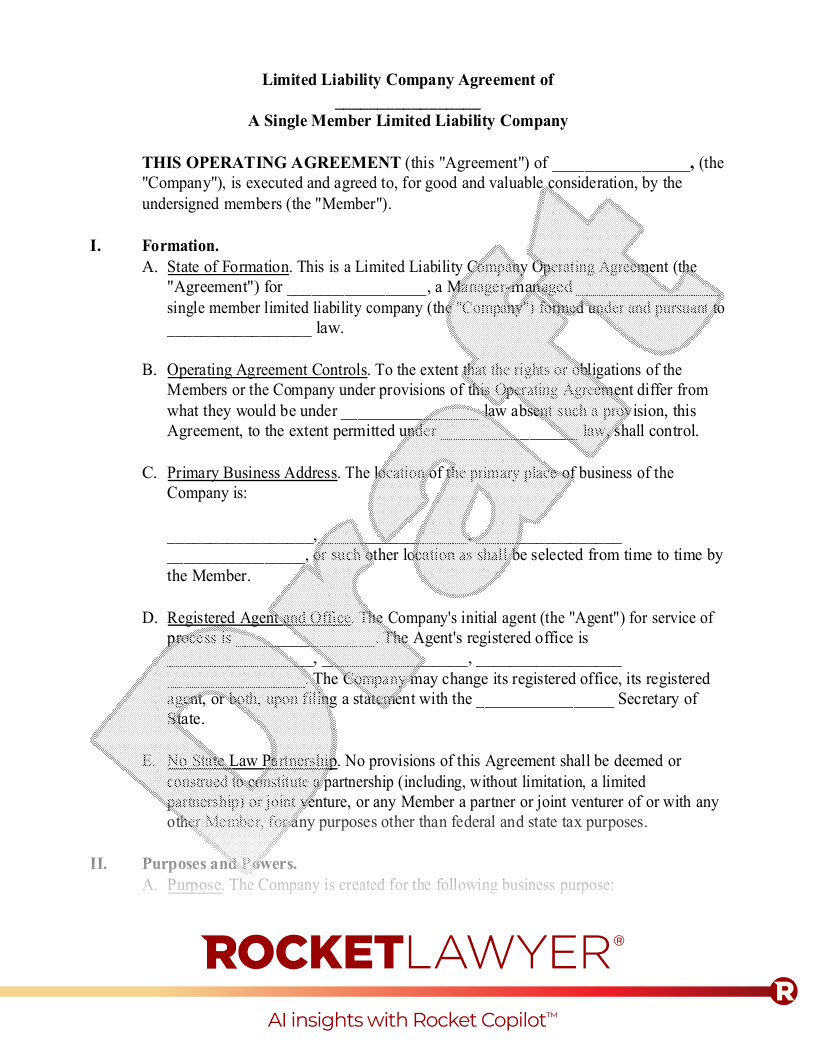
Is an Operating Agreement Legally Required for an LLC?
While forming an LLC, most states in the U.S. do not legally mandate an operating agreement. However, a few states, such as New York and Missouri, require LLCs to have one as part of their formation process. Even in states where it is not required, an operating agreement is highly recommended to:
- Clarify the roles and responsibilities of members.
- Establish profit-sharing and decision-making rules.
- Protect the LLC’s limited liability status by separating personal and business assets.
Why Should an LLC Have an Operating Agreement Even If Not Required?
An operating agreement provides critical legal and operational clarity for LLCs. Without it, the LLC defaults to state default rules, which may not align with members’ intentions. Key benefits include:
- Avoiding internal disputes by defining ownership percentages and voting rights.
- Strengthening the LLC’s credibility with banks, investors, or courts.
- Customizing rules for management structure (member-managed vs. manager-managed).
What Happens If an LLC Operates Without an Operating Agreement?
Operating without an agreement exposes the LLC to risks such as:
- State laws governing profit distribution and dissolution, which may not suit the members.
- Potential personal liability if courts disregard the corporate veil due to lack of formal structure.
- Conflicts among members over decision-making authority or exit strategies.
Key Elements to Include in an LLC Operating Agreement
A well-drafted operating agreement should address:
- Membership details (names, contributions, ownership stakes).
- Management and voting procedures (how decisions are made).
- Dissolution or transfer rules for membership interests.
How Do State Laws Influence the Need for an Operating Agreement?
State laws vary significantly:
- Some states, like California, require specific clauses (e.g., dissolution terms).
- States like Delaware offer flexibility but still recommend an agreement to override default provisions.
- In states without requirements, the agreement remains vital for legal protection and operational clarity.
What are the pitfalls of an LLC operating agreement?
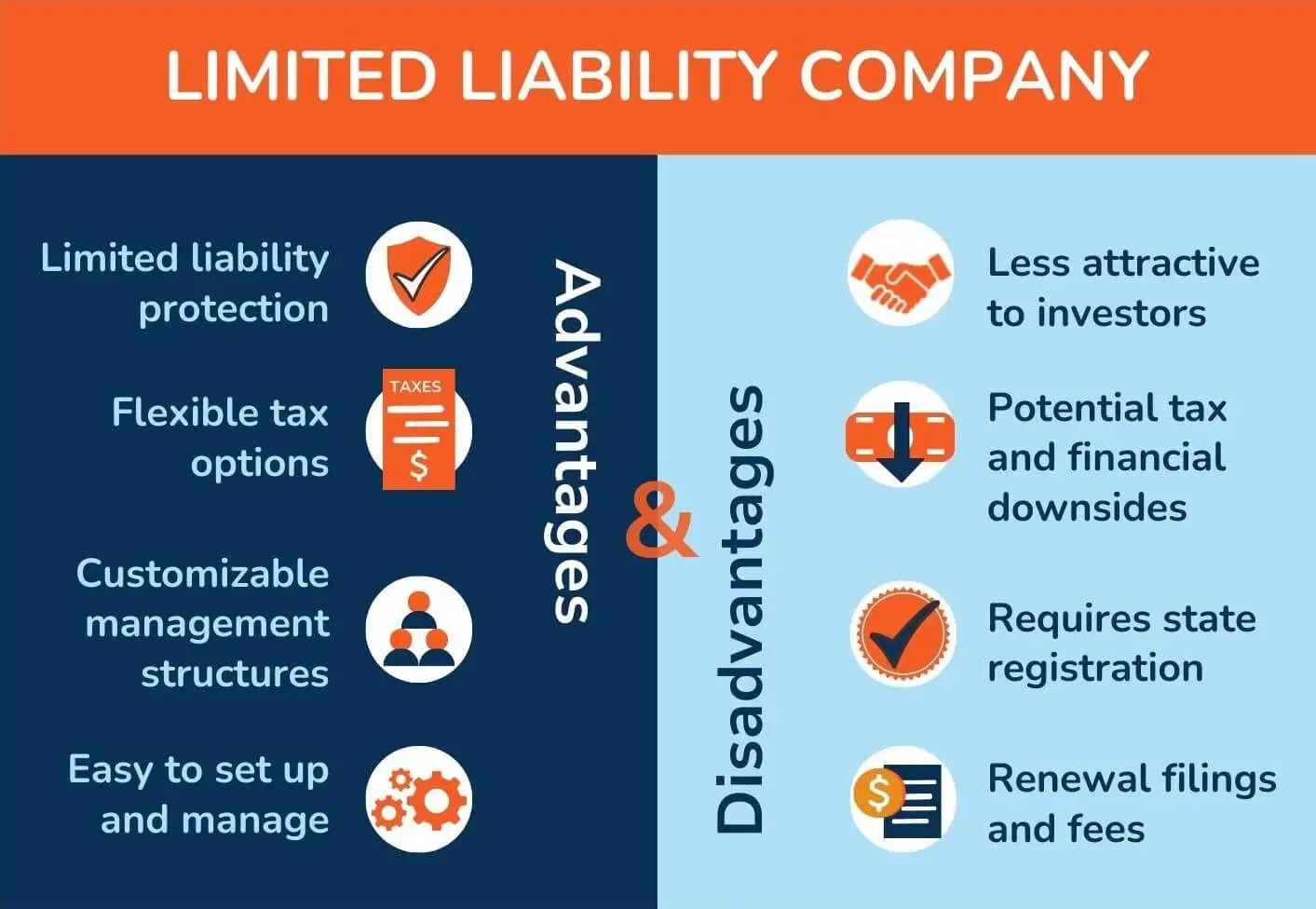
Inadequate Clarity in Roles and Responsibilities
One common pitfall of an LLC operating agreement is failing to clearly define roles, responsibilities, and decision-making authority among members. Ambiguity can lead to conflicts, operational delays, or legal disputes. To avoid this:
- Specify management structures (member-managed vs. manager-managed).
- Outline voting rights and procedures for major decisions.
- Define duties for each member, including financial contributions and day-to-day tasks.
Unclear Profit and Loss Distribution Terms
Poorly drafted provisions regarding profit and loss allocations can create tension. Without explicit terms, members may disagree on distributions or tax obligations. Key considerations include:
- Aligning distributions with ownership percentages or custom arrangements.
- Addressing tax implications of uneven profit splits.
- Including mechanisms to handle retained earnings or reinvestment strategies.
Lack of Succession or Exit Strategies
Ignoring succession planning or exit mechanisms can destabilize the LLC during member departures or unexpected events. Critical oversights often involve:
- Failing to define buyout procedures for retiring or deceased members.
- Omitting transfer restrictions to prevent unwanted third-party ownership.
- Neglecting dispute resolution processes for member exits.
Non-Compliance with State-Specific Regulations
Operating agreements must adhere to state laws, which vary significantly. Generic templates may overlook critical legal requirements, resulting in:
- Invalid clauses due to statutory non-compliance.
- Penalties for missing annual reporting or governance rules.
- Challenges in enforcing agreements during litigation.
Failure to Address Dispute Resolution Mechanisms
Without predefined methods to handle conflicts, disagreements can escalate into costly legal battles. Essential elements to include are:
- Mediation or arbitration requirements before litigation.
- Clear decision-making protocols during deadlocks.
- Provisions for dissolution if disputes remain unresolved.
Frequently Asked Questions About LLCs (FAQs)
Is an LLC Operating Agreement required for Nevada LLCs?
Nevada does not legally require LLCs to have an Operating Agreement. However, creating one is highly recommended. The agreement establishes the rights, responsibilities, and ownership structure of members, outlines profit-sharing rules, and helps protect the company’s limited liability status. Without it, Nevada’s default LLC statutes will govern your business, which may not align with your specific needs.
What key provisions should a Nevada LLC Operating Agreement include?
A comprehensive Nevada LLC Operating Agreement should detail member ownership percentages, voting rights, and management structure (member-managed vs. manager-managed). It should also address profit and loss distribution, procedures for adding/removing members, and dispute resolution methods. Additionally, include clauses for dissolution processes and Nevada-specific protections like charging order protection to shield members from personal liability for LLC debts.
Can a Nevada LLC Operating Agreement be customized for flexibility?
Yes, Nevada’s LLC laws allow significant flexibility in tailoring Operating Agreements. You can customize rules for voting thresholds, profit allocation, and management roles to suit your business needs. For example, you can create non-standard ownership classes or include confidentiality clauses. However, the agreement must comply with Nevada’s Revised Statutes (NRS 86) and cannot override certain legal requirements, such as annual reporting obligations.
How do I amend a Nevada LLC Operating Agreement?
To amend a Nevada LLC Operating Agreement, follow the amendment procedures outlined in the original document. Typically, this requires a vote or written consent from a majority or supermajority of members. Once approved, draft an amendment document specifying the changes, have all members sign it, and retain it with your LLC records. While Nevada does not require amendments to be filed with the state, updating your internal records ensures legal clarity and operational consistency.
Leave a Reply
Our Recommended Articles