
What Are the Expectations of the Venture Capitalist While Investing in a Startup


Venture capitalists (VCs) play a pivotal role in the growth and success of startups, providing not only financial backing but also strategic guidance and industry connections. However, their investments come with specific expectations aimed at maximizing returns and minimizing risks. Understanding these expectations is crucial for entrepreneurs seeking funding. VCs typically look for scalable business models, strong founding teams, and clear market opportunities. They also prioritize startups with a competitive edge, a well-defined growth strategy, and the potential for high returns. This article explores the key expectations of venture capitalists when investing in startups, offering insights into what drives their decision-making process and how founders can align with their criteria.
- What Are the Expectations of the Venture Capitalist While Investing in a Startup?
- What are the expectations of venture capitalists?
- What is the main focus of a venture capital to invest in a startup?
- What do venture capitalists look for when investing in new companies?
- Frequently Asked Questions (FAQs)
What Are the Expectations of the Venture Capitalist While Investing in a Startup?
Venture capitalists (VCs) are investors who provide capital to startups in exchange for equity or ownership stakes. Their primary goal is to achieve a high return on investment (ROI) by backing companies with significant growth potential. However, before investing, VCs have specific expectations to ensure their investment is worthwhile. These expectations revolve around the startup's team, market opportunity, product or service, scalability, and exit strategy.
See Also If Techstars takes a 6% equity stake for $18,000, is it fair to say a Techstars quality idea/prototype is worth $300,000 when raising seed money?
1. Strong and Experienced Founding Team
A venture capitalist places immense importance on the startup's founding team. They look for founders who possess a combination of industry expertise, leadership skills, and a proven track record. The team's ability to execute the business plan, adapt to challenges, and drive growth is critical. VCs often assess the team's cohesion, vision, and commitment to the startup's success.
2. Large and Growing Market Opportunity
VCs seek startups that operate in large and expanding markets. They want to invest in businesses that address significant pain points or unmet needs within a market with substantial growth potential. A startup targeting a niche market may struggle to attract VC interest unless it demonstrates the ability to scale or expand into adjacent markets.
See Also What Are Some of the Films Financed by Silicon Valley Vcs?
3. Innovative and Scalable Product or Service
The startup's product or service must be innovative and offer a unique value proposition. VCs look for solutions that stand out from competitors and have the potential to disrupt the market. Additionally, the product or service must be scalable, meaning it can grow rapidly without proportional increases in costs.
4. Clear Path to Profitability
While early-stage startups may not be profitable initially, VCs expect a clear and realistic path to profitability. This includes a well-defined business model, revenue streams, and cost management strategies. VCs also evaluate the startup's ability to achieve sustainable growth and generate long-term returns.
See Also How much does a corporation pay to have TechStars power a custom accelerator program?
5. Viable Exit Strategy
VCs invest with the expectation of a lucrative exit, typically through an initial public offering (IPO) or acquisition. They assess the startup's potential to attract buyers or go public within a reasonable timeframe. A well-thought-out exit strategy is crucial for VCs to realize their returns.
| Expectation | Description |
|---|---|
| Strong Team | Founders with expertise, leadership, and a proven track record. |
| Market Opportunity | Large and growing market with significant potential. |
| Innovative Product | Unique value proposition and scalability. |
| Profitability Path | Clear business model and revenue streams. |
| Exit Strategy | Potential for IPO or acquisition. |
What are the expectations of venture capitalists?
What Do Venture Capitalists Look for in a Startup?
Venture capitalists (VCs) evaluate startups based on several key factors to determine their potential for success. These include:
- Scalability: VCs seek businesses that can grow rapidly and expand into large markets.
- Strong Management Team: A capable and experienced team is crucial for executing the business plan effectively.
- Innovative Product or Service: The startup should offer a unique solution that addresses a significant market need.
- Market Potential: The target market should be large enough to support substantial growth and profitability.
- Traction: Evidence of early success, such as customer acquisition or revenue growth, is highly valued.
What Financial Returns Do Venture Capitalists Expect?
Venture capitalists typically have high return expectations due to the high-risk nature of their investments. Their financial goals include:
- High ROI: VCs aim for returns that are significantly higher than traditional investments, often targeting 10x or more.
- Exit Strategy: They look for clear exit opportunities, such as an IPO or acquisition, to realize their returns.
- Equity Stake: VCs usually require a substantial equity stake in the company to justify the risk.
- Short to Medium-Term Horizon: They expect returns within 5 to 10 years, depending on the startup's growth trajectory.
How Do Venture Capitalists Assess Risk?
Risk assessment is a critical part of a VC's decision-making process. Key considerations include:
- Market Risk: Evaluating whether the target market is large and growing enough to support the startup.
- Technology Risk: Assessing the feasibility and scalability of the technology or product.
- Team Risk: Ensuring the founding team has the skills and experience to overcome challenges.
- Financial Risk: Analyzing the startup's financial health and burn rate to ensure sustainability.
What Role Do Venture Capitalists Play in a Startup?
Beyond funding, VCs often provide significant value to startups through:
- Mentorship: Offering guidance and expertise to help the startup grow.
- Networking: Connecting the startup with industry contacts, potential partners, and customers.
- Strategic Planning: Assisting with business strategy and long-term planning.
- Operational Support: Helping with hiring, scaling operations, and other critical functions.
What Are the Common Red Flags for Venture Capitalists?
VCs are cautious about certain warning signs that may indicate potential issues. These include:
- Lack of Focus: Startups that try to tackle too many markets or products simultaneously.
- Weak Financials: Poor revenue models, high burn rates, or unclear financial projections.
- Unrealistic Valuations: Overestimating the company's worth without sufficient justification.
- Team Instability: Frequent changes in the founding team or key personnel.
What is the main focus of a venture capital to invest in a startup?
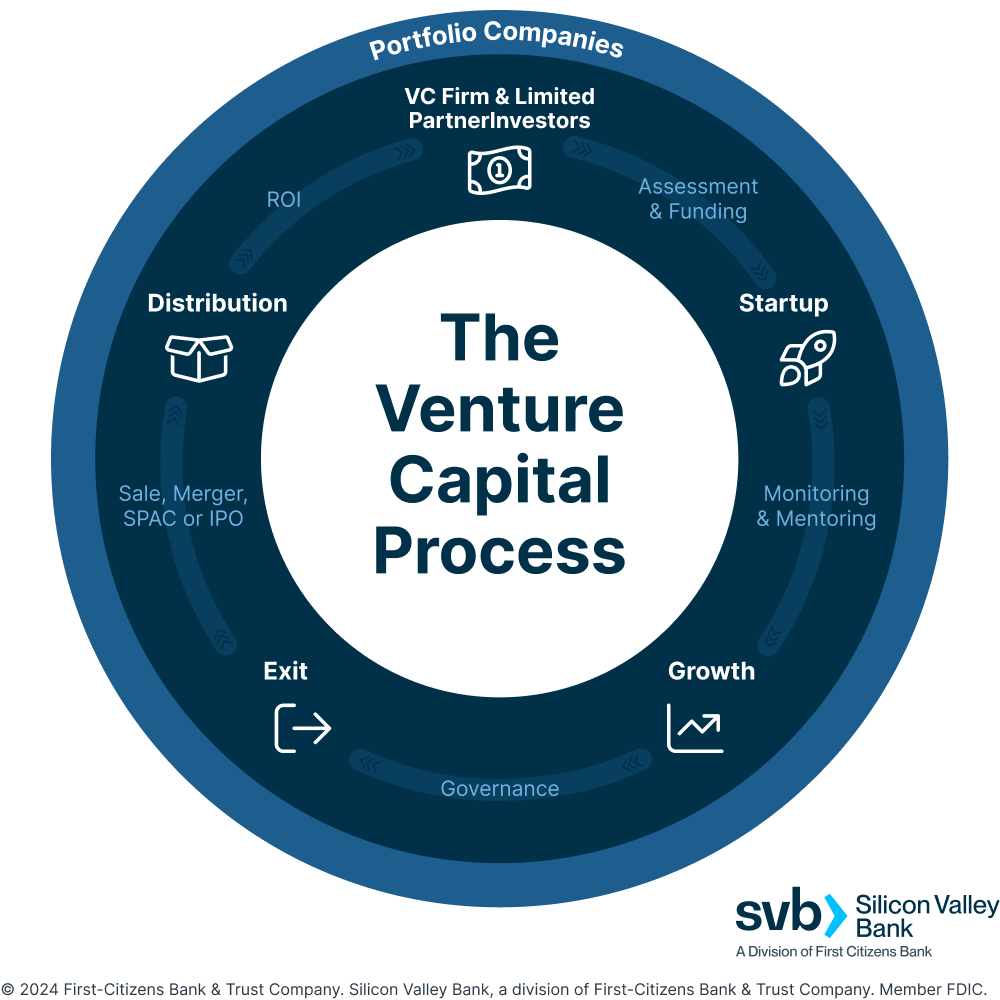
High Growth Potential
The primary focus of venture capital is to invest in startups that demonstrate high growth potential. Venture capitalists seek companies that can scale rapidly and generate significant returns on investment. Key factors include:
- Market size: The startup should target a large and expanding market.
- Scalability: The business model should allow for rapid expansion without proportional cost increases.
- Innovation: The startup should offer a unique product or service that disrupts existing markets.
Strong Founding Team
Venture capitalists place a strong emphasis on the founding team of a startup. A capable and experienced team increases the likelihood of success. Key considerations include:
- Experience: Founders with relevant industry experience are preferred.
- Track record: A history of successful ventures or projects is a positive indicator.
- Leadership skills: The ability to inspire and manage a growing team is crucial.
Innovative Product or Service
Venture capitalists look for startups that offer innovative products or services with a competitive edge. The product should address a significant market need or pain point. Key aspects include:
- Uniqueness: The product should stand out from existing solutions.
- Market fit: There should be clear evidence of demand for the product.
- Scalability: The product should be capable of reaching a wide audience.
Clear Revenue Model
A clear revenue model is essential for venture capital investment. Startups must demonstrate how they will generate income and achieve profitability. Key elements include:
- Revenue streams: Multiple sources of income are preferred.
- Profitability timeline: A realistic plan for achieving profitability is crucial.
- Customer acquisition cost: The cost of acquiring customers should be sustainable.
Exit Strategy
Venture capitalists invest with an exit strategy in mind, aiming to realize returns on their investment. Common exit strategies include:
- IPO: Taking the company public through an initial public offering.
- Acquisition: Selling the company to a larger corporation.
- Merger: Combining with another company to enhance value.
What do venture capitalists look for when investing in new companies?
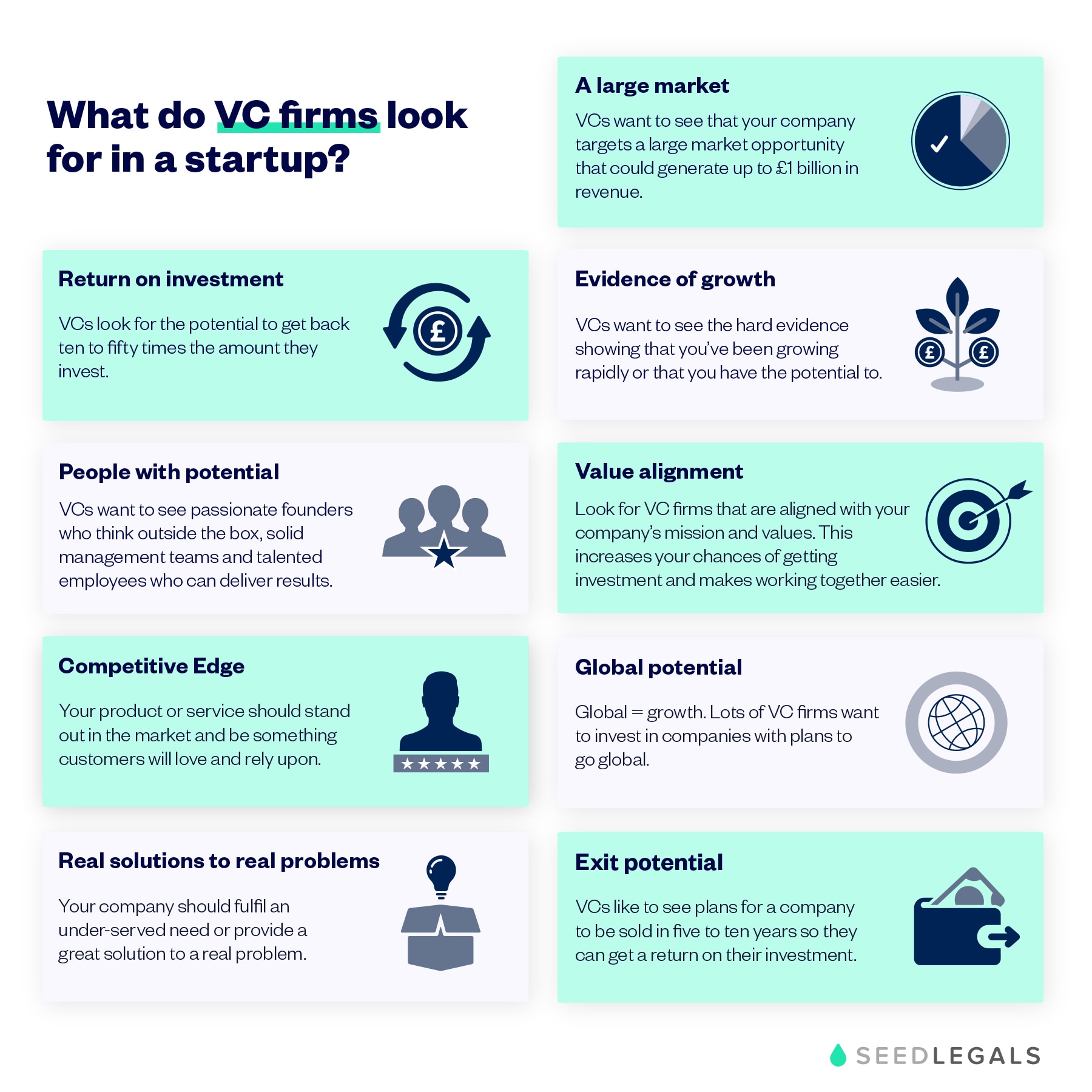
Strong Founding Team
Venture capitalists prioritize investing in companies with a strong founding team. They look for founders who possess a combination of expertise, vision, and execution capabilities. Key qualities include:
- Industry experience: Founders with deep knowledge of the industry they are entering.
- Leadership skills: The ability to inspire and manage a team effectively.
- Resilience: The capacity to navigate challenges and adapt to changing circumstances.
Scalable Business Model
A scalable business model is critical for venture capitalists. They seek companies that can grow rapidly and generate significant returns. Important factors include:
- Market potential: The ability to address a large and growing market.
- Revenue streams: Diverse and sustainable sources of income.
- Operational efficiency: Systems that allow for scaling without proportional cost increases.
Innovative Product or Service
Venture capitalists are drawn to companies offering innovative products or services that solve real problems. They evaluate:
- Uniqueness: A product or service that stands out in the market.
- Customer demand: Evidence of strong interest or need from the target audience.
- Competitive advantage: Features or technology that are difficult to replicate.
Traction and Market Validation
Traction and market validation are key indicators of a company's potential success. Venture capitalists look for:
- Customer growth: Increasing numbers of users or clients.
- Revenue growth: Consistent and rising income over time.
- Partnerships: Strategic alliances that enhance credibility and reach.
Clear Exit Strategy
Venture capitalists invest with the expectation of a clear exit strategy. They assess:
- IPO potential: The likelihood of the company going public.
- Acquisition opportunities: Interest from larger companies in acquiring the startup.
- Return on investment: A timeline and plan for achieving significant financial returns.
Frequently Asked Questions (FAQs)
What criteria do venture capitalists use to evaluate a startup?
Venture capitalists (VCs) evaluate startups based on several key criteria. These include the market potential of the product or service, the strength of the founding team, the scalability of the business model, and the traction the startup has already achieved. VCs look for startups that operate in large, growing markets with significant demand. They also prioritize teams with a proven track record, relevant expertise, and the ability to execute their vision. Additionally, a startup's ability to scale quickly and efficiently is crucial, as VCs aim for high returns on their investments.
What level of involvement do venture capitalists expect in a startup?
Venture capitalists typically expect a moderate to high level of involvement in the startups they invest in. While the extent of involvement varies depending on the VC firm and the stage of the startup, most VCs provide strategic guidance, mentorship, and access to their network. They may also take a seat on the startup's board of directors to influence key decisions. However, VCs generally avoid micromanaging and instead focus on helping the startup achieve its milestones and grow effectively.
What financial returns do venture capitalists expect from a startup?
Venture capitalists expect significant financial returns from their investments, often aiming for a 10x to 20x return on their initial investment. This is because VCs invest in high-risk, high-reward opportunities and need to compensate for the high failure rate of startups. They typically look for startups with the potential to achieve exponential growth and a clear path to a lucrative exit strategy, such as an acquisition or an initial public offering (IPO). The timeline for these returns usually ranges from 5 to 10 years.
How do venture capitalists assess the risks associated with investing in a startup?
Venture capitalists assess risks by analyzing multiple factors, including the market risk, execution risk, and financial risk. They evaluate whether the startup is addressing a real market need and if the market is large enough to support significant growth. They also assess the team's ability to execute the business plan and overcome challenges. Additionally, VCs review the startup's financial health, burn rate, and funding requirements to ensure the business can sustain itself until it becomes profitable or secures additional funding. Diversifying their portfolio is another strategy VCs use to mitigate risks.
Leave a Reply
Our Recommended Articles