
What is a Major Drawback of Accepting Venture Capital?


Accepting venture capital (VC) can be a game-changer for startups, providing the financial resources needed to scale rapidly and achieve ambitious goals. However, this funding model comes with significant trade-offs that entrepreneurs must carefully consider. One major drawback of accepting venture capital is the loss of control and autonomy over the company. VC investors often require equity in exchange for funding, which can lead to pressure to prioritize short-term growth over long-term vision. Additionally, founders may face demands to meet aggressive milestones or exit strategies, potentially compromising their original mission. Understanding these challenges is crucial for founders weighing the benefits and risks of VC funding.
What is a Major Drawback of Accepting Venture Capital?
Accepting venture capital (VC) can be a double-edged sword for startups. While it provides the necessary funds to scale operations, it often comes with significant trade-offs. One major drawback is the loss of control and autonomy that founders experience. Venture capitalists typically demand equity in exchange for funding, which means they gain a say in the company's strategic decisions. This can lead to conflicts, especially if the founders' vision diverges from the investors' expectations.
See Also What Happened to Benchmark's Website?
Loss of Equity and Ownership
When startups accept venture capital, they often have to give up a significant portion of their equity. This dilution of ownership can reduce the founders' stake in the company, potentially diminishing their financial rewards in the long term. For example, if a founder owns 50% of the company before funding, they might end up with only 20-30% after multiple rounds of investment.
Pressure to Deliver Rapid Growth
Venture capitalists expect a high return on their investment, which often translates into pressure for rapid growth. This can lead to risky decisions, such as expanding too quickly or prioritizing short-term gains over long-term sustainability. Startups may also feel compelled to focus on metrics like user acquisition or revenue growth at the expense of product quality or customer satisfaction.
See Also Why Do Venture Capitalists Replace Founders of Startups?
Potential for Misaligned Goals
Founders and venture capitalists may have different objectives. While founders are often passionate about their vision and mission, VCs are primarily focused on maximizing financial returns. This misalignment can create tension, especially when it comes to decisions about the company's direction, exit strategy, or reinvestment of profits.
Increased Scrutiny and Reporting Requirements
Accepting venture capital often means subjecting the company to increased scrutiny. VCs typically require regular updates, detailed financial reports, and performance metrics. This can be time-consuming for founders and may divert their attention from core business activities.
See Also What Does a Series 1 Financing/funding Mean?
Risk of Losing Control Over Key Decisions
With a significant equity stake, venture capitalists often demand a seat on the board of directors. This gives them influence over key decisions, such as hiring executives, setting budgets, or pursuing mergers and acquisitions. Founders may find themselves overruled or pressured into decisions that don't align with their original vision.
| Drawback | Impact |
|---|---|
| Loss of Equity | Reduced ownership and financial rewards for founders |
| Pressure for Growth | Risk of prioritizing short-term gains over long-term stability |
| Misaligned Goals | Potential conflicts between founders and investors |
| Increased Scrutiny | Time-consuming reporting and oversight |
| Loss of Control | Investors influence key strategic decisions |
What is a drawback of using venture capital?

 How Do I Become an Lp in a Vc Fund?
Loss of Control and Decision-Making Power
One significant drawback of using venture capital is the potential loss of control over your business. Venture capitalists often require a substantial equity stake in exchange for their investment, which can lead to:
- Reduced ownership: Founders may own a smaller percentage of their company.
- Influence over decisions: Investors may demand a say in key business decisions, such as hiring, strategy, or product development.
- Pressure to scale quickly: VCs often prioritize rapid growth, which may not align with the founder's vision.
High Expectations for Returns
Venture capitalists invest with the expectation of high returns, which can create significant pressure on the business. This can result in:
See AlsoHow Does the Enfp Personality Type Respond to Being Micromanaged- Aggressive growth targets: Companies may be pushed to expand faster than they are ready.
- Short-term focus: Emphasis on quick wins over long-term sustainability.
- Risk of failure: If the company doesn't meet expectations, it may face funding cuts or even closure.
Dilution of Equity
Accepting venture capital often means giving up a portion of your company's equity, which can have long-term consequences:
- Reduced financial rewards: Founders may receive a smaller share of profits or exit proceeds.
- Future fundraising challenges: Additional funding rounds may further dilute equity.
- Impact on team morale: Employees with equity stakes may feel their shares are less valuable.
Potential for Conflicts with Investors
Differences in vision or strategy between founders and venture capitalists can lead to conflicts:
- Misaligned goals: Investors may prioritize financial returns over the company's mission.
- Disagreements on strategy: Founders and VCs may clash over the direction of the business.
- Pressure to exit: Investors may push for a sale or IPO before the company is ready.
Limited Flexibility in Operations
Venture capital funding can restrict a company's operational flexibility due to:
- Reporting requirements: Regular updates and performance metrics may be required.
- Focus on milestones: Companies may need to prioritize investor-driven goals over other opportunities.
- Loss of autonomy: Founders may have less freedom to experiment or pivot.
What is the biggest risk in venture capital?

Market Risk
Market risk is one of the most significant challenges in venture capital. It refers to the possibility that the market for a startup's product or service may not develop as anticipated. This can occur due to changes in consumer preferences, economic downturns, or the emergence of superior competing technologies. To mitigate this risk, venture capitalists often:
- Conduct thorough market research to understand demand and competition.
- Diversify their portfolio across various industries and stages.
- Monitor market trends continuously to adapt their strategies.
Execution Risk
Execution risk involves the potential that a startup may fail to implement its business plan effectively. This can stem from poor management, inadequate resources, or operational inefficiencies. Key strategies to address execution risk include:
- Investing in experienced management teams with a proven track record.
- Providing mentorship and operational support to portfolio companies.
- Setting clear milestones and regularly reviewing progress.
Technology Risk
Technology risk pertains to the possibility that a startup's technology may not perform as expected or may become obsolete. This is particularly relevant in fast-evolving sectors like tech and biotech. To manage technology risk, venture capitalists typically:
- Evaluate the scalability and robustness of the technology.
- Assess the intellectual property portfolio to ensure protection against competitors.
- Stay informed about technological advancements that could impact the startup.
Financial Risk
Financial risk involves the potential for financial loss due to factors such as cash flow problems, high burn rates, or inability to secure additional funding. Venture capitalists mitigate financial risk by:
- Conducting detailed financial due diligence before investing.
- Ensuring startups have a clear path to profitability or the next funding round.
- Monitoring financial performance closely and intervening when necessary.
Regulatory Risk
Regulatory risk refers to the potential for changes in laws or regulations to adversely affect a startup's operations or market. This is especially critical in industries like healthcare, fintech, and energy. To address regulatory risk, venture capitalists often:
- Engage legal experts to navigate complex regulatory environments.
- Stay updated on regulatory changes that could impact portfolio companies.
- Advocate for favorable policies through industry associations and lobbying efforts.
Which of the following is a disadvantage of venture capital?
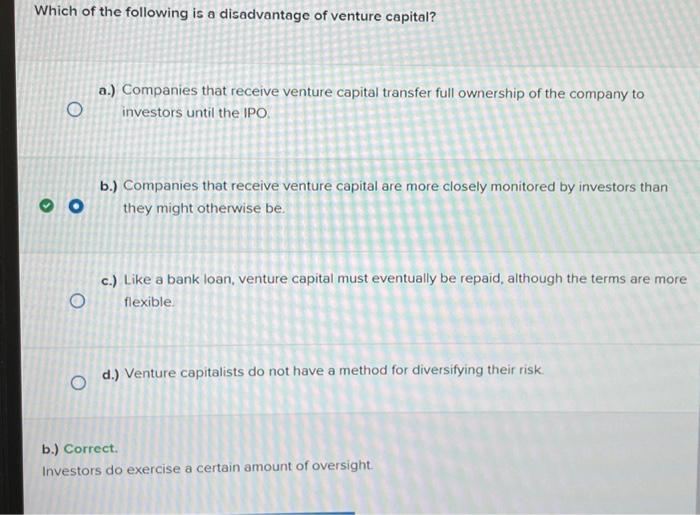
Loss of Control and Ownership
One of the primary disadvantages of venture capital is the potential loss of control and ownership. When a startup accepts venture capital, investors often require equity in exchange for funding. This means:
- Founders may have to give up a significant portion of their company, reducing their ownership stake.
- Investors may demand a seat on the board of directors, influencing key decisions.
- The original vision of the company might be compromised due to external pressures.
High Expectations and Pressure
Venture capitalists typically expect high returns on their investments, which can create immense pressure for startups. This includes:
- Aggressive growth targets that may not align with the company's natural pace.
- Pressure to achieve profitability quickly, potentially leading to short-term decisions over long-term strategy.
- The risk of burnout for founders and employees due to the demanding expectations.
Dilution of Equity
Accepting venture capital often leads to the dilution of equity for existing shareholders. This can result in:
- Reduced ownership for founders and early investors as new shares are issued to venture capitalists.
- Lower returns for original stakeholders if the company is sold or goes public.
- Potential conflicts among shareholders regarding the distribution of equity.
Stringent Terms and Conditions
Venture capital agreements often come with strict terms and conditions that can be challenging for startups. These include:
- Liquidation preferences that prioritize investors in the event of a sale or liquidation.
- Restrictive covenants that limit the company's operational flexibility.
- Mandatory milestones that must be met to secure additional funding.
Potential for Conflict
The involvement of venture capitalists can sometimes lead to conflicts within the company. This may involve:
- Disagreements between founders and investors over strategic direction.
- Differences in risk tolerance and decision-making styles.
- Potential for power struggles if investors seek to exert more control than founders are comfortable with.
Why avoid venture capital?

Loss of Control and Decision-Making Power
One of the primary reasons to avoid venture capital is the potential loss of control over your company. When you accept venture capital, investors often require a significant equity stake and a say in major decisions. This can lead to:
- Dilution of ownership: Founders may lose majority control, reducing their influence over the company's direction.
- Pressure to prioritize investor interests: Decisions may shift from long-term growth to short-term profitability to satisfy investors.
- Conflict in vision: Misalignment between founders and investors can lead to disputes over strategy and operations.
High Expectations and Pressure for Rapid Growth
Venture capital often comes with high expectations for rapid growth and returns. This can create immense pressure on the business, leading to:
- Unrealistic timelines: Investors may push for aggressive expansion, which can strain resources and lead to burnout.
- Focus on scaling over sustainability: Companies may prioritize growth at the expense of building a solid foundation.
- Risk of overextension: Rapid scaling can result in operational inefficiencies and financial instability.
Dilution of Equity and Future Profits
Accepting venture capital means giving up a portion of your company's equity, which can have long-term consequences:
- Reduced ownership: Founders may end up with a smaller share of the company, impacting their financial rewards in the event of a sale or IPO.
- Limited control over future funding rounds: Early investors may impose terms that affect future fundraising efforts.
- Impact on team morale: Employees with equity stakes may feel their shares are devalued as more investors come on board.
Potential Misalignment of Interests
Venture capitalists and founders may not always share the same goals or vision, leading to potential conflicts:
- Different timelines: Investors may seek a quick exit, while founders may want to build a long-term business.
- Focus on financial returns: Investors prioritize profitability, which may clash with the founder's mission or values.
- Pressure to pivot: Founders may be pushed to change their business model or strategy to meet investor demands.
Alternative Funding Options
There are several alternative funding options that may be more suitable than venture capital, depending on the business's needs:
- Bootstrapping: Self-funding allows founders to retain full control and avoid external pressures.
- Angel investors: These individuals may offer more flexible terms and align better with the founder's vision.
- Revenue-based financing: This model ties repayments to revenue, reducing the pressure for rapid growth.
Frequently Asked Questions by our Community
What is a major drawback of accepting venture capital?
One of the major drawbacks of accepting venture capital is the loss of control over your company. Venture capitalists often require a significant equity stake in exchange for their investment, which can lead to reduced decision-making power for the founders. Additionally, they may impose strict conditions or demand a say in key business decisions, potentially altering the original vision of the company.
How does accepting venture capital affect company ownership?
Accepting venture capital typically means diluting ownership of your company. In exchange for funding, venture capitalists usually acquire a percentage of equity, which reduces the founders' share. Over multiple funding rounds, this dilution can become significant, leaving founders with a minority stake in the business they started.
What are the financial risks of taking venture capital?
While venture capital provides immediate funding, it often comes with high expectations for rapid growth and profitability. If the company fails to meet these expectations, it may face pressure to pivot or even risk losing further funding. Additionally, venture capitalists typically seek a high return on investment, which can lead to aggressive strategies that may not align with the founders' long-term goals.
How does venture capital influence company culture?
Venture capital can significantly impact company culture by prioritizing growth and scalability over other values. This shift can lead to a high-pressure environment, where short-term results are emphasized over long-term sustainability. Furthermore, the involvement of external investors may introduce conflicting priorities, potentially disrupting the original ethos and mission of the company.
Leave a Reply
Our Recommended Articles