
How Do I Get Break Into Private Equity/ Venture Capital?

Breaking into private equity (PE) or venture capital (VC) is a highly sought-after career path, known for its competitive nature and lucrative opportunities. These industries attract ambitious professionals seeking to work with high-growth companies, manage investments, and drive innovation. However, landing a role in PE or VC requires a strategic approach, as the field demands a unique blend of financial expertise, analytical skills, and industry connections. Whether you're a recent graduate, a finance professional, or someone looking to pivot into this space, understanding the key steps, qualifications, and networking strategies is essential to successfully navigate this challenging yet rewarding career transition.
- How Do I Get Break Into Private Equity/ Venture Capital?
- How do you break into PE VC?
- Can you break into private equity with no experience?
- What is the 80/20 rule in private equity?
- How to break in to private equity?
-
Frequently Asked Questions (FAQs)
- What educational background is required to break into private equity or venture capital?
- What type of work experience is most beneficial for entering private equity or venture capital?
- How important is networking in securing a role in private equity or venture capital?
- What skills are most important for success in private equity or venture capital?
How Do I Get Break Into Private Equity/ Venture Capital?
Breaking into Private Equity (PE) or Venture Capital (VC) can be a challenging yet rewarding career path. These industries are highly competitive, and candidates need to demonstrate a strong combination of financial expertise, networking skills, and industry knowledge. Below, we explore the key steps and strategies to help you navigate this journey.
See Also What is the Difference Between Venture and Non Venture Capital or in Other Words What is the Definition of Non Venture Capital
1. Build a Strong Educational Foundation
A solid educational background is crucial for entering Private Equity or Venture Capital. Most professionals in these fields hold degrees in finance, business, or economics. Pursuing an MBA from a top-tier business school can significantly enhance your chances, as many firms actively recruit from these institutions. Additionally, certifications like the CFA (Chartered Financial Analyst) can demonstrate your commitment to financial expertise.
| Education Level | Recommended Path |
|---|---|
| Undergraduate | Finance, Business, or Economics |
| Graduate | MBA from a top-tier school |
| Certifications | CFA, Series 7, or Series 79 |
2. Gain Relevant Work Experience
Prior experience in investment banking, management consulting, or corporate finance is highly valued in PE and VC. These roles provide the necessary skills in financial modeling, valuation, and deal structuring. Internships at PE or VC firms can also be a great way to gain exposure and build connections in the industry.
See Also What Degree is Most Useful to Get Into Venture Capital or Investment Banking
| Experience Type | Why It Matters |
|---|---|
| Investment Banking | Develops financial modeling and deal execution skills |
| Management Consulting | Enhances strategic thinking and problem-solving |
| Corporate Finance | Provides insights into financial operations |
3. Develop a Strong Network
Networking is critical in Private Equity and Venture Capital. Attend industry events, join professional organizations, and leverage platforms like LinkedIn to connect with professionals in the field. Building relationships with mentors and alumni can open doors to opportunities and provide valuable guidance.
| Networking Strategy | Benefits |
|---|---|
| Industry Events | Meet professionals and stay updated on trends |
| Professional Organizations | Access to exclusive resources and job postings |
| Expand your network and showcase your profile |
4. Master Financial Modeling and Valuation
Financial modeling and valuation are core skills in PE and VC. You should be proficient in building discounted cash flow (DCF) models, leveraged buyout (LBO) models, and conducting comparative company analysis. Online courses and certifications can help you hone these skills.
See Also What Career is More Lucrative; Private Equity or Venture Capital?
| Skill | Importance |
|---|---|
| DCF Modeling | Essential for valuing companies |
| LBO Modeling | Key for private equity transactions |
| Comparative Analysis | Helps in benchmarking companies |
5. Understand the Industry and Stay Updated
To succeed in Private Equity or Venture Capital, you need to stay informed about market trends, emerging technologies, and investment opportunities. Regularly read industry publications like PitchBook, CB Insights, and The Wall Street Journal. This knowledge will help you stand out during interviews and discussions.
| Resource | Purpose |
|---|---|
| PitchBook | Track deals and market trends |
| CB Insights | Analyze emerging technologies |
| The Wall Street Journal | Stay updated on financial news |
How do you break into PE VC?
 Which Angels or Vcs Will Fund Hardware Startups?
Understanding the PE VC Industry
To break into the private equity (PE) and venture capital (VC) industry, it is essential to first understand its core functions and dynamics. PE and VC firms invest in companies, but they differ in their focus. PE typically targets mature companies for buyouts or growth capital, while VC focuses on early-stage or high-growth startups. Key steps to understand the industry include:
- Research the differences between PE and VC, including investment strategies and risk profiles.
- Follow industry news and trends through platforms like PitchBook, Crunchbase, or CB Insights.
- Read books or take courses on private equity and venture capital to build foundational knowledge.
Building Relevant Skills and Experience
Breaking into PE VC requires a combination of technical skills and practical experience. Firms often look for candidates with strong financial modeling, valuation, and analytical abilities. Here’s how to build these skills:
See Also Venture Capital: Which Vcs Blog?
- Gain experience in investment banking, management consulting, or corporate finance to develop a strong financial background.
- Learn to use tools like Excel, Python, or Tableau for data analysis and modeling.
- Pursue certifications such as the CFA (Chartered Financial Analyst) or CAIA (Chartered Alternative Investment Analyst) to enhance your credibility.
Networking and Building Relationships
Networking is critical in the PE VC industry, as many opportunities arise through personal connections and referrals. To build a strong network:
- Attend industry events, conferences, and meetups to connect with professionals in the field.
- Leverage platforms like LinkedIn to reach out to PE VC professionals and request informational interviews.
- Join alumni networks or professional organizations like the National Venture Capital Association (NVCA).
Gaining Hands-On Experience
Practical experience is invaluable when trying to break into PE VC. Consider the following steps to gain relevant experience:
- Apply for internships or analyst roles at PE VC firms, even if they are unpaid or part-time.
- Work with startups or accelerators to understand the entrepreneurial ecosystem and investment process.
- Participate in case competitions or investment challenges to showcase your skills.
Tailoring Your Application and Interview Preparation
When applying for roles in PE VC, it’s crucial to tailor your resume and prepare thoroughly for interviews. Key steps include:
- Highlight relevant experience, such as deal execution, financial analysis, or portfolio management, on your resume.
- Prepare for technical interview questions on topics like LBO modeling, valuation techniques, and market analysis.
- Practice behavioral questions to demonstrate your teamwork, problem-solving, and leadership skills.
Can you break into private equity with no experience?
What is Private Equity and Why is Experience Valued?
Private equity (PE) involves investing in private companies or conducting buyouts of public companies to delist them from stock exchanges. Experience is highly valued in this field because it requires a deep understanding of financial modeling, valuation, deal structuring, and market analysis. Firms often seek candidates with a proven track record in investment banking, consulting, or corporate finance to ensure they can handle the complexities of PE transactions.
- Financial modeling is critical for evaluating investment opportunities.
- Valuation techniques like discounted cash flow (DCF) are essential for assessing company worth.
- Deal structuring requires expertise in negotiating terms and managing risks.
Can You Enter Private Equity Without Prior Experience?
Breaking into private equity without direct experience is challenging but not impossible. Entry-level roles in PE are rare, and most firms prefer candidates with at least 1-2 years of experience in related fields like investment banking or consulting. However, exceptional academic performance, strong networking skills, and relevant internships can sometimes compensate for the lack of direct experience.
- Exceptional academic performance in finance or business can make you stand out.
- Networking with industry professionals can open doors to opportunities.
- Relevant internships in finance or consulting can provide foundational skills.
What Skills Are Essential for Private Equity?
To succeed in private equity, you need a combination of technical and soft skills. Technical skills include financial analysis, modeling, and valuation, while soft skills like communication, negotiation, and teamwork are equally important. Demonstrating these skills, even without direct PE experience, can make you a competitive candidate.
- Financial analysis helps in evaluating company performance.
- Communication skills are vital for presenting deals to stakeholders.
- Teamwork is crucial for collaborating on complex transactions.
How to Build a Network in Private Equity?
Networking is a critical component of breaking into private equity. Attending industry events, joining finance-related groups, and leveraging platforms like LinkedIn can help you connect with professionals in the field. Informational interviews and mentorship can also provide valuable insights and potential referrals.
- Industry events like conferences and seminars are great for meeting professionals.
- LinkedIn is a powerful tool for connecting with PE professionals.
- Informational interviews can help you learn about the industry and build relationships.
What Are Alternative Paths to Private Equity?
If you lack direct experience, consider alternative paths such as working in investment banking, consulting, or corporate finance first. These roles provide the necessary skills and exposure to financial markets, making it easier to transition into private equity later. Additionally, pursuing certifications like the CFA or MBA can enhance your qualifications.
- Investment banking provides strong financial modeling and deal experience.
- Consulting offers strategic thinking and problem-solving skills.
- CFA or MBA certifications can boost your credibility and knowledge.
What is the 80/20 rule in private equity?
:max_bytes(150000):strip_icc()/Term-Definitions_80-20-rule-e0f7f05b70d5479d8d4f8fcfd6a5286b.jpg)
Understanding the 80/20 Rule in Private Equity
The 80/20 rule, also known as the Pareto Principle, is a concept widely applied in private equity to describe the distribution of returns. It suggests that approximately 80% of the returns in a private equity portfolio are generated by 20% of the investments. This principle highlights the importance of identifying and focusing on high-performing assets to maximize overall portfolio performance.
- Focus on high-impact investments: Private equity firms prioritize deals with the potential to deliver outsized returns.
- Diversification with purpose: While diversification is important, the 80/20 rule emphasizes quality over quantity in investment selection.
- Resource allocation: Firms allocate more resources to monitoring and supporting the top-performing 20% of investments.
How the 80/20 Rule Influences Investment Strategies
In private equity, the 80/20 rule shapes investment strategies by encouraging firms to concentrate on deals with the highest potential for success. This approach often involves:
- Rigorous due diligence: Firms conduct extensive research to identify the most promising opportunities.
- Active management: The top 20% of investments receive significant attention to ensure they achieve their full potential.
- Exit planning: Firms focus on optimizing exit strategies for high-performing assets to maximize returns.
The Role of the 80/20 Rule in Portfolio Management
Portfolio management in private equity is heavily influenced by the 80/20 rule. This principle helps firms:
- Identify key performers: Pinpointing the 20% of investments that drive the majority of returns.
- Optimize resource distribution: Allocating time, capital, and expertise to the most impactful deals.
- Mitigate risks: Reducing exposure to underperforming assets by focusing on high-quality investments.
Challenges of Applying the 80/20 Rule in Private Equity
While the 80/20 rule is a valuable guideline, it presents certain challenges for private equity firms:
- Identifying top performers: Predicting which investments will fall into the top 20% is inherently uncertain.
- Balancing risk: Over-concentration on a few deals can increase portfolio risk if those investments underperform.
- Resource constraints: Allocating significant resources to a small number of deals may limit opportunities elsewhere.
Real-World Examples of the 80/20 Rule in Private Equity
Many private equity firms have successfully applied the 80/20 rule to achieve exceptional returns. Examples include:
- Successful exits: Firms like Blackstone and KKR have seen a significant portion of their returns come from a small number of high-performing investments.
- Fund performance: Top-performing private equity funds often attribute their success to a few standout deals.
- Case studies: Specific investments in companies like Uber or Airbnb have driven disproportionate returns for their investors.
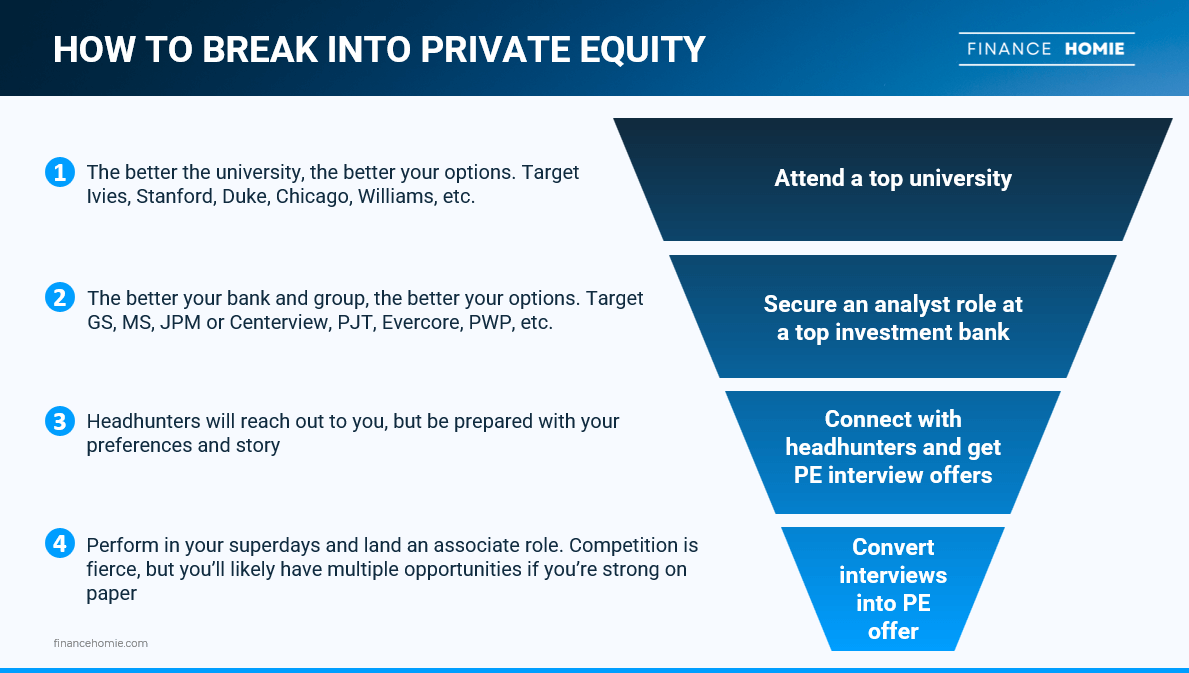
How to break in to private equity?
Understanding the Private Equity Industry
To break into private equity, it is essential to first understand the industry's structure and dynamics. Private equity involves investing in private companies or taking public companies private to restructure and sell them for a profit. Key players include private equity firms, institutional investors, and portfolio companies. To gain a foothold, consider the following steps:
- Research the industry: Learn about different types of private equity firms, such as venture capital, growth equity, and buyout firms.
- Understand the investment process: Familiarize yourself with deal sourcing, due diligence, valuation, and exit strategies.
- Follow industry trends: Stay updated on market trends, regulatory changes, and emerging sectors.
Building a Strong Educational Foundation
A solid educational background is crucial for entering private equity. Most professionals in this field hold advanced degrees or certifications. Here’s how to build your academic credentials:
- Pursue a relevant degree: Degrees in finance, economics, or business administration are highly valued.
- Consider an MBA: Many private equity professionals hold an MBA from a top-tier business school.
- Obtain certifications: Certifications like the Chartered Financial Analyst (CFA) can enhance your credibility.
Gaining Relevant Work Experience
Work experience is a critical component of breaking into private equity. Most firms prefer candidates with prior experience in investment banking, consulting, or corporate finance. Follow these steps to build your experience:
- Start in investment banking: Many private equity professionals begin their careers in investment banking to gain deal-making experience.
- Consider internships: Secure internships at private equity firms or related fields to gain hands-on experience.
- Network with professionals: Attend industry events and connect with private equity professionals to learn about job opportunities.
Developing Key Skills for Private Equity
Private equity requires a unique set of skills, including financial modeling, valuation, and negotiation. Here’s how to develop these skills:
- Master financial modeling: Learn to build complex financial models to evaluate investment opportunities.
- Improve valuation techniques: Understand methods like discounted cash flow (DCF) and comparable company analysis.
- Enhance negotiation skills: Practice negotiating deals and terms to prepare for real-world scenarios.
Networking and Building Relationships
Networking is a vital part of breaking into private equity. Building relationships with industry professionals can open doors to job opportunities. Here’s how to network effectively:
- Attend industry events: Participate in conferences, seminars, and networking events to meet private equity professionals.
- Leverage LinkedIn: Connect with industry experts and join private equity groups on LinkedIn.
- Seek informational interviews: Request informational interviews to learn more about the industry and gain insights from experienced professionals.
Frequently Asked Questions (FAQs)
What educational background is required to break into private equity or venture capital?
To break into private equity or venture capital, having a strong educational foundation is crucial. Most professionals in these fields hold degrees in finance, business administration, or economics. A Master of Business Administration (MBA) from a top-tier institution is highly valued and often considered a prerequisite for many roles. Additionally, certifications like the Chartered Financial Analyst (CFA) can provide a competitive edge. While not mandatory, a background in engineering or technology can be advantageous, especially in venture capital, where understanding emerging technologies is key.
What type of work experience is most beneficial for entering private equity or venture capital?
Gaining relevant work experience is essential for breaking into private equity or venture capital. Many professionals start their careers in investment banking, management consulting, or corporate finance, as these roles provide the analytical and financial modeling skills required in PE and VC. Experience in startups or entrepreneurship can also be valuable, particularly for venture capital, as it demonstrates an understanding of the challenges faced by early-stage companies. Internships in PE or VC firms, even at smaller or boutique firms, can provide direct exposure and help build a network in the industry.
How important is networking in securing a role in private equity or venture capital?
Networking plays a critical role in breaking into private equity or venture capital. The industry is highly competitive and often relies on personal connections and referrals. Attending industry conferences, joining professional organizations, and leveraging alumni networks can help you connect with professionals in the field. Building relationships with mentors or advisors who have experience in PE or VC can provide valuable insights and potentially lead to job opportunities. Additionally, maintaining an active presence on platforms like LinkedIn and engaging with industry-specific content can help you stay visible and informed.
What skills are most important for success in private equity or venture capital?
Success in private equity and venture capital requires a combination of technical and interpersonal skills. Strong financial modeling and valuation skills are essential for analyzing potential investments. Additionally, having a deep understanding of market trends and industry dynamics is crucial for making informed decisions. On the interpersonal side, communication and negotiation skills are vital for interacting with entrepreneurs, investors, and other stakeholders. Finally, a strong sense of curiosity and the ability to think critically and creatively are key traits that can set you apart in this competitive field.
Leave a Reply
Our Recommended Articles