
What Are the Key Differences Between Private Equity and Venture Capital


Private equity and venture capital are two prominent forms of investment, often used interchangeably but fundamentally distinct in their approach and purpose. Private equity typically involves investing in established companies, often taking significant ownership stakes to drive operational improvements and long-term growth. Venture capital, on the other hand, focuses on early-stage or high-growth startups, providing capital in exchange for equity to fuel innovation and rapid expansion. While both aim to generate substantial returns, they differ in target companies, risk profiles, investment timelines, and levels of involvement. Understanding these key differences is essential for entrepreneurs and investors navigating the complex landscape of alternative investments.
- What Are the Key Differences Between Private Equity and Venture Capital?
- What is the difference between private equity and venture capital?
- Which is an uncommon feature of private equity and venture capital?
- What is the difference between venture capital and private investors?
- Is it harder to get into VC or PE?
-
Frequently Asked Questions (FAQs)
- What is the primary focus of private equity compared to venture capital?
- How do the investment stages differ between private equity and venture capital?
- What are the typical investment sizes in private equity versus venture capital?
- How do the exit strategies differ between private equity and venture capital?
What Are the Key Differences Between Private Equity and Venture Capital?
Private equity and venture capital are both forms of investment that provide funding to companies, but they differ significantly in their approach, target companies, and investment strategies. Understanding these differences is crucial for entrepreneurs and investors alike.
See Also What is the Difference Between a Private Equity Firm and a Venture Capital Firm
1. Target Companies and Stages of Investment
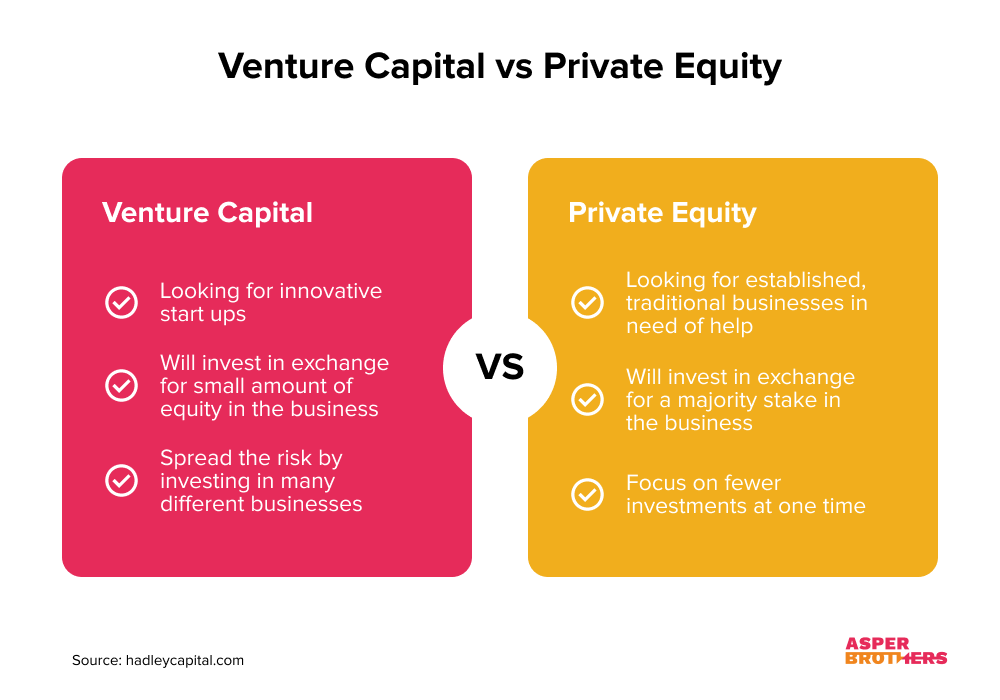
Private equity firms typically invest in mature companies that are already established and generating revenue. These companies may be looking for capital to expand, restructure, or improve operations. On the other hand, venture capital firms focus on early-stage startups or companies with high growth potential, often in the technology or innovation sectors. These startups are usually in the seed or Series A funding stages.
2. Investment Size and Ownership Stake
Private equity investments are generally larger in size, often involving hundreds of millions or even billions of dollars. These firms usually acquire a significant ownership stake, sometimes even a controlling interest, in the companies they invest in. In contrast, venture capital investments are smaller, ranging from a few hundred thousand to a few million dollars, and venture capitalists typically take a minority stake in the company.
See Also Which Scenario Would a Venture Capitalist Prefer?
3. Risk and Return Profiles
Private equity investments are considered lower risk compared to venture capital because they target established companies with proven business models. However, the returns can still be substantial, often achieved through operational improvements or strategic acquisitions. Venture capital, on the other hand, is high-risk, high-reward, as it involves betting on unproven startups with the potential for exponential growth.
4. Involvement in Company Operations
Private equity firms often take an active role in the management and operations of the companies they invest in. They may bring in new management teams, implement cost-cutting measures, or restructure the business to improve profitability. Venture capitalists, while also providing guidance, tend to be more hands-off, focusing on strategic advice and networking opportunities rather than day-to-day operations.
See Also Is It Possible From Someone Who is Working in Private Equity to Switch to Venture Capital and Vice Versa
5. Exit Strategies
The exit strategies for private equity and venture capital also differ. Private equity firms typically aim for an exit through a sale to another company or an initial public offering (IPO) after improving the company's value. Venture capitalists, however, often exit through an IPO or by selling their stake to another investor, usually after the startup has achieved significant growth.
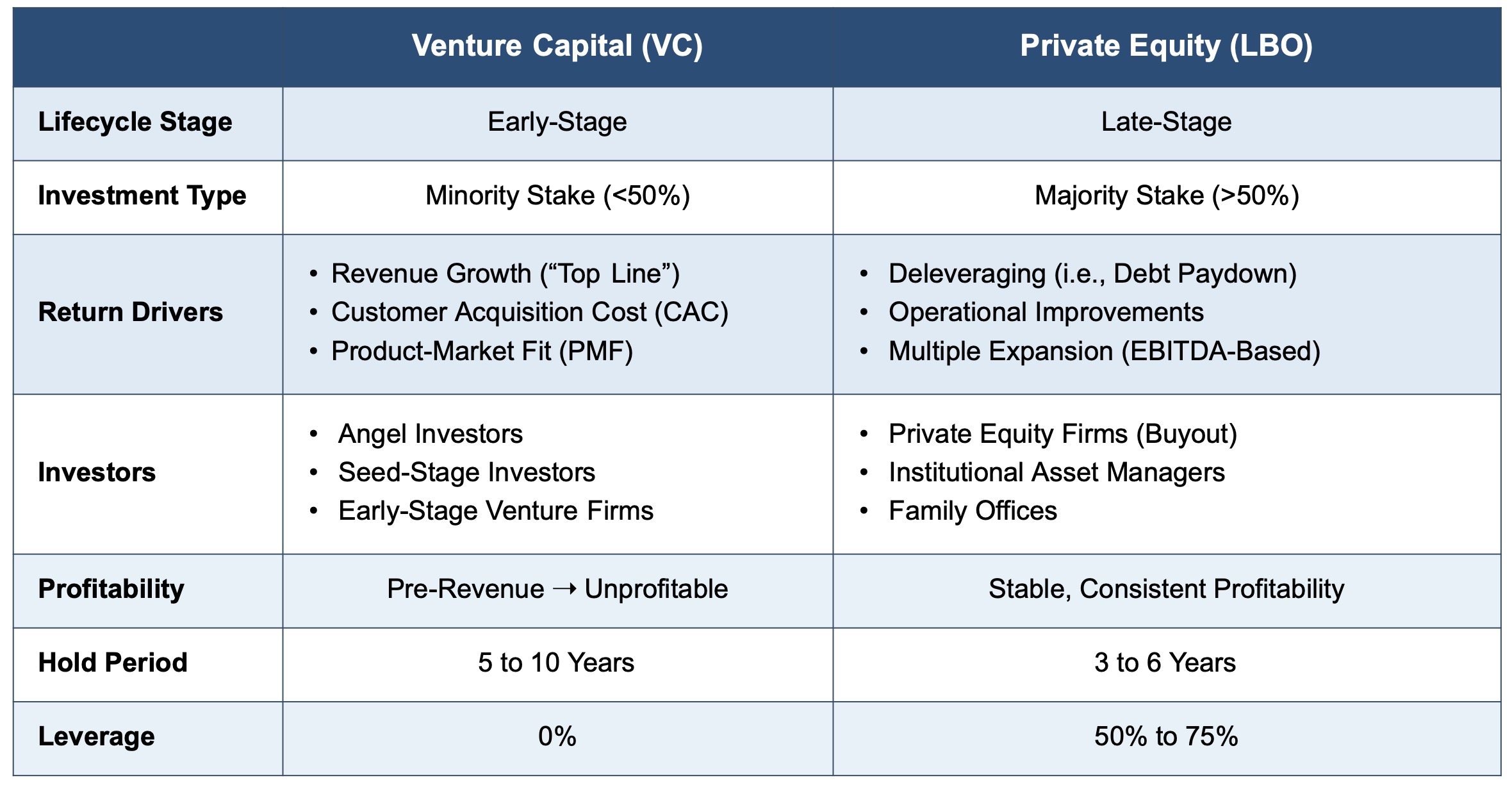
| Aspect | Private Equity | Venture Capital |
|---|---|---|
| Target Companies | Mature, established companies | Early-stage startups |
| Investment Size | Large (hundreds of millions to billions) | Smaller (thousands to millions) |
| Risk Profile | Lower risk | High risk |
| Ownership Stake | Significant or controlling | Minority stake |
| Exit Strategy | Sale or IPO | IPO or stake sale |
What is the difference between private equity and venture capital?
 Which of the Following Statements is Not True About Entrepreneurship It Creates a New Business It Creates New Jobs or Its About Profit Maximization
Definition and Focus
Private equity and venture capital are both forms of investment, but they differ in their focus and target companies. Private equity typically invests in established companies that are looking for capital to expand, restructure, or improve operations. Venture capital, on the other hand, focuses on early-stage companies or startups with high growth potential, often in technology or innovative sectors.
- Private equity targets mature companies.
- Venture capital focuses on startups and early-stage businesses.
- Both aim for high returns but through different strategies.
Investment Size and Stage
The size and stage of investment differ significantly between private equity and venture capital. Private equity deals usually involve larger sums of money, often in the range of hundreds of millions to billions of dollars, and are directed towards companies that are already generating revenue. Venture capital investments are generally smaller, ranging from a few hundred thousand to a few million dollars, and are aimed at companies in their initial stages, often before they have significant revenue.
See Also Where Can I Find Examples of Investment Deal Memos Writen by Venture Capitalists
- Private equity involves larger investments in established firms.
- Venture capital provides smaller amounts to startups.
- The investment stage determines the risk and potential return.
Risk and Return Profile
The risk and return profiles of private equity and venture capital are distinct. Private equity investments are considered lower risk because they target established companies with proven business models. However, the returns are typically steady and moderate. Venture capital investments are high-risk due to the uncertainty of startup success, but they offer the potential for extremely high returns if the company succeeds.
- Private equity offers lower risk with moderate returns.
- Venture capital carries high risk but can yield high rewards.
- Investors choose based on their risk tolerance and return expectations.
Investment Horizon
The investment horizon for private equity and venture capital also varies. Private equity firms usually have a longer investment horizon, often holding their investments for 5 to 10 years, as they work on improving the company's operations and profitability. Venture capital firms, in contrast, may exit their investments sooner, typically within 3 to 7 years, especially if the startup achieves rapid growth or is acquired.
- Private equity investments are held for longer periods.
- Venture capital exits are often quicker due to rapid growth.
- The investment horizon affects liquidity and strategy.
Role in Company Management
The level of involvement in company management differs between private equity and venture capital. Private equity firms often take a hands-on approach, actively participating in the management and strategic decisions of the companies they invest in. Venture capital firms, while also involved, typically take a more advisory role, providing guidance and support to help the startup grow without directly managing operations.
- Private equity firms actively manage their investments.
- Venture capital firms offer advisory support.
- The level of involvement impacts the company's direction and growth.
Which is an uncommon feature of private equity and venture capital?

Limited Liquidity
One uncommon feature of private equity and venture capital is the limited liquidity of investments. Unlike publicly traded stocks, these investments are not easily convertible to cash. Investors often face long holding periods, typically ranging from 5 to 10 years, before they can realize returns. This illiquidity is due to the nature of the investments, which are often in early-stage or privately held companies that require significant time to mature and generate returns.
- Long holding periods: Investments are locked in for extended durations.
- No secondary market: There is no readily available market to sell these investments.
- Capital calls: Investors may need to provide additional funds over time, further tying up their capital.
High Minimum Investment Thresholds
Private equity and venture capital often require high minimum investment thresholds, which can be a barrier for many individual investors. These thresholds are typically in the range of hundreds of thousands to millions of dollars, making these investment vehicles accessible primarily to institutional investors or high-net-worth individuals.
- Institutional focus: Funds are often structured to attract large institutional investors.
- Exclusive access: High minimums limit participation to a select group of investors.
- Capital concentration: Large sums are required, which can limit diversification opportunities for smaller investors.
Active Involvement in Portfolio Companies
Another uncommon feature is the active involvement of private equity and venture capital firms in the management of their portfolio companies. Unlike passive investments, these firms often take a hands-on approach, providing strategic guidance, operational support, and sometimes even replacing management teams to drive growth and improve performance.
- Strategic guidance: Firms often help shape the business strategy of portfolio companies.
- Operational support: They may provide expertise in areas like finance, marketing, and technology.
- Management changes: Firms may replace or restructure the management team to align with their goals.
Performance-Based Compensation Structures
Private equity and venture capital firms typically operate with performance-based compensation structures, such as carried interest. This means that the fund managers earn a significant portion of their compensation based on the performance of the investments, aligning their interests with those of the investors.
- Carried interest: Managers receive a share of the profits, usually around 20%.
- Management fees: These are typically around 2% of the assets under management.
- Alignment of interests: Compensation is tied to the success of the investments, incentivizing strong performance.
Concentration Risk
Private equity and venture capital investments often involve concentration risk, as funds may invest in a relatively small number of companies or sectors. This lack of diversification can lead to higher volatility and potential losses if one or more investments underperform.
- Limited diversification: Funds may focus on a few high-potential companies or sectors.
- Higher volatility: The performance of the fund can be heavily influenced by a small number of investments.
- Potential for significant losses: Poor performance in a concentrated portfolio can lead to substantial losses.
What is the difference between venture capital and private investors?
What is Venture Capital?
Venture capital (VC) refers to a form of private equity financing provided by professional investment firms to early-stage, high-potential, and often high-risk startups. These firms pool money from institutional investors, such as pension funds and endowments, to invest in companies with significant growth potential. Venture capitalists typically take an equity stake in the company and actively participate in its management and strategic decisions.
- Professional Investment Firms: VC firms are structured entities with a team of experts who evaluate and manage investments.
- High-Risk, High-Reward: They focus on startups with the potential for exponential growth, accepting the risk of failure.
- Active Involvement: VCs often provide mentorship, industry connections, and strategic guidance to the companies they invest in.
Who are Private Investors?
Private investors, also known as angel investors or individual investors, are typically wealthy individuals who invest their personal funds into businesses. Unlike venture capitalists, private investors operate independently and often invest in smaller amounts. They may or may not take an active role in the company’s operations, depending on their interest and expertise.
- Individual Funding: Private investors use their own money, not pooled funds from institutions.
- Flexible Involvement: They may choose to be hands-on or passive, depending on their preferences.
- Early-Stage Focus: Many private investors target startups in their initial stages, providing seed funding.
Key Differences in Investment Size
One of the primary differences between venture capital and private investors is the scale of investment. Venture capital firms typically invest larger sums of money, often in the millions, while private investors usually contribute smaller amounts, ranging from tens of thousands to a few hundred thousand dollars.
- VC Investments: Often range from $1 million to $10 million or more per round.
- Private Investor Investments: Typically range from $25,000 to $500,000 per investment.
- Funding Rounds: VCs participate in multiple funding rounds, while private investors may only contribute to early stages.
Level of Involvement in Business Operations
Venture capitalists and private investors differ significantly in their level of involvement in the businesses they fund. VCs often take a hands-on approach, offering strategic advice, networking opportunities, and operational support. In contrast, private investors may prefer a more passive role, leaving day-to-day operations to the company’s management.
- VC Involvement: Active participation in decision-making and board representation.
- Private Investor Involvement: May provide advice but generally avoid direct management.
- Mentorship: VCs often act as mentors, while private investors may limit their role to financial support.
Risk Tolerance and Return Expectations
Both venture capitalists and private investors seek high returns, but their risk tolerance and expectations differ. VCs are accustomed to high-risk investments and expect significant returns, often through an IPO or acquisition. Private investors, on the other hand, may have more modest expectations and a lower risk tolerance, focusing on steady growth and smaller exits.
- VC Risk Tolerance: High, with a focus on disruptive technologies and rapid scaling.
- Private Investor Risk Tolerance: Moderate, with a preference for stable, proven business models.
- Return Expectations: VCs aim for 10x or higher returns, while private investors may be satisfied with 2x to 5x returns.
Investment Criteria and Selection Process
The criteria and process for selecting investments also vary between venture capital firms and private investors. VCs have a formalized process, including due diligence, market analysis, and team evaluation. Private investors, however, may rely more on personal judgment, industry experience, and gut feeling when choosing where to invest.
- VC Selection Process: Rigorous and structured, often involving multiple stages of evaluation.
- Private Investor Selection Process: More informal, based on personal interest and trust in the entrepreneur.
- Focus Areas: VCs prioritize scalability and market potential, while private investors may value passion and vision.
Is it harder to get into VC or PE?

Understanding the Differences Between VC and PE
Venture Capital (VC) and Private Equity (PE) are both forms of private investment, but they differ significantly in their focus and approach. VC typically involves investing in early-stage or high-growth startups with high potential but also high risk. PE, on the other hand, usually involves investing in more established companies, often with the goal of restructuring or improving operations to increase value. The differences in target companies and investment stages make the entry requirements and skill sets for each field distinct.
- VC focuses on startups and high-growth companies.
- PE targets mature companies with stable cash flows.
- VC investments are generally riskier but offer higher potential returns.
Educational and Professional Background Requirements
Breaking into either VC or PE typically requires a strong educational background and relevant professional experience. For VC, a background in entrepreneurship, technology, or a related field is often beneficial. In contrast, PE firms usually prefer candidates with experience in investment banking, consulting, or corporate finance. Both fields value analytical skills, but the specific expertise required can vary.
- VC often values entrepreneurial experience and technical knowledge.
- PE prioritizes financial modeling and deal execution skills.
- Advanced degrees like an MBA can be advantageous in both fields.
Networking and Industry Connections
Networking plays a crucial role in both VC and PE, but the nature of the connections differs. In VC, having a strong network within the startup ecosystem, including founders and angel investors, can be a significant advantage. For PE, connections with investment bankers, consultants, and industry executives are often more important. Building and maintaining these relationships can be a key factor in securing opportunities.
- VC relies heavily on connections within the startup community.
- PE benefits from relationships with financial and corporate professionals.
- Attending industry events and conferences can help build these networks.
Competitiveness and Job Market Dynamics
Both VC and PE are highly competitive fields, but the dynamics of the job market can differ. VC roles are often fewer in number and more specialized, making them harder to secure. PE, while also competitive, tends to have more structured recruitment processes, especially at larger firms. The level of competition can vary depending on the region and the specific firm.
- VC positions are often limited and highly sought after.
- PE roles may offer more structured entry points, such as analyst programs.
- Competition can be influenced by the firm's reputation and location.
Skill Sets and Personal Attributes
The skill sets required for success in VC and PE can differ significantly. In VC, a strong ability to identify market trends, assess technological innovations, and work closely with entrepreneurs is crucial. In PE, skills in financial analysis, due diligence, and operational improvement are often more important. Personal attributes such as risk tolerance, adaptability, and strategic thinking are valued in both fields but may be applied differently.
- VC requires a keen eye for innovation and market potential.
- PE demands strong financial acumen and operational expertise.
- Both fields value strategic thinking and adaptability.
Frequently Asked Questions (FAQs)
What is the primary focus of private equity compared to venture capital?
Private equity primarily focuses on investing in established companies that are often mature and generate steady cash flows. These investments typically involve acquiring a significant or controlling stake in the company, with the goal of improving operations, increasing profitability, and eventually selling the company at a higher valuation. On the other hand, venture capital is geared towards early-stage or startup companies with high growth potential. Venture capitalists provide funding to these startups in exchange for equity, often taking on higher risk in the hopes of achieving substantial returns if the company succeeds.
How do the investment stages differ between private equity and venture capital?
Private equity investments usually occur in later stages of a company's lifecycle, such as during growth, expansion, or even turnaround phases. These investments often involve leveraged buyouts (LBOs) or recapitalizations of established businesses. In contrast, venture capital investments are made during the early stages of a company's development, such as seed funding, Series A, or Series B rounds. Venture capitalists focus on nurturing startups through their initial growth phases, providing not only capital but also mentorship and strategic guidance.
What are the typical investment sizes in private equity versus venture capital?
Private equity investments are generally much larger in size compared to venture capital deals. Private equity firms often invest hundreds of millions or even billions of dollars in a single transaction, targeting established companies with proven business models. Conversely, venture capital investments are smaller, typically ranging from a few hundred thousand dollars to tens of millions, depending on the stage of the startup. The smaller investment size reflects the higher risk associated with funding unproven businesses.
How do the exit strategies differ between private equity and venture capital?
Private equity firms typically aim for exit strategies such as selling the company to another private equity firm, conducting an initial public offering (IPO), or merging with another company. These exits are often planned within a 5-10 year timeframe, with the goal of achieving a significant return on investment. In contrast, venture capital exits usually involve the startup being acquired by a larger company or going public through an IPO. However, venture capital exits can take longer to materialize, as they depend on the startup's ability to scale and achieve market success.
Leave a Reply
Our Recommended Articles