
Which Scenario Would a Venture Capitalist Prefer?


Venture capitalists (VCs) are pivotal players in the startup ecosystem, providing funding and expertise to high-potential businesses. However, not all investment opportunities are created equal. When evaluating potential investments, VCs weigh various factors, such as market size, scalability, team expertise, and competitive advantage. This article explores the key scenarios that venture capitalists typically prefer, from early-stage startups with disruptive innovations to established companies seeking growth capital. By understanding the criteria VCs prioritize, entrepreneurs can better position their ventures to attract funding and align with investor expectations. Dive into the decision-making process of venture capitalists and uncover what makes a scenario truly compelling for investment.
- Which Scenario Would a Venture Capitalist Prefer?
- What are venture capitalists interested in?
- What is a venture capitalist quizlet?
- What type of organizations do venture capitalists prefer?
- What business form do venture capitalists typically prefer and why?
- Frequently Asked Questions by our Community
Which Scenario Would a Venture Capitalist Prefer?
Venture capitalists (VCs) are always on the lookout for promising investment opportunities that offer high returns. When evaluating scenarios, they consider factors such as market potential, scalability, team expertise, competitive advantage, and exit strategy. Below, we explore five key scenarios and analyze which one a venture capitalist would likely prefer.
See Also How Many Pitch Decks Does a Venture Capital Firm Usually Get Within a Year
1. High-Growth Market vs. Stable Market
A venture capitalist would typically prefer a high-growth market over a stable one. High-growth markets, such as technology or renewable energy, offer the potential for exponential returns. In contrast, stable markets, while less risky, often provide limited growth opportunities. For example, a startup in the artificial intelligence sector is more likely to attract VC interest than one in a mature industry like textiles.
| High-Growth Market | Stable Market |
|---|---|
| Potential for exponential returns | Limited growth opportunities |
| Higher risk but higher reward | Lower risk but lower reward |
2. Scalable Business Model vs. Niche Business Model
VCs favor scalable business models that can grow rapidly with minimal incremental costs. A scalable model, such as a software-as-a-service (SaaS) platform, allows a company to expand its customer base without significant additional expenses. On the other hand, a niche business model, while potentially profitable, may have limited scalability, making it less attractive to VCs.
See Also Why is Ltv Supposed to Be at Least 3x of Cac Wouldnt Ltv of 1 5x Cac Mean 50 Irr for the Investor Assuming Lifetime is 12 Months
| Scalable Business Model | Niche Business Model |
|---|---|
| Rapid growth potential | Limited scalability |
| Lower marginal costs | Higher marginal costs |
3. Experienced Team vs. Inexperienced Team
An experienced team with a proven track record is a significant factor for VCs. Startups led by individuals who have successfully scaled businesses in the past are more likely to secure funding. In contrast, an inexperienced team, even with a great idea, may struggle to gain VC trust due to the higher perceived risk.
| Experienced Team | Inexperienced Team |
|---|---|
| Proven track record | Higher perceived risk |
| Greater investor confidence | Limited investor confidence |
4. Strong Competitive Advantage vs. No Competitive Advantage
A startup with a strong competitive advantage, such as proprietary technology or a unique business model, is more appealing to VCs. This advantage creates barriers to entry for competitors and increases the likelihood of long-term success. Conversely, a startup with no competitive advantage may struggle to differentiate itself in a crowded market.
See Also What Are Secondary Investments in Venture Capital What Are the Benefits
| Strong Competitive Advantage | No Competitive Advantage |
|---|---|
| Barriers to entry | High competition |
| Higher chances of success | Lower chances of success |
5. Clear Exit Strategy vs. Unclear Exit Strategy
VCs prioritize startups with a clear exit strategy, such as an IPO or acquisition. This provides a roadmap for how investors will realize returns on their investment. A startup with an unclear exit strategy may deter VCs, as it raises questions about the feasibility of achieving a profitable exit.
| Clear Exit Strategy | Unclear Exit Strategy |
|---|---|
| Defined path to returns | Uncertainty for investors |
| Higher investor confidence | Lower investor confidence |
What are venture capitalists interested in?
:max_bytes(150000):strip_icc()/venture-capitalist-4187107-1-279ebe8e1bb9410a9f8c3cf7dc47c7cb.jpg)
 How Do You Write a Good Venture Capital Proposal?
What Are Venture Capitalists Looking for in Startups?
Venture capitalists are primarily interested in identifying startups with the potential for high growth and significant returns on investment. They focus on businesses that can scale quickly and dominate their respective markets. Key factors they evaluate include:
- Innovative business models that disrupt existing industries.
- Strong founding teams with a track record of success or relevant expertise.
- Market size and the potential for the startup to capture a substantial share.
Why Do Venture Capitalists Prioritize Scalability?
Scalability is a critical factor for venture capitalists because it determines how quickly and efficiently a startup can grow. They seek businesses that can expand their operations without a proportional increase in costs. Key aspects include:
- Technology-driven solutions that can be easily replicated or scaled.
- Global market potential rather than being limited to a local or regional audience.
- Efficient operational processes that allow for rapid growth.
How Important Is the Founding Team to Venture Capitalists?
The founding team is one of the most critical elements venture capitalists consider. They look for teams with a combination of vision, execution capability, and resilience. Key traits they evaluate include:
- Industry experience and a deep understanding of the market.
- Leadership skills and the ability to inspire and manage a team.
- Adaptability to overcome challenges and pivot when necessary.
What Role Does Market Potential Play in Venture Capital Decisions?
Market potential is a decisive factor for venture capitalists because it determines the ceiling for growth and profitability. They prefer startups targeting large or rapidly growing markets. Key considerations include:
- Total addressable market (TAM) to assess the revenue potential.
- Market trends indicating increasing demand or emerging opportunities.
- Competitive landscape and the startup's ability to differentiate itself.
Why Do Venture Capitalists Focus on Exit Strategies?
Venture capitalists invest with the expectation of a profitable exit, which is how they realize returns on their investment. They evaluate startups based on their potential for acquisition or IPO. Key factors include:
- Strategic partnerships that could lead to acquisition opportunities.
- Financial performance and growth metrics that appeal to public markets.
- Clear exit timelines that align with the venture capitalist's investment horizon.
What is a venture capitalist quizlet?

What is a Venture Capitalist?
A venture capitalist is an investor who provides capital to startups or small businesses with high growth potential in exchange for equity or ownership stakes. These investors typically focus on early-stage companies that require funding to scale their operations, develop products, or enter new markets. Venture capitalists often take on significant risk, as many startups fail, but they also have the potential for substantial returns if the company succeeds.
- Capital Providers: Venture capitalists invest in companies that show promise but lack sufficient funding.
- Equity Stake: They receive a share of ownership in the company in return for their investment.
- High-Risk, High-Reward: They take on the risk of potential failure for the chance of significant financial gain.
How Do Venture Capitalists Operate?
Venture capitalists operate by pooling funds from various sources, such as institutional investors, wealthy individuals, or corporations, to create a venture capital fund. They then use this fund to invest in multiple startups, diversifying their risk. Their involvement often goes beyond just providing money; they may offer strategic guidance, mentorship, and access to their professional networks to help the company grow.
- Fund Creation: They raise money from investors to form a venture capital fund.
- Diversified Investments: They spread investments across multiple startups to mitigate risk.
- Active Involvement: They often play an active role in the companies they invest in.
What Are the Stages of Venture Capital Investment?
Venture capital investments typically occur in stages, starting with seed funding for early-stage ideas and progressing to Series A, B, and C rounds as the company grows. Each stage corresponds to a different level of development and funding needs, with venture capitalists adjusting their involvement and expectations accordingly.
- Seed Stage: Initial funding to develop a product or idea.
- Series A: Funding for scaling operations and achieving market traction.
- Series B and C: Later-stage funding for expansion and market dominance.
What Are the Key Characteristics of a Venture Capitalist?
Venture capitalists are characterized by their risk tolerance, focus on high-growth industries, and ability to identify promising startups. They often have extensive experience in business, finance, or technology, which helps them evaluate potential investments and guide companies toward success.
- Risk Tolerance: Willingness to invest in high-risk, high-reward opportunities.
- Industry Focus: Preference for industries with rapid growth potential, such as tech or biotech.
- Expertise: Strong background in business, finance, or technology.
What Are the Benefits of Venture Capital Funding?
Venture capital funding provides startups with the financial resources needed to grow, as well as access to valuable expertise and networks. This type of funding can help companies accelerate their development, enter new markets, and achieve long-term success.
- Financial Support: Access to significant capital for growth and expansion.
- Strategic Guidance: Mentorship and advice from experienced investors.
- Networking Opportunities: Connections to industry leaders and potential partners.
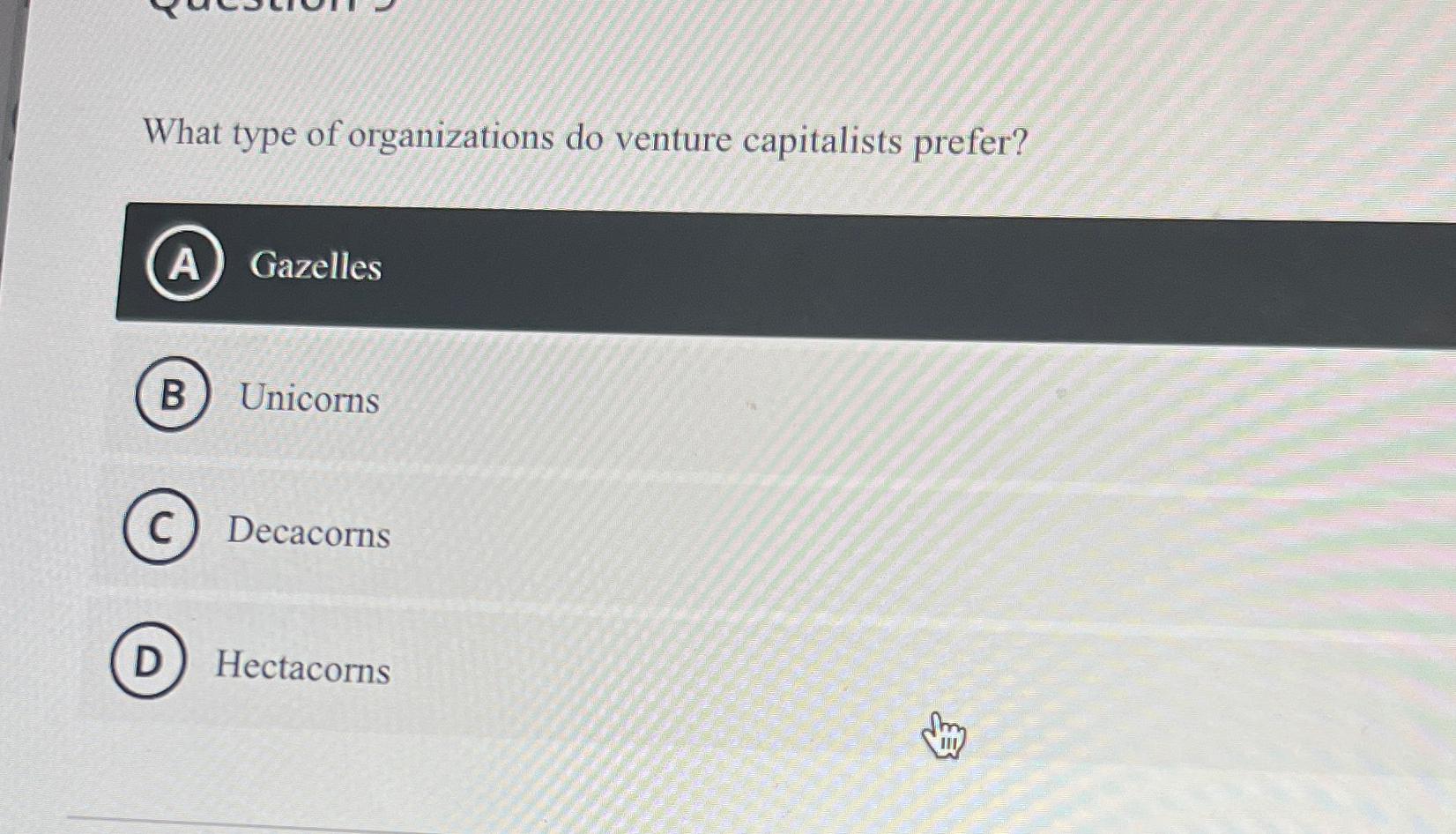
What type of organizations do venture capitalists prefer?
High-Growth Potential Startups
Venture capitalists typically prefer organizations that demonstrate high-growth potential. These startups often operate in industries with rapid scalability, such as technology, biotechnology, or renewable energy. Key characteristics include:
- Innovative business models that disrupt traditional markets.
- A large total addressable market (TAM) to ensure significant revenue opportunities.
- Strong intellectual property or proprietary technology.
Strong Founding Teams
Venture capitalists place a high emphasis on the founding team of an organization. They look for teams with a proven track record, complementary skills, and the ability to execute their vision. Important factors include:
- Relevant industry experience and expertise.
- A clear vision and leadership capabilities.
- Demonstrated resilience and adaptability in challenging situations.
Scalable Business Models
Organizations with scalable business models are highly attractive to venture capitalists. These models allow for rapid expansion without a proportional increase in costs. Key elements include:
- Recurring revenue streams, such as subscriptions or SaaS models.
- Low marginal costs for serving additional customers.
- Ability to expand into new markets or geographies efficiently.
Clear Market Traction
Venture capitalists prefer organizations that already show market traction, indicating demand for their product or service. Indicators of traction include:
- Growing customer base or user adoption rates.
- Positive revenue growth or consistent sales performance.
- Strong customer feedback or testimonials.
Exit Strategy Potential
An organization's potential for a successful exit strategy is critical for venture capitalists. They seek companies that can provide a lucrative return on investment through:
- Acquisition by larger corporations.
- Initial Public Offering (IPO) on stock exchanges.
- Strategic partnerships or mergers.
What business form do venture capitalists typically prefer and why?
Why Do Venture Capitalists Prefer Corporations?
Venture capitalists typically prefer investing in corporations due to their structured and scalable nature. Corporations offer clear legal frameworks, making it easier to manage equity distribution and attract additional investors. Additionally, corporations provide limited liability protection, which is crucial for both investors and founders.
- Legal Structure: Corporations have a well-defined legal framework that simplifies equity distribution and governance.
- Limited Liability: Shareholders are protected from personal liability, reducing financial risk.
- Scalability: Corporations can easily issue new shares, making it simpler to raise additional capital.
What Are the Advantages of Corporations for Venture Capitalists?
Corporations offer several advantages that align with the goals of venture capitalists, such as ease of equity management, tax benefits, and the ability to attract institutional investors.
- Equity Management: Corporations can issue different classes of stock, allowing for flexible equity arrangements.
- Tax Benefits: Certain corporate structures, like C-Corps, offer tax advantages that are attractive to investors.
- Institutional Investment: Corporations are more likely to attract institutional investors, which can lead to larger funding rounds.
How Do Corporations Facilitate Exit Strategies?
Corporations are preferred by venture capitalists because they facilitate smoother exit strategies, such as IPOs or acquisitions, which are critical for realizing returns on investment.
- IPO Readiness: Corporations are better positioned to go public, providing a lucrative exit option for investors.
- Acquisition Potential: The structured nature of corporations makes them more attractive to potential acquirers.
- Shareholder Agreements: Corporations can implement shareholder agreements that outline exit strategies, ensuring clarity for all parties.
What Role Does Limited Liability Play in Venture Capital Investments?
Limited liability is a key factor that makes corporations the preferred business form for venture capitalists, as it protects investors from personal financial risk.
- Risk Mitigation: Limited liability ensures that investors are not personally liable for the company's debts or legal issues.
- Investor Confidence: This protection increases investor confidence, making it easier to secure funding.
- Legal Protection: Limited liability provides a legal safeguard, reducing the potential for personal financial loss.
Why Are Corporations More Attractive for Scaling Businesses?
Corporations are inherently designed for scalability, which is essential for startups looking to grow rapidly and attract venture capital.
- Capital Raising: Corporations can issue new shares, making it easier to raise additional funds as the business grows.
- Global Expansion: The corporate structure is recognized internationally, facilitating global expansion.
- Operational Flexibility: Corporations can adapt more easily to changes in scale, such as hiring more employees or entering new markets.
Frequently Asked Questions by our Community
What factors do venture capitalists consider when evaluating a startup?
Venture capitalists (VCs) evaluate startups based on several key factors, including the market potential, the strength of the founding team, the scalability of the business model, and the competitive advantage of the product or service. They also assess the financial projections and the exit strategy, as these determine the potential return on investment. A startup with a large addressable market, a strong team, and a unique value proposition is more likely to attract VC interest.
Why do venture capitalists prefer high-growth industries?
Venture capitalists prefer high-growth industries because they offer the potential for exponential returns. Industries like technology, biotech, and clean energy are often favored due to their rapid innovation cycles and ability to disrupt traditional markets. These sectors typically have lower barriers to entry for new players and higher chances of achieving market dominance, which aligns with the VC goal of maximizing returns within a relatively short time frame.
How important is the founding team to venture capitalists?
The founding team is one of the most critical factors for venture capitalists. VCs look for teams with a strong track record, relevant industry experience, and the ability to execute their vision. A cohesive team with complementary skills and a clear understanding of the market is more likely to succeed. Additionally, VCs value founders who demonstrate resilience, adaptability, and the ability to pivot when necessary, as these traits are essential for navigating the challenges of scaling a startup.
What role does scalability play in a venture capitalist's decision?
Scalability is a crucial factor for venture capitalists because it determines the potential for a startup to grow rapidly and generate significant returns. VCs look for business models that can expand without proportional increases in costs, such as software-as-a-service (SaaS) platforms or marketplace models. A scalable business can serve a growing customer base with minimal additional resources, making it more attractive to investors. Startups that demonstrate the ability to scale globally are particularly appealing, as they offer the potential for massive market penetration and high profitability.
Leave a Reply
Our Recommended Articles