
What Do Operations Roles Look Like at a Venture Capital Firm?


Venture capital (VC) firms are known for their role in funding innovative startups, but behind the scenes, operations roles are the backbone that ensures these firms run smoothly. From managing fund administration and compliance to overseeing portfolio company support and internal processes, operations professionals play a critical role in the success of a VC firm. These roles require a unique blend of financial acumen, organizational skills, and strategic thinking. As the venture capital landscape evolves, operations teams are increasingly tasked with driving efficiency, scalability, and innovation. This article explores the diverse responsibilities, career paths, and impact of operations roles within a venture capital firm.
- What Do Operations Roles Look Like at a Venture Capital Firm?
- What are venture capital operations?
- What are operators in VC?
- What are the positions in a venture capital firm?
- What is the 80/20 rule in venture capital?
-
Frequently Asked Questions by our Community
- What are the primary responsibilities of operations roles in a venture capital firm?
- What skills are essential for someone in an operations role at a venture capital firm?
- How do operations roles contribute to the success of a venture capital firm?
- What career progression opportunities are available in operations roles at venture capital firms?
What Do Operations Roles Look Like at a Venture Capital Firm?
Operations roles at a venture capital (VC) firm are essential for ensuring the smooth functioning of the organization. These roles encompass a wide range of responsibilities, from managing internal processes to supporting portfolio companies. Unlike investment roles, which focus on deal sourcing and execution, operations roles are more about maintaining the infrastructure that allows the firm to operate efficiently. Below, we explore the key aspects of operations roles in a VC firm.
See Also Where Do Venture Capital Firms Get Their Money?
1. Key Responsibilities of Operations Roles
Operations roles in a VC firm involve a variety of tasks that ensure the firm runs smoothly. These responsibilities include financial management, human resources, IT support, office management, and compliance. Operations professionals often act as the backbone of the firm, handling day-to-day tasks that allow investors to focus on deal-making and portfolio management. They also play a critical role in organizing events, managing relationships with external vendors, and ensuring that the firm adheres to regulatory requirements.
2. Financial Management in VC Operations
Financial management is a cornerstone of operations roles in a VC firm. This includes budgeting, forecasting, tracking expenses, and managing fund performance. Operations teams work closely with the finance department to ensure that the firm’s financial health is maintained. They also assist in preparing reports for limited partners (LPs) and ensuring that all financial transactions are accurately recorded. This role requires a strong understanding of accounting principles and financial software.
See Also Whats the Best Portfolio Management Software for Venture Capital Why
3. Human Resources and Talent Management
Human resources (HR) is another critical area within VC operations. Operations professionals are responsible for recruiting, onboarding, employee engagement, and performance management. They ensure that the firm attracts and retains top talent, which is crucial for maintaining a competitive edge. Additionally, they handle payroll, benefits administration, and compliance with labor laws. In smaller firms, HR responsibilities may overlap with other operational tasks.
4. IT and Technology Support
In today’s digital age, IT support is vital for the seamless operation of a VC firm. Operations teams manage software systems, cybersecurity, data storage, and network infrastructure. They ensure that the firm’s technology is up-to-date and secure, enabling employees to work efficiently. This role often involves troubleshooting technical issues, implementing new software solutions, and training staff on technology usage.
See Also What Are Secondary Investments in Venture Capital What Are the Benefits
5. Compliance and Regulatory Oversight
Compliance is a non-negotiable aspect of VC operations. Operations professionals ensure that the firm adheres to all legal and regulatory requirements. This includes filing reports, maintaining records, and conducting audits. They also stay updated on changes in regulations that may impact the firm’s operations. Compliance roles require a keen eye for detail and a thorough understanding of the legal landscape in which the firm operates.
| Area | Key Responsibilities |
|---|---|
| Financial Management | Budgeting, forecasting, expense tracking, fund performance |
| Human Resources | Recruiting, onboarding, employee engagement, payroll |
| IT Support | Software management, cybersecurity, data storage |
| Compliance | Regulatory filings, record maintenance, audits |
| Office Management | Vendor relationships, event organization, daily operations |
What are venture capital operations?

 How Many Pitch Decks Does a Venture Capital Firm Usually Get Within a Year
What is Venture Capital?
Venture capital refers to a form of private equity financing that investors provide to early-stage, high-potential, and often high-risk startups. These investors, known as venture capitalists, offer funding in exchange for equity or ownership stakes in the companies they invest in. The primary goal is to support the growth of these startups and achieve significant returns on investment when the companies succeed or go public.
- Early-stage funding: Venture capital is often provided during the initial stages of a company's development.
- High-risk, high-reward: Investments are made in startups with the potential for exponential growth, despite the inherent risks.
- Equity exchange: Investors receive ownership stakes in the companies they fund.
How Do Venture Capital Operations Work?
Venture capital operations involve a structured process where investors identify, evaluate, and fund promising startups. This process typically includes sourcing deals, conducting due diligence, negotiating terms, and providing ongoing support to portfolio companies. The ultimate aim is to help these startups scale and achieve a successful exit, such as an IPO or acquisition.
- Deal sourcing: Identifying potential investment opportunities through networks, referrals, or pitch events.
- Due diligence: Thoroughly evaluating the startup's business model, market potential, and team.
- Term negotiation: Agreeing on investment terms, including equity stakes and valuation.
Key Players in Venture Capital Operations
The venture capital ecosystem consists of several key players, including venture capitalists, startups, limited partners (LPs), and intermediaries like investment banks. Each player has a distinct role in ensuring the success of venture capital operations.
- Venture capitalists: Professionals who manage venture capital funds and make investment decisions.
- Startups: Early-stage companies seeking funding to grow their businesses.
- Limited partners: Institutional or individual investors who provide capital to venture capital funds.
Stages of Venture Capital Funding
Venture capital funding is typically divided into several stages, each corresponding to a specific phase of a startup's growth. These stages include seed funding, Series A, Series B, and later rounds, depending on the company's progress and funding needs.
- Seed funding: Initial capital to develop a business idea or prototype.
- Series A: Funding to scale operations and achieve market traction.
- Series B and beyond: Capital for further expansion, product development, or market dominance.
Risks and Rewards of Venture Capital Operations
Venture capital operations are inherently risky due to the high failure rate of startups. However, successful investments can yield substantial rewards, making it an attractive option for investors seeking high returns. The key is to balance risk through diversification and thorough due diligence.
- High failure rate: Many startups fail, leading to potential losses for investors.
- Substantial rewards: Successful exits can generate significant returns, often multiples of the initial investment.
- Diversification: Spreading investments across multiple startups to mitigate risk.
What are operators in VC?

What Are Operators in Venture Capital (VC)?
In the context of venture capital (VC), operators are individuals who have hands-on experience in building and scaling businesses. They often take on roles such as CEOs, COOs, or other executive positions within portfolio companies. Their primary responsibility is to drive growth, optimize operations, and ensure the company achieves its strategic goals. Operators are highly valued in VC firms because they bring practical expertise and a deep understanding of the challenges startups face.
- Operators are typically former entrepreneurs or executives with a proven track record.
- They focus on execution and scaling rather than just investment decisions.
- Their role often involves mentoring founders and providing strategic guidance.
Why Are Operators Important in VC Firms?
Operators play a critical role in VC firms because they bridge the gap between investors and portfolio companies. They leverage their experience to help startups navigate challenges, avoid common pitfalls, and accelerate growth. Their involvement can significantly increase the likelihood of a startup's success, which directly impacts the VC firm's returns.
- They provide hands-on support to portfolio companies.
- Operators help mitigate risks by offering practical solutions.
- They contribute to building a strong company culture and operational efficiency.
How Do Operators Differ from Traditional VC Investors?
Unlike traditional VC investors, who primarily focus on financial analysis and deal-making, operators are deeply involved in the day-to-day operations of portfolio companies. They bring a unique perspective rooted in real-world experience, which complements the financial expertise of other investors. This combination of skills is essential for driving long-term success.
- Operators focus on execution, while investors focus on capital allocation.
- They often have industry-specific knowledge that investors may lack.
- Their involvement is more hands-on compared to traditional investors.
What Roles Do Operators Typically Play in Portfolio Companies?
Operators in portfolio companies often take on leadership roles or advisory positions. They may serve as interim executives, mentors, or consultants, depending on the company's needs. Their primary goal is to ensure the company achieves its milestones and scales effectively.
- They may act as interim CEOs or COOs during critical phases.
- Operators provide strategic guidance on product development and market expansion.
- They help build and manage high-performing teams.
What Skills Do Operators Bring to VC Firms?
Operators bring a diverse set of skills to VC firms, including leadership, operational expertise, and industry-specific knowledge. These skills enable them to add significant value to portfolio companies and contribute to the overall success of the VC firm.
- Leadership and team-building capabilities.
- Deep understanding of scaling businesses and operational efficiency.
- Ability to identify and solve critical business challenges.
What are the positions in a venture capital firm?
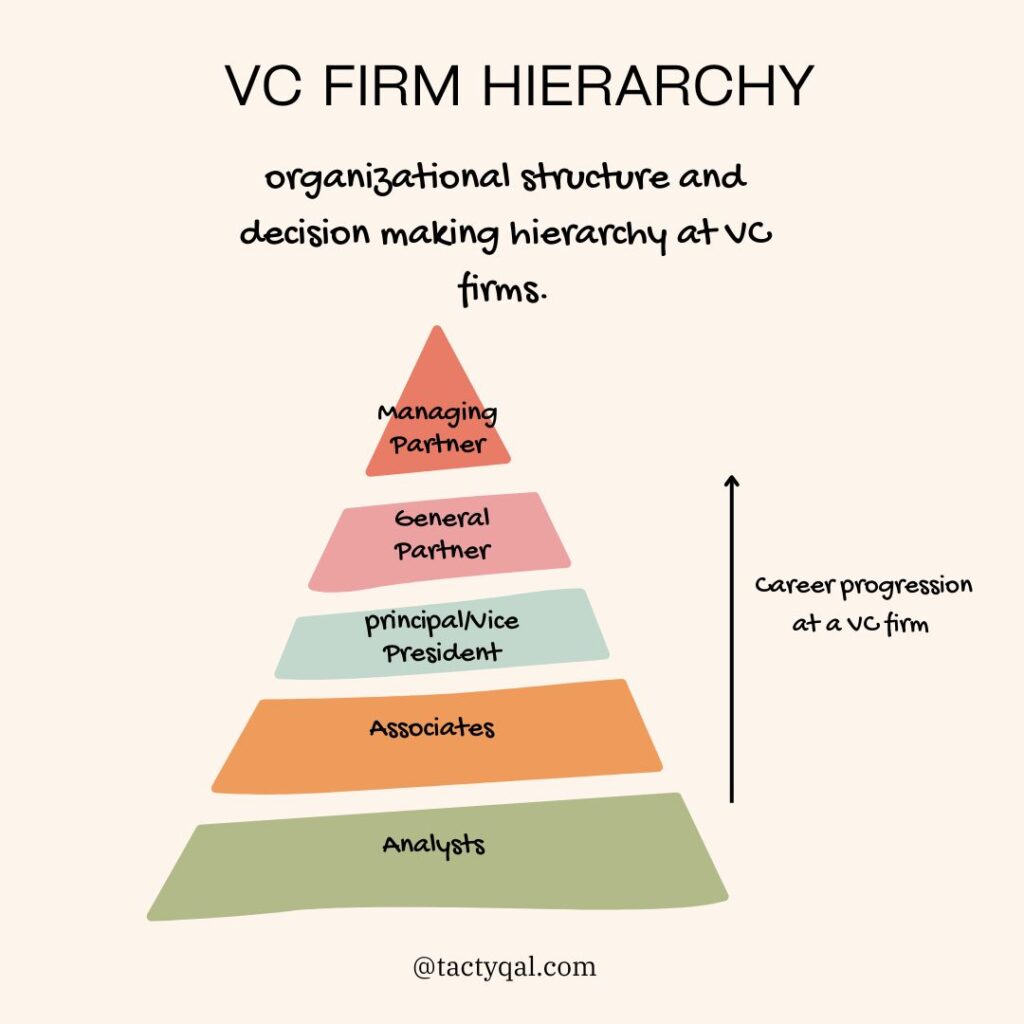
1. General Partners (GPs)
General Partners are the senior decision-makers in a venture capital firm. They are responsible for managing the fund, making investment decisions, and overseeing portfolio companies. Their roles include:
- Fundraising: GPs raise capital from limited partners (LPs) to create the fund.
- Deal Sourcing: They identify and evaluate potential investment opportunities.
- Portfolio Management: GPs monitor and support the growth of portfolio companies.
2. Venture Partners
Venture Partners are typically experienced professionals who work with the firm on a part-time or project basis. They contribute to the firm by:
- Deal Flow: Bringing in new investment opportunities through their networks.
- Mentorship: Advising portfolio companies and helping them scale.
- Due Diligence: Assisting in evaluating potential investments.
3. Principals
Principals are mid-level professionals who play a key role in the investment process. Their responsibilities include:
- Deal Execution: Leading the due diligence and negotiation processes.
- Analysis: Conducting market research and financial modeling.
- Portfolio Support: Working closely with portfolio companies to drive growth.
4. Associates
Associates are entry-level or junior professionals who support the investment team. Their tasks involve:
- Research: Analyzing industries and identifying trends.
- Deal Screening: Reviewing pitch decks and initial deal flow.
- Administrative Support: Assisting in preparing investment memos and presentations.
5. Analysts
Analysts are often recent graduates or early-career professionals who focus on data-driven tasks. Their duties include:
- Data Analysis: Building financial models and conducting quantitative research.
- Market Research: Gathering insights on emerging markets and technologies.
- Reporting: Preparing reports and presentations for senior team members.
What is the 80/20 rule in venture capital?

The 80/20 rule in venture capital refers to the observation that a significant portion of returns in a venture capital portfolio often comes from a small fraction of investments. Specifically, it suggests that 80% of the returns are generated by 20% of the investments. This principle highlights the high-risk, high-reward nature of venture capital, where a few successful home runs can compensate for the losses or underperformance of the majority of investments.
Understanding the 80/20 Rule in Venture Capital
The 80/20 rule, also known as the Pareto Principle, is a concept that applies to various fields, including venture capital. In this context, it emphasizes the importance of identifying and nurturing the top-performing startups in a portfolio. Venture capitalists often focus on:
- High-growth potential: Investing in startups with the potential to scale rapidly and dominate their markets.
- Diversification: Spreading investments across multiple sectors to mitigate risks.
- Active involvement: Providing mentorship and resources to increase the chances of success for portfolio companies.
Why the 80/20 Rule Matters in Venture Capital
The 80/20 rule is critical in venture capital because it underscores the asymmetric returns that drive the industry. Key reasons include:
- Risk management: Accepting that most investments may fail, but a few will deliver outsized returns.
- Focus on outliers: Prioritizing startups with the potential to become market leaders.
- Portfolio strategy: Balancing high-risk, high-reward bets with more stable investments.
How Venture Capitalists Apply the 80/20 Rule
Venture capitalists use the 80/20 rule to guide their investment strategies. This involves:
- Deal sourcing: Identifying startups with disruptive technologies or business models.
- Due diligence: Conducting thorough research to assess the potential of each investment.
- Post-investment support: Providing strategic guidance to help portfolio companies succeed.
Examples of the 80/20 Rule in Action
The 80/20 rule is evident in many successful venture capital portfolios. For instance:
- Sequoia Capital: Their investment in companies like Apple and Google generated massive returns.
- Andreessen Horowitz: Backing startups like Airbnb and Lyft, which became industry leaders.
- Accel Partners: Early investment in Facebook, which delivered exponential returns.
Challenges of the 80/20 Rule in Venture Capital
While the 80/20 rule is a guiding principle, it also presents challenges, such as:
- Identifying winners: Predicting which startups will succeed is inherently uncertain.
- Resource allocation: Deciding how much to invest in high-risk opportunities versus safer bets.
- Market dynamics: External factors like economic downturns can impact the success of portfolio companies.
Frequently Asked Questions by our Community
What are the primary responsibilities of operations roles in a venture capital firm?
Operations roles in a venture capital firm are crucial for ensuring the smooth functioning of the organization. These roles typically involve managing day-to-day activities, such as overseeing administrative tasks, coordinating with portfolio companies, and ensuring compliance with legal and regulatory requirements. Additionally, operations professionals often handle financial reporting, fund management, and investor relations, ensuring that the firm operates efficiently and maintains strong relationships with stakeholders.
What skills are essential for someone in an operations role at a venture capital firm?
To excel in an operations role at a venture capital firm, individuals need a combination of analytical, organizational, and communication skills. Strong financial acumen is essential for managing funds and preparing reports, while project management skills are crucial for coordinating various tasks and initiatives. Additionally, attention to detail and the ability to work under pressure are vital, as operations roles often involve handling complex and time-sensitive tasks.
How do operations roles contribute to the success of a venture capital firm?
Operations roles play a pivotal role in the success of a venture capital firm by ensuring that the firm's internal processes run smoothly and efficiently. These roles support the investment team by managing back-office functions, such as accounting, compliance, and reporting, allowing the investment professionals to focus on identifying and nurturing promising startups. Furthermore, operations professionals help maintain strong relationships with investors and portfolio companies, which is critical for the firm's long-term success and reputation.
What career progression opportunities are available in operations roles at venture capital firms?
Career progression in operations roles at venture capital firms can be highly rewarding. Entry-level positions, such as operations associates, often involve handling administrative and support tasks. With experience, individuals can advance to roles like operations manager or chief operating officer (COO), where they oversee broader aspects of the firm's operations. Additionally, professionals in these roles may have opportunities to transition into investment roles or take on leadership positions within the firm, depending on their skills and interests.
Leave a Reply
Our Recommended Articles