
What Do Vcs Look for in a Financial Model?


When pitching to venture capitalists (VCs), a well-crafted financial model is often the cornerstone of a compelling investment case. VCs scrutinize financial models to assess a startup’s potential for growth, profitability, and scalability. They look for clarity, realism, and alignment with the business’s strategic goals. Key elements include revenue projections, cost structures, cash flow analysis, and sensitivity to market changes. A robust financial model not only demonstrates the founder’s understanding of their business but also instills confidence in the startup’s ability to deliver returns. Understanding what VCs prioritize can significantly enhance a startup’s chances of securing funding.
What Do VCs Look for in a Financial Model?
When evaluating a financial model, venture capitalists (VCs) focus on several key aspects to determine the viability and potential of a startup. A well-structured financial model not only demonstrates the company's current financial health but also provides a clear projection of future growth and profitability. Below, we explore the critical elements VCs consider when analyzing a financial model.
See Also How Can Startup Companies Raise Money Initial Stage?
1. Revenue Projections
VCs pay close attention to revenue projections as they indicate the startup's potential to generate income. They look for realistic, data-driven forecasts that align with market trends and the company's growth strategy. Overly optimistic projections can raise red flags, while conservative estimates may suggest a lack of ambition.
| Key Aspect | Description |
|---|---|
| Realism | Projections should be based on historical data and market research. |
| Growth Rate | VCs assess whether the growth rate is achievable and sustainable. |
| Market Size | The total addressable market (TAM) should support the projected revenues. |
2. Cost Structure
A clear understanding of the cost structure is essential for VCs. They analyze fixed and variable costs to determine how efficiently the startup can scale. A well-defined cost structure helps VCs assess the company's ability to achieve profitability.
See Also What Are Some of the Top Vcs in the Travel and Tourism Space?
| Key Aspect | Description |
|---|---|
| Fixed Costs | These include expenses like rent and salaries that remain constant regardless of production levels. |
| Variable Costs | Costs that fluctuate with production, such as raw materials and shipping. |
| Scalability | VCs evaluate whether the cost structure allows for efficient scaling. |
3. Cash Flow Management
Cash flow management is a critical factor for VCs. They want to ensure that the startup has enough liquidity to cover operational expenses and invest in growth. A detailed cash flow statement helps VCs understand the company's financial health.
| Key Aspect | Description |
|---|---|
| Burn Rate | The rate at which the company spends its cash reserves. |
| Runway | The amount of time before the company runs out of cash. |
| Liquidity | VCs assess whether the company can meet its short-term obligations. |
4. Key Metrics and KPIs
VCs rely on key metrics and KPIs to evaluate the startup's performance. Metrics like customer acquisition cost (CAC), lifetime value (LTV), and gross margin provide insights into the company's efficiency and profitability.
See Also What are the pros and cons of going through accelerator programs like TechStars and Y Combinator?
| Key Aspect | Description |
|---|---|
| CAC | The cost of acquiring a new customer. |
| LTV | The total revenue a customer generates during their relationship with the company. |
| Gross Margin | The percentage of revenue remaining after deducting the cost of goods sold (COGS). |
5. Sensitivity Analysis
Sensitivity analysis is crucial for VCs as it shows how changes in key assumptions impact the financial model. This analysis helps VCs assess the startup's resilience to market fluctuations and external risks.
| Key Aspect | Description |
|---|---|
| Scenario Planning | VCs look for best-case, worst-case, and base-case scenarios. |
| Risk Assessment | Identifying potential risks and their impact on financial performance. |
| Flexibility | The ability of the model to adapt to changing market conditions. |
What financial models do venture capital firms use?
Discounted Cash Flow (DCF) Model
The Discounted Cash Flow (DCF) model is a fundamental tool used by venture capital firms to estimate the value of an investment based on its expected future cash flows. This model involves projecting the company's future cash flows and discounting them back to their present value using a discount rate, which reflects the risk associated with the investment. Key steps include:
See AlsoHow Was Peter Thiel Able to Become a Venture Capitalist if He Had No Money to Invest to Begin With- Projecting future cash flows: Estimating the company's revenue, expenses, and free cash flow over a specific period.
- Determining the discount rate: Calculating the rate that reflects the risk and opportunity cost of the investment.
- Calculating the present value: Discounting the projected cash flows to determine the current value of the investment.
Comparable Company Analysis (CCA)
The Comparable Company Analysis (CCA) is a relative valuation method used to assess a company's value by comparing it to similar companies in the same industry. Venture capital firms use this model to benchmark the target company against its peers based on financial metrics such as revenue, EBITDA, and valuation multiples. Key steps include:
- Identifying comparable companies: Selecting companies with similar business models, size, and growth prospects.
- Analyzing valuation multiples: Calculating multiples like Price-to-Earnings (P/E) or Enterprise Value-to-EBITDA (EV/EBITDA).
- Applying multiples to the target company: Estimating the target company's value based on the multiples of comparable companies.
Venture Capital Method (VCM)
The Venture Capital Method (VCM) is specifically designed for early-stage investments and focuses on estimating the potential exit value of a startup. This model helps venture capital firms determine the pre-money valuation of a company by projecting its future exit value and discounting it back to the present. Key steps include:
See Also What Kind of Consultants Do Venture Capital Firms Use
- Estimating the exit value: Projecting the company's value at the time of exit, such as an IPO or acquisition.
- Determining the required return: Calculating the expected return on investment based on the risk profile.
- Calculating the pre-money valuation: Discounting the exit value to determine the current valuation of the company.
First Chicago Method
The First Chicago Method is a hybrid approach that combines elements of the DCF model and scenario analysis. This method is particularly useful for venture capital firms evaluating startups with high uncertainty. It involves creating multiple scenarios (e.g., best-case, base-case, and worst-case) and assigning probabilities to each. Key steps include:
- Developing scenarios: Creating different financial projections based on varying assumptions.
- Assigning probabilities: Estimating the likelihood of each scenario occurring.
- Calculating the weighted average value: Combining the values of all scenarios based on their probabilities to determine the overall valuation.
Option Pricing Model
The Option Pricing Model is used by venture capital firms to value the flexibility and optionality inherent in startup investments. This model is particularly relevant for companies with high growth potential but significant uncertainty. It applies principles from financial options theory to estimate the value of the investment. Key steps include:
- Identifying the underlying asset: Defining the asset whose value is being evaluated, such as the company's equity.
- Estimating volatility: Calculating the uncertainty or risk associated with the asset's future value.
- Applying option pricing formulas: Using models like the Black-Scholes formula to estimate the value of the investment.
What do venture capital firms look for?
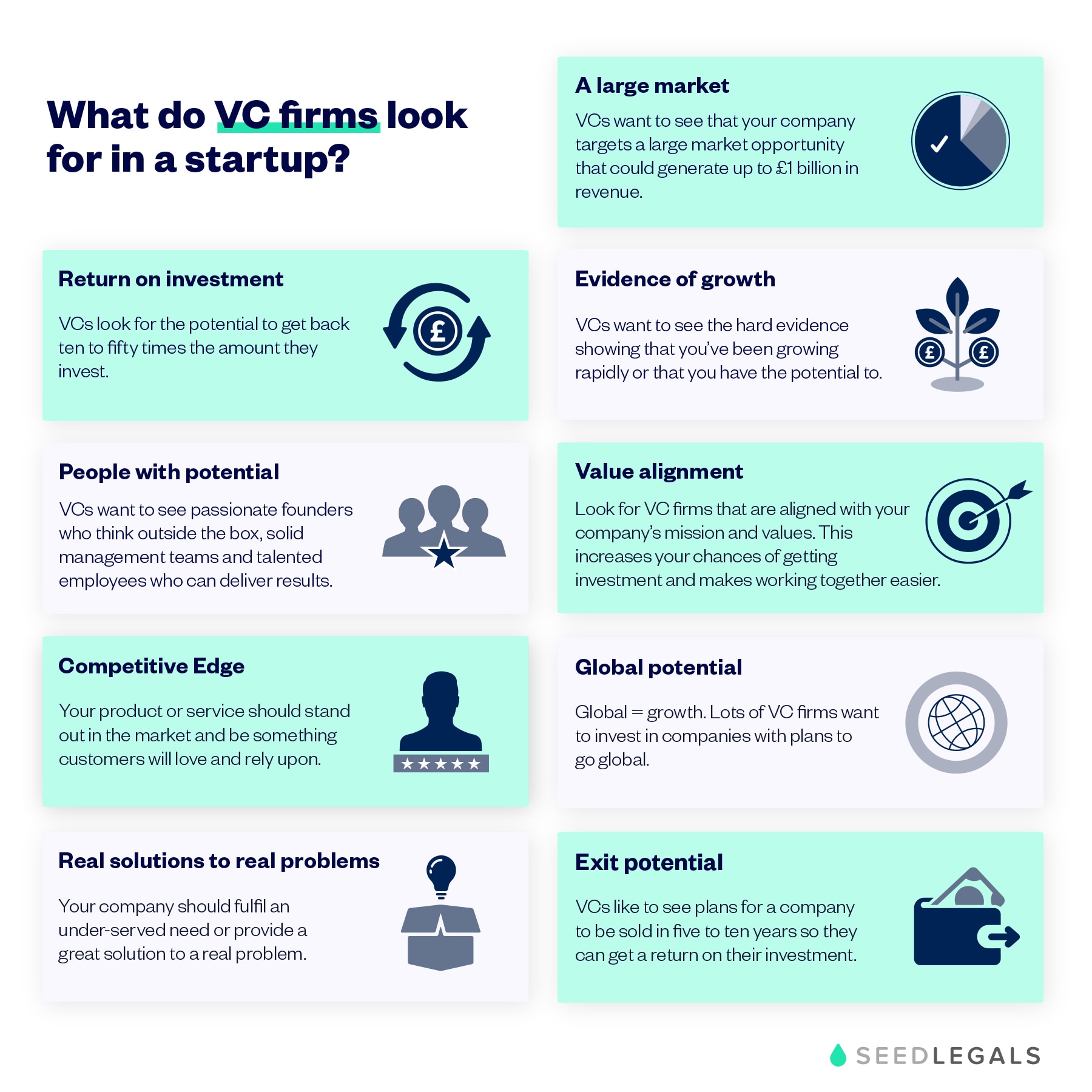
Strong Founding Team
Venture capital firms prioritize investing in startups with a strong founding team. They look for founders who possess:
- Relevant experience: Founders with a background in the industry they are targeting.
- Leadership skills: The ability to inspire and manage a team effectively.
- Resilience and adaptability: Founders who can navigate challenges and pivot when necessary.
Scalable Business Model
A scalable business model is crucial for venture capital firms. They seek startups that can:
- Grow rapidly: Demonstrate potential for exponential growth in a short period.
- Expand globally: Show the ability to enter and dominate international markets.
- Generate recurring revenue: Offer products or services with a subscription or repeat purchase model.
Market Opportunity
Venture capital firms focus on startups that address a large and growing market opportunity. Key factors include:
- Total Addressable Market (TAM): The overall revenue opportunity if the startup captures 100% of the market.
- Market trends: Industries experiencing rapid growth or disruption.
- Customer demand: Clear evidence of unmet needs or pain points in the market.
Innovative Product or Service
Startups must offer an innovative product or service that stands out. Venture capitalists look for:
- Unique value proposition: A clear differentiation from competitors.
- Intellectual property: Patents, trademarks, or proprietary technology that provide a competitive edge.
- Product-market fit: Evidence that the product resonates with its target audience.
Strong Financials and Traction
Venture capital firms evaluate a startup's financial health and traction. They consider:
- Revenue growth: Consistent and increasing revenue over time.
- Customer acquisition: A growing and engaged customer base.
- Burn rate and runway: Efficient use of capital and sufficient time to achieve milestones.
What do venture capitalists consider financing to?
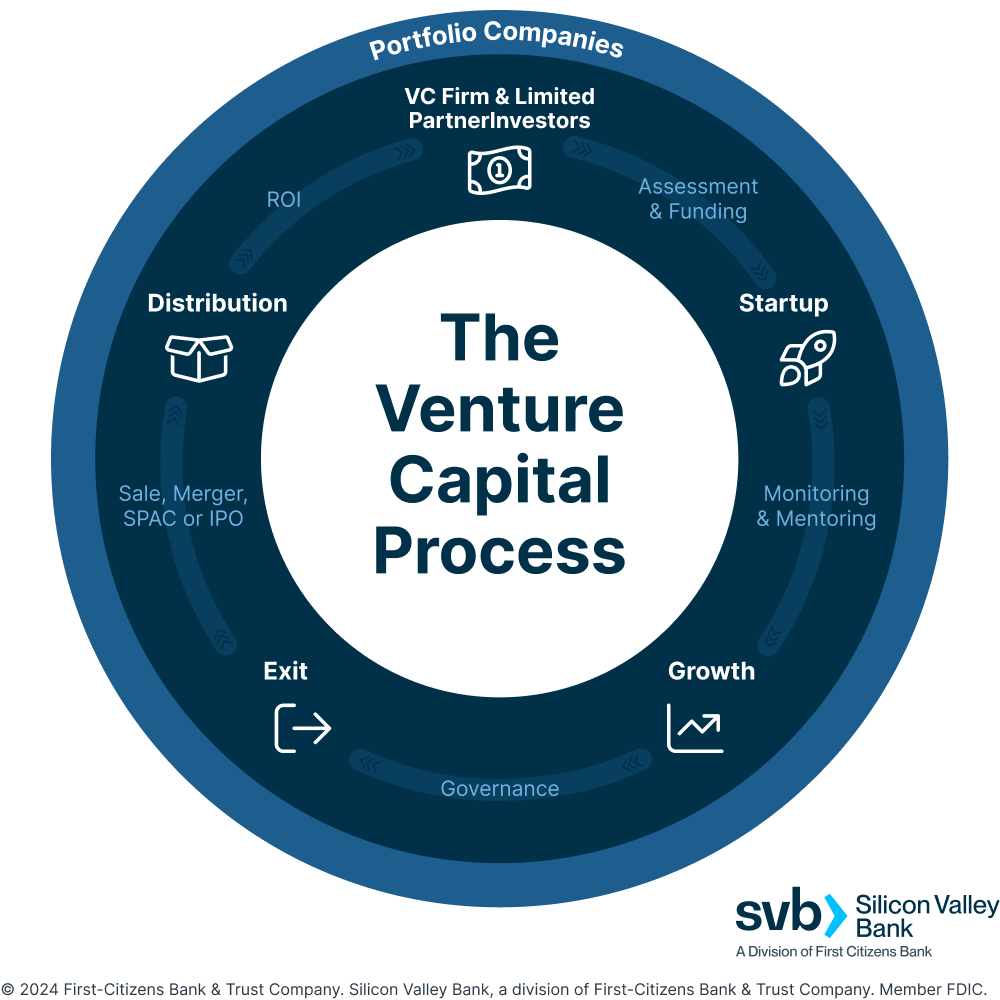
What Types of Businesses Do Venture Capitalists Finance?
Venture capitalists typically finance businesses that demonstrate high growth potential and scalability. They focus on industries such as technology, biotechnology, clean energy, and consumer products. These businesses often require significant capital to develop innovative products or services and expand their market reach.
- Startups with disruptive ideas or technologies.
- Early-stage companies with proven business models.
- High-growth industries with substantial market opportunities.
What Criteria Do Venture Capitalists Use to Evaluate Investments?
Venture capitalists evaluate investments based on several key criteria, including the management team, market size, competitive advantage, and financial projections. They seek businesses with strong leadership, a clear value proposition, and the potential to generate significant returns.
- Experienced and capable management team.
- Large and growing target market.
- Unique product or service offering.
How Do Venture Capitalists Structure Their Financing?
Venture capitalists structure financing through equity investments, convertible notes, or preferred stock. They often take an active role in the company's operations, providing mentorship and strategic guidance. The terms of financing are designed to align the interests of both parties and mitigate risks.
- Equity stakes in exchange for capital.
- Convertible notes that can be converted into equity later.
- Preferred stock with specific rights and privileges.
What Are the Risks and Rewards for Venture Capitalists?
Venture capitalists face significant risks, including the potential for business failure and illiquidity. However, the rewards can be substantial, with successful investments yielding high returns. They diversify their portfolios to balance risk and reward.
- High failure rate of startups.
- Long investment horizons before liquidity events.
- Potential for outsized returns from successful exits.
What Role Do Venture Capitalists Play in Business Growth?
Venture capitalists play a crucial role in business growth by providing not only capital but also strategic guidance, industry connections, and operational expertise. They help companies scale efficiently and navigate challenges to achieve long-term success.
- Mentorship and strategic advice.
- Access to networks and partnerships.
- Assistance in scaling operations.
What returns are VCs looking for?
What is the typical return expectation for VCs?
Venture capitalists (VCs) typically look for high returns on their investments, often aiming for a 10x to 20x return on their initial investment over a period of 5 to 10 years. This is because VCs invest in high-risk, high-reward startups where the majority of investments may fail, but a few successful exits can generate significant returns.
- High-risk tolerance: VCs understand that most startups fail, so they seek outsized returns from the few that succeed.
- Portfolio approach: By investing in multiple startups, VCs spread their risk and increase the chances of hitting a home run.
- Long-term horizon: VCs are patient investors, willing to wait several years for a startup to mature and achieve a successful exit.
How do VCs measure success in terms of returns?
VCs measure success through Internal Rate of Return (IRR) and multiple on invested capital (MOIC). These metrics help them evaluate the performance of their investments and compare them against benchmarks or other investment opportunities.
- IRR: This measures the annualized return on an investment, factoring in the time value of money.
- MOIC: This shows how much money has been returned relative to the amount invested, without considering the time factor.
- Benchmarking: VCs often compare their returns to industry standards or other asset classes to assess performance.
What factors influence VC return expectations?
Several factors influence the return expectations of VCs, including the stage of investment, the industry, and the geographic market. Early-stage investments typically require higher returns due to their higher risk, while later-stage investments may have lower return expectations but more predictable outcomes.
- Investment stage: Seed and Series A rounds demand higher returns compared to Series B or later rounds.
- Industry dynamics: Sectors like tech and biotech often promise higher returns due to rapid innovation and scalability.
- Market conditions: Economic trends and market demand can significantly impact potential returns.
Why do VCs focus on exits for returns?
VCs focus on exits—such as IPOs or acquisitions—because these events provide the liquidity needed to realize returns on their investments. Without a successful exit, the value of their equity stake remains unrealized.
- IPOs: Going public allows startups to raise capital and provides VCs with an opportunity to sell their shares.
- Acquisitions: Being acquired by a larger company is a common exit strategy that can deliver significant returns.
- Secondary markets: In some cases, VCs may sell their shares to other investors before an exit event.
How do VCs balance risk and return?
VCs balance risk and return by carefully selecting startups with high growth potential and scalable business models. They also diversify their portfolios to mitigate the risk of any single investment failing.
- Due diligence: VCs conduct thorough research to assess the viability and potential of a startup.
- Diversification: Investing in a range of startups across different sectors reduces overall portfolio risk.
- Active involvement: VCs often provide mentorship and resources to help startups succeed, thereby increasing the likelihood of a positive return.
Frequently Asked Questions (FAQs)
What are the key components VCs look for in a financial model?
Venture capitalists (VCs) prioritize several key components when evaluating a financial model. These include revenue projections, which should be realistic and based on solid assumptions. They also look for detailed expense breakdowns, including fixed and variable costs, to assess the company's ability to manage cash flow. Additionally, VCs focus on profit margins and break-even analysis to understand when the business will become profitable. A well-structured cash flow statement is also critical, as it demonstrates the company's liquidity and financial health over time.
How important is scalability in a financial model for VCs?
Scalability is one of the most critical factors VCs consider in a financial model. They want to see how the business can grow its revenue without proportionally increasing its costs. A financial model that demonstrates efficient scaling through strategies like automation, economies of scale, or expanding into new markets is highly attractive. VCs are particularly interested in models that show how the company can achieve exponential growth while maintaining or improving profitability over time.
Why do VCs focus on the assumptions behind a financial model?
VCs place significant emphasis on the assumptions underlying a financial model because they determine its credibility and reliability. They scrutinize assumptions related to market size, customer acquisition costs, pricing strategies, and growth rates to ensure they are realistic and well-researched. If the assumptions are overly optimistic or lack supporting data, VCs may question the model's validity. Clear, logical, and data-backed assumptions are essential to gaining their trust and confidence.
How does a financial model reflect a company's risk profile for VCs?
A financial model provides VCs with insights into a company's risk profile by highlighting potential challenges and uncertainties. VCs look for models that include sensitivity analysis or scenario planning, which show how changes in key variables (e.g., sales volume, pricing, or costs) could impact the business. They also assess the company's capital requirements and runway to determine if it can sustain operations during downturns. A well-prepared financial model will address these risks transparently and propose mitigation strategies, making the investment opportunity more compelling.
Leave a Reply
Our Recommended Articles