
What is the Difference Between Vc Angel Investor and Acceleration Programs and How Do They Help a Start Up

In the dynamic world of startups, securing the right type of funding and support can make all the difference between success and failure. Venture capitalists (VCs), angel investors, and acceleration programs are three key players that entrepreneurs often turn to for resources and guidance. While VCs and angel investors provide financial backing in exchange for equity, acceleration programs offer a structured environment for growth, mentorship, and networking. Understanding the distinctions between these options is crucial for founders aiming to align their business needs with the most suitable support system. This article explores the differences between VCs, angel investors, and acceleration programs, and how each can contribute to a startup's journey.
- What is the Difference Between VC, Angel Investors, and Acceleration Programs, and How Do They Help a Startup?
- What is the difference between VC and angel investor?
- What is the difference between startup accelerator and VC?
- What is the main difference between an angel investor and a crowdfund investor?
- What's the difference between VC and PE?
-
Frequently Asked Questions by our Community
- What is the main difference between a VC, an angel investor, and an acceleration program?
- How do VCs and angel investors help startups beyond funding?
- What role do acceleration programs play in a startup's growth?
- Which is better for a startup: VC funding, angel investment, or an acceleration program?
What is the Difference Between VC, Angel Investors, and Acceleration Programs, and How Do They Help a Startup?
1. What is a Venture Capitalist (VC)?
A Venture Capitalist (VC) is an individual or firm that invests in early-stage or high-growth startups in exchange for equity. VCs typically provide larger funding amounts compared to angel investors and focus on startups with high scalability potential. They often take an active role in the company, offering mentorship, strategic guidance, and access to their network. VCs usually invest in later stages of a startup's growth, such as Series A or B funding rounds.
See Also Is Goldman Sachs or Venture Capital a Better Career Starter?
2. Who is an Angel Investor?
An Angel Investor is an individual who invests their personal funds into startups, usually during the seed stage. Unlike VCs, angel investors often invest smaller amounts and may not require as much equity. They are typically experienced entrepreneurs or business professionals who provide mentorship and industry connections to help the startup grow. Angel investors are more likely to take risks on unproven ideas compared to VCs.
3. What are Acceleration Programs?
Acceleration Programs are structured initiatives designed to help startups grow rapidly over a short period, usually 3-6 months. These programs provide mentorship, workshops, networking opportunities, and sometimes seed funding in exchange for equity. Accelerators often culminate in a demo day, where startups pitch to investors. Examples include Y Combinator and Techstars. Unlike VCs or angel investors, accelerators focus on early-stage startups and provide a more hands-on approach to development.
See Also Who is the Best Headhunter for the Venture Capital Start Up Space
4. How Do VCs and Angel Investors Differ in Their Approach?
The primary difference lies in their investment size, stage of involvement, and level of control. VCs invest larger sums and usually come in during later stages, while angel investors provide smaller amounts during the seed stage. VCs often seek board seats and significant equity, whereas angel investors may take a more passive role. Both, however, aim to help startups scale and succeed.
5. How Do Acceleration Programs Complement VC and Angel Investments?
Acceleration programs act as a launchpad for startups, preparing them for future investments. They provide structured guidance, validation of business models, and access to investor networks. Startups that graduate from accelerators are often more attractive to VCs and angel investors because they have already undergone rigorous training and have a clearer path to growth.
See AlsoWhich Venture Capital Firms Invest in Recruitment Technology Space| Criteria | Venture Capitalist (VC) | Angel Investor | Acceleration Program |
|---|---|---|---|
| Investment Stage | Later stages (Series A, B, etc.) | Seed stage | Early stage |
| Funding Amount | Large | Small to medium | Small (seed funding) |
| Equity Taken | Significant | Moderate | Small |
| Role in Startup | Active (board seats, mentorship) | Passive to active | Hands-on (mentorship, training) |
| Focus | Scalability and high returns | Early growth and potential | Rapid development and validation |
What is the difference between VC and angel investor?
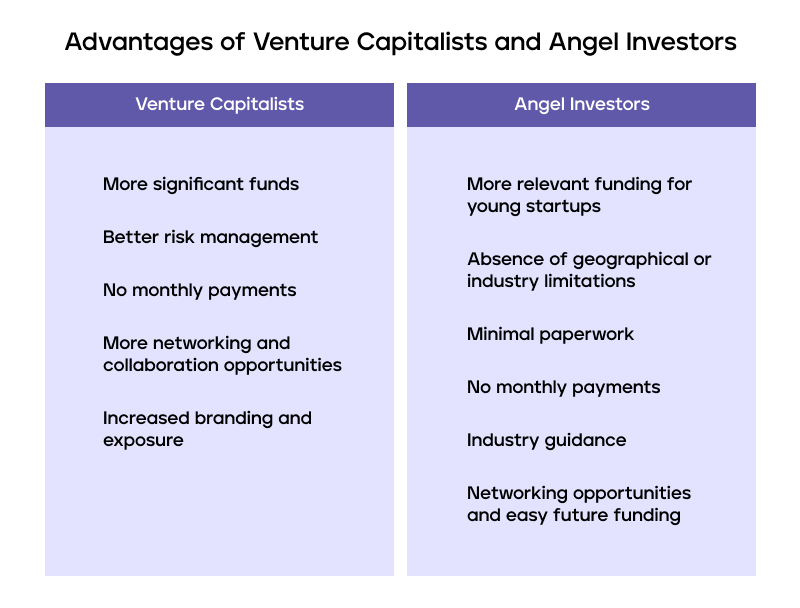
What is a Venture Capitalist (VC)?
A Venture Capitalist (VC) is a professional investor or firm that provides capital to startups and small businesses with high growth potential. VCs typically invest large sums of money in exchange for equity and often take an active role in the company's management. Here are some key characteristics:
See Also Are There Any Vcs Still Investing in Fabless Semiconductor Startups
- Source of Funds: VCs manage pooled funds from institutional investors, such as pension funds, endowments, and wealthy individuals.
- Investment Size: They usually invest larger amounts, ranging from millions to tens of millions of dollars.
- Stage of Investment: VCs often invest in later stages, such as Series A, B, or C funding rounds, when the company has already demonstrated some traction.
What is an Angel Investor?
An Angel Investor is an individual who invests their personal funds into early-stage startups, often in exchange for equity. Unlike VCs, angel investors are typically high-net-worth individuals who provide smaller amounts of capital. Here are some key characteristics:
- Source of Funds: Angel investors use their own money, making them more flexible and less formal in their investment approach.
- Investment Size: They usually invest smaller amounts, ranging from tens of thousands to a few million dollars.
- Stage of Investment: Angels often invest in the seed or pre-seed stages, when the company is still in its infancy.
Key Differences in Investment Size
The investment size is one of the most significant differences between VCs and angel investors. Here’s how they compare:
See AlsoWho Are the Biggest Vc Firms in Agriculture?- VCs: Typically invest millions of dollars, focusing on scaling businesses that have already shown potential.
- Angels: Invest smaller amounts, often less than $1 million, to help startups get off the ground.
- Impact: VCs can fund rapid growth, while angels provide the initial capital to prove a concept.
Differences in Involvement and Control
Another key difference lies in the level of involvement and control each type of investor has in the business:
- VCs: Often take a seat on the board of directors and influence major decisions, such as hiring or strategic direction.
- Angels: Usually have a more hands-off approach, offering mentorship and advice without demanding control.
- Expectations: VCs expect a high return on investment and may push for aggressive growth, while angels are often more patient.
Risk Tolerance and Investment Stages
The risk tolerance and preferred investment stages of VCs and angel investors also differ significantly:
- VCs: Prefer to invest in companies with proven business models and revenue streams, reducing their risk.
- Angels: Are willing to take higher risks by investing in unproven ideas or early-stage startups.
- Focus: VCs focus on scaling, while angels focus on innovation and early validation.
What is the difference between startup accelerator and VC?

What is a Startup Accelerator?
A startup accelerator is a program designed to help early-stage companies grow rapidly by providing them with resources, mentorship, and funding. These programs typically last for a fixed period, often three to six months, and culminate in a demo day where startups pitch to investors. Key features include:
- Structured Programs: Accelerators offer a structured curriculum that includes workshops, mentorship, and networking opportunities.
- Seed Funding: Startups usually receive a small amount of seed funding in exchange for equity, typically ranging from $20,000 to $150,000.
- Mentorship: Access to experienced entrepreneurs, industry experts, and investors who provide guidance and support.
What is a Venture Capital (VC) Firm?
A venture capital (VC) firm is an investment firm that provides capital to startups and small businesses with high growth potential in exchange for equity. Unlike accelerators, VC firms do not offer structured programs but focus on providing larger amounts of funding. Key features include:
- Investment Focus: VCs invest in startups at various stages, from early-stage to growth-stage, depending on the firm's focus.
- Equity Stake: In exchange for funding, VCs take an equity stake in the company, often with a seat on the board.
- Long-Term Involvement: VCs are typically involved in the company for the long term, providing ongoing support and strategic guidance.
Key Differences in Funding
The funding provided by startup accelerators and VC firms differs significantly in terms of amount, structure, and purpose. Here are the main differences:
- Amount: Accelerators provide smaller amounts of seed funding, while VCs offer larger investments, often in the millions.
- Equity Exchange: Accelerators take a smaller equity stake compared to VCs, who may take a significant portion of the company.
- Purpose: Accelerator funding is meant to help startups get off the ground, while VC funding is aimed at scaling the business.
Mentorship and Support
Both startup accelerators and VC firms offer mentorship and support, but the nature and extent of this support differ. Here’s how:
- Accelerators: Provide intensive, hands-on mentorship through structured programs, workshops, and access to a network of experts.
- VCs: Offer strategic guidance and support, often through board membership, but do not provide structured mentorship programs.
- Networking: Both provide networking opportunities, but accelerators often have a more extensive network of mentors and alumni.
Duration and Commitment
The duration and level of commitment required by startup accelerators and VC firms vary significantly. Here’s a breakdown:
- Accelerators: Typically require a short-term commitment, usually three to six months, with a focus on rapid growth and development.
- VCs: Involve a long-term commitment, often several years, with a focus on scaling the business and achieving significant milestones.
- Time Investment: Accelerators demand a high level of time and effort during the program, while VCs require ongoing engagement but less intensive involvement.
What is the main difference between an angel investor and a crowdfund investor?

Definition and Nature of Investment
The primary difference between an angel investor and a crowdfund investor lies in their nature and approach to investment. An angel investor is typically an individual who provides capital to startups or early-stage companies in exchange for equity or ownership stakes. In contrast, crowdfund investors are a group of individuals who collectively contribute smaller amounts of money, often through online platforms, to support a project or business in exchange for rewards, equity, or debt.
- Angel investors are usually high-net-worth individuals.
- Crowdfund investors are often a diverse group of backers.
- Angel investments are typically larger sums compared to crowdfunding contributions.
Investment Size and Risk
Angel investors often invest significant amounts of money, ranging from tens of thousands to millions of dollars, and they take on a higher level of risk due to the early-stage nature of the businesses they support. Crowdfund investors, on the other hand, contribute smaller amounts, often as little as $10 or $100, which reduces their individual risk but spreads the investment across a larger number of backers.
- Angel investors assume higher financial risk.
- Crowdfund investors contribute smaller, more manageable amounts.
- The collective nature of crowdfunding reduces individual exposure.
Decision-Making and Involvement
Angel investors often play an active role in the businesses they invest in, providing mentorship, strategic advice, and networking opportunities. Crowdfund investors, however, are typically passive and do not have a direct say in the company's operations or decision-making processes.
- Angel investors may join the board of directors.
- Crowdfund investors rarely have voting rights.
- Angel investors contribute expertise beyond capital.
Funding Process and Accessibility
The process of securing funding from an angel investor often involves personal connections, pitch meetings, and detailed negotiations. Crowdfunding, however, is more accessible to the general public, as it relies on online platforms where entrepreneurs can present their ideas to a broad audience and attract small contributions from many people.
- Angel funding requires direct engagement with investors.
- Crowdfunding leverages digital platforms for outreach.
- Crowdfunding democratizes access to capital.
Return on Investment (ROI) Expectations
Angel investors typically seek a high return on investment through equity stakes, aiming for significant growth in the company's valuation. Crowdfund investors may have varied expectations, ranging from receiving a product or service as a reward to earning a modest return through equity or interest payments.
- Angel investors focus on long-term equity gains.
- Crowdfund investors may prioritize rewards over financial returns.
- ROI expectations differ based on the investor type.
What's the difference between VC and PE?

What is Venture Capital (VC)?
Venture Capital (VC) refers to a form of private equity financing that is provided to early-stage, high-potential, and often high-risk startups. VC firms invest in companies with the expectation of significant growth and a high return on investment. These investments are typically made in exchange for equity or ownership stakes in the company.
- Focus: VC primarily targets startups and early-stage companies with innovative ideas or technologies.
- Risk Level: High risk due to the unproven nature of the businesses.
- Investment Size: Smaller compared to PE, but can vary depending on the stage of the company.
What is Private Equity (PE)?
Private Equity (PE) involves investing in established companies that are not publicly traded. PE firms typically acquire significant or majority stakes in these companies, often with the goal of restructuring, improving operations, and eventually selling them for a profit.
- Focus: PE targets mature companies with stable cash flows and growth potential.
- Risk Level: Lower risk compared to VC, as the companies are more established.
- Investment Size: Larger investments, often involving billions of dollars.
Key Differences in Investment Stages
The stages at which VC and PE firms invest are fundamentally different. VC firms focus on early-stage companies, while PE firms invest in more mature businesses.
- VC: Seed, Series A, Series B, and later-stage funding rounds.
- PE: Buyouts, growth capital, and turnaround investments.
- Exit Strategy: VC aims for IPOs or acquisitions, while PE often sells to other investors or takes companies public.
Risk and Return Profiles
The risk and return profiles of VC and PE investments differ significantly due to the nature of the companies they invest in.
- VC: High risk with the potential for exponential returns if the startup succeeds.
- PE: Moderate risk with steady, predictable returns from established companies.
- Failure Rate: VC investments have a higher failure rate compared to PE investments.
Management Involvement
The level of involvement in the management of portfolio companies varies between VC and PE firms.
- VC: Typically provides strategic guidance and mentorship but does not take over day-to-day operations.
- PE: Often takes an active role in management, implementing operational changes and restructuring.
- Decision-Making: PE firms usually have more control over major decisions compared to VC firms.
Frequently Asked Questions by our Community
What is the main difference between a VC, an angel investor, and an acceleration program?
Venture Capitalists (VCs) and angel investors are both sources of funding for startups, but they operate differently. VCs are professional investment firms that manage pooled funds from various investors, typically investing larger amounts in exchange for equity. They often focus on startups with high growth potential and a proven track record. On the other hand, angel investors are individuals who invest their own money, usually at earlier stages, and may provide mentorship alongside funding. Acceleration programs, however, are not direct funding sources but structured programs offering mentorship, resources, and sometimes seed funding in exchange for equity. They aim to help startups grow rapidly within a short timeframe, often culminating in a demo day to attract further investment.
How do VCs and angel investors help startups beyond funding?
Both VCs and angel investors bring more than just capital to the table. VCs often provide strategic guidance, industry connections, and operational support to help startups scale. They may also assist with hiring, partnerships, and future funding rounds. Angel investors, being experienced entrepreneurs or professionals themselves, often offer hands-on mentorship, advice, and access to their personal networks. Their involvement can be particularly valuable in the early stages when startups need direction and credibility to attract further investment or partnerships.
What role do acceleration programs play in a startup's growth?
Acceleration programs are designed to fast-track a startup's development by providing a structured environment for growth. These programs typically offer a combination of mentorship, workshops, networking opportunities, and access to investors. They help startups refine their business models, develop go-to-market strategies, and prepare for scaling. Additionally, many programs provide seed funding in exchange for equity, which can be crucial for early-stage startups. By the end of the program, startups are often better positioned to secure further funding or partnerships, thanks to the skills and connections gained during the program.
Which is better for a startup: VC funding, angel investment, or an acceleration program?
The choice between VC funding, angel investment, or an acceleration program depends on the startup's stage, goals, and needs. Early-stage startups with limited traction may benefit more from angel investors or acceleration programs, as they provide not only funding but also mentorship and resources to build a foundation. For startups with a proven product and significant growth potential, VC funding may be more suitable, as it offers larger amounts of capital to scale operations. Ultimately, many startups combine these options, starting with angel investors or acceleration programs and later seeking VC funding to fuel expansion.
Leave a Reply
Our Recommended Articles