
LLC Operating Agreement: Hawaii

Forming a limited liability company (LLC) in Hawaii requires careful attention to its legal framework, particularly the creation of an LLC operating agreement. This foundational document outlines the rights, responsibilities, and relationships among members, while establishing procedures for management, profit distribution, and dispute resolution. Though Hawaii does not legally mandate an operating agreement for LLCs, adopting one is critical to safeguarding member interests and ensuring clarity in business operations. State-specific considerations, such as compliance with Hawaii Revised Statutes Chapter 428 and unique tax implications, further underscore the need for a tailored agreement. A well-drafted operating agreement not only reinforces legal protections but also provides flexibility to address the distinct needs of Hawaii-based businesses.
- Understanding the Essentials of an LLC Operating Agreement in Hawaii
- Is an operating agreement required for an LLC in Hawaii?
-
Can I write my own operating agreement for my LLC?
- Can I Legally Draft My Own Operating Agreement for an LLC?
- What Are the Benefits of Writing Your Own Operating Agreement?
- What Risks Are Involved in Self-Drafting an Operating Agreement?
- What Key Clauses Should a DIY Operating Agreement Include?
- When Should You Consult a Lawyer Instead of Self-Drafting?
- Should an LLC have an operating agreement?
-
What if an LLC has no operating agreement?
- What Happens If an LLC Lacks an Operating Agreement?
- How Does the Absence of an Operating Agreement Affect Management?
- What Are the Risks to Profit Distribution Without an Operating Agreement?
- How Does the Lack of an Operating Agreement Impact Dispute Resolution?
- Can an LLC Without an Operating Agreement Face Dissolution Issues?
- Frequently Asked Questions About LLCs (FAQs)
Understanding the Essentials of an LLC Operating Agreement in Hawaii
Why an LLC Operating Agreement is Crucial for Hawaii Businesses
An LLC Operating Agreement is a foundational document for any Hawaii-based LLC, even though the state does not legally require it. This agreement outlines the rights, responsibilities, and relationships among members, ensuring clarity on profit distribution, management structure, and decision-making processes. Without it, Hawaii LLCs default to state laws under the Hawaii Revised Statutes §428-103, which may not align with members' preferences. A well-drafted agreement also strengthens the LLC’s legal credibility, protecting members from personal liability and disputes.
See AlsoNew Mexico LLC Operating Agreement| Key Aspect | Importance |
|---|---|
| Custom Rules | Overrides generic state laws |
| Liability Protection | Reinforces corporate veil |
| Dispute Resolution | Defines processes for conflicts |
Key Components of a Hawaii LLC Operating Agreement
A robust Operating Agreement for a Hawaii LLC should include member ownership percentages, management structure (member-managed vs. manager-managed), voting rights, and profit/loss allocation. It should also address dissolution procedures and amendments. Including Hawaii-specific clauses, such as compliance with the State Business Registration Division, ensures adherence to local regulations.
| Component | Description |
|---|---|
| Management Structure | Defines roles in daily operations |
| Tax Treatment | Specifies federal/state tax elections |
| Transfer of Ownership | Rules for selling membership interests |
State-Specific Requirements for Hawaii LLC Operating Agreements
Hawaii imposes unique requirements, such as publication obligations for newly formed LLCs (publishing a notice in a local newspaper) and annual state tax ID filings. While the Operating Agreement itself isn’t filed with the state, it must align with Hawaii Revised Statutes §428-101 et seq., covering dissolution, mergers, and member withdrawal.
See AlsoIowa LLC Operating Agreement| Requirement | Hawaii Law Reference |
|---|---|
| Publication | Must publish formation notice |
| Annual Reports | Filed with Hawaii DCCA |
| Registered Agent | Mandatory in-state representative |
Amending an LLC Operating Agreement in Hawaii
To amend an Operating Agreement in Hawaii, members must follow the amendment process outlined in the original document. Typically, this requires a member vote with a predefined majority. Amendments should be documented in writing and signed by all members. Common reasons for amendments include adding/removing members, changing profit shares, or updating management roles.
| Amendment Reason | Process |
|---|---|
| New Members | Approval by existing members |
| Tax Changes | Update IRS election status |
| Legal Compliance | Align with updated state laws |
Legal Compliance and Dispute Resolution in Hawaii LLC Agreements
Hawaii LLCs must ensure their Operating Agreements comply with federal tax guidelines and state employment laws. Including a dispute resolution clause (e.g., mediation or arbitration) minimizes litigation risks. The agreement should also reference Hawaii’s business licensing requirements and zoning laws to avoid penalties.
See AlsoLLC Operating Agreement: Illinois| Compliance Area | Details |
|---|---|
| Tax Filings | Hawaii GET and income taxes |
| Employment Laws | Worker’s compensation rules |
| Dispute Methods | Mandatory arbitration clauses |
Is an operating agreement required for an LLC in Hawaii?
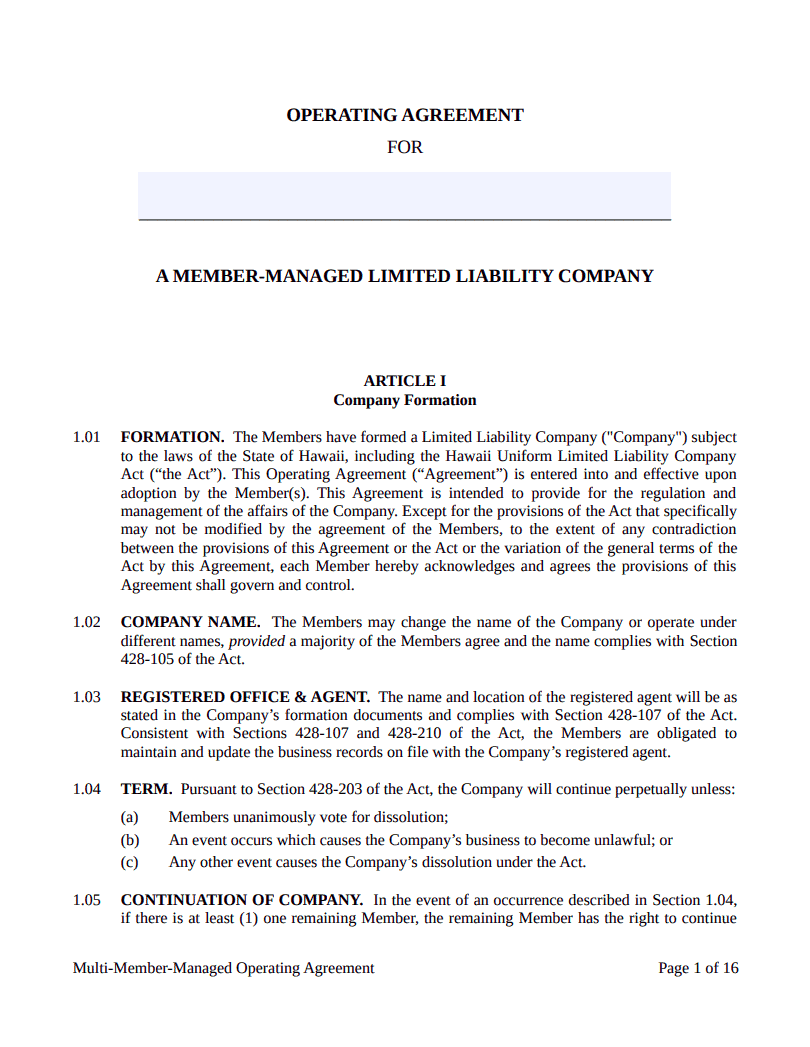
Is an Operating Agreement Legally Required for an LLC in Hawaii?
In Hawaii, an operating agreement is not legally required to form an LLC. However, state law (Hawaii Revised Statutes § 428-103) allows LLC members to create one to govern internal operations. While the state does not mandate it, having an operating agreement is strongly recommended to:
See AlsoLLC Operating Agreement: Utah- Clarify member roles, rights, and responsibilities.
- Protect the LLC’s limited liability status by formalizing its structure.
- Override default state rules that may not align with the members’ intentions.
Key Benefits of Creating an Operating Agreement in Hawaii
An operating agreement provides critical advantages for Hawaii LLCs, even if it’s optional. These include:
- Defining profit-sharing ratios and financial contributions.
- Establishing procedures for dispute resolution or member exit.
- Enhancing credibility with banks, investors, or courts by demonstrating a professional structure.
Potential Risks of Not Having an Operating Agreement
Without an operating agreement, Hawaii LLCs are governed by default state laws, which may lead to unintended consequences:
See AlsoLLC Operating Agreement: Ohio- Members lose control over decision-making processes outlined in state statutes.
- Increased risk of internal disputes due to undefined management roles.
- Potential challenges in proving the LLC’s separate legal entity status in court.
How to Draft an Operating Agreement for a Hawaii LLC
Creating a compliant operating agreement in Hawaii involves:
- Consulting a business attorney familiar with Hawaii LLC laws.
- Customizing templates to reflect the LLC’s management structure (member-managed vs. manager-managed).
- Including clauses for dissolution, member admission, and ownership transfers.
State-Specific Rules for Hawaii LLC Operating Agreements
Hawaii imposes certain guidelines for operating agreements, such as:
- Permitting oral or written agreements, though written agreements are advisable.
- Requiring agreements to comply with Hawaii Revised Statutes Chapter 428.
- Allowing amendments with approval from all members unless otherwise specified.
Can I write my own operating agreement for my LLC?
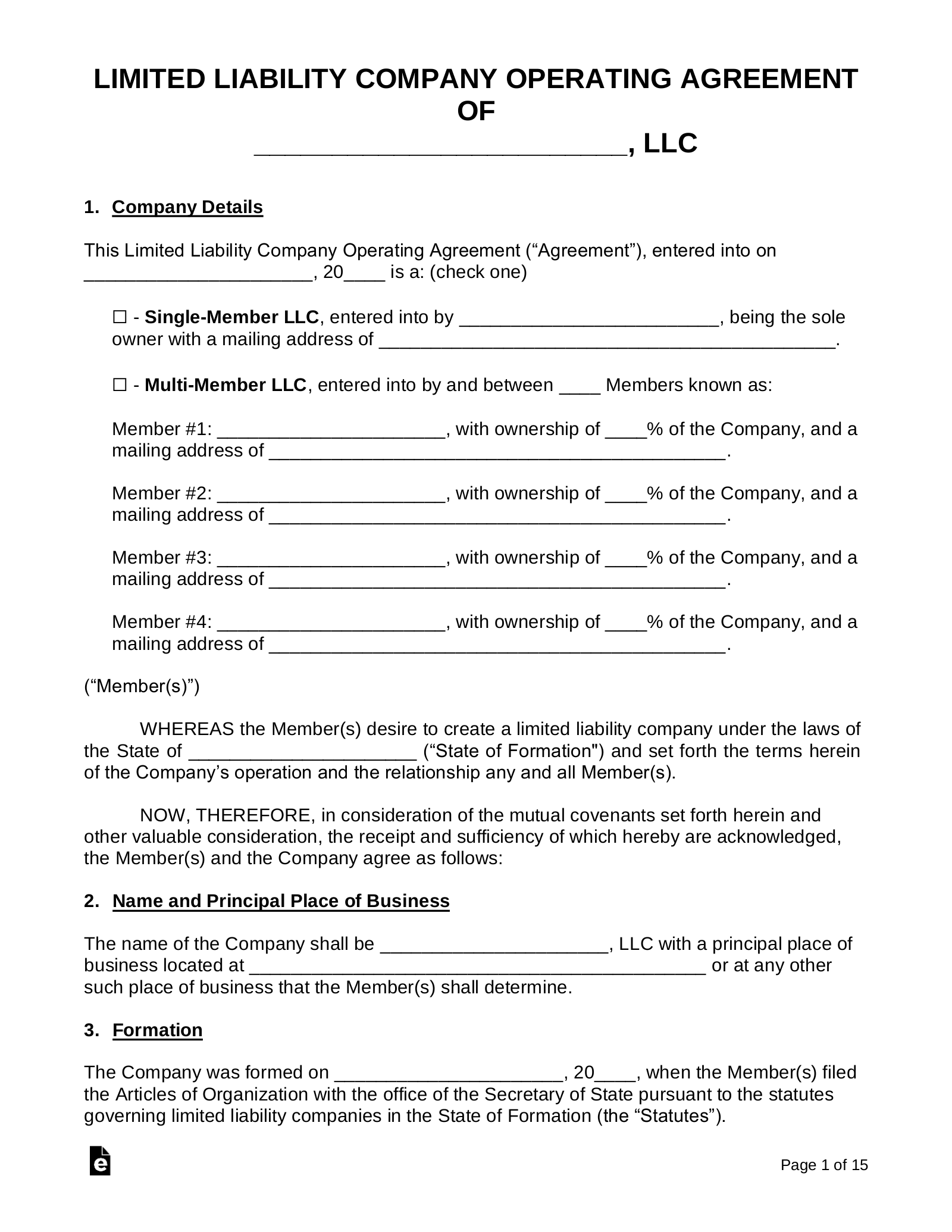
Can I Legally Draft My Own Operating Agreement for an LLC?
Yes, you can legally draft your own operating agreement for an LLC in most U.S. states. While some states do not legally require an operating agreement, creating one is highly recommended to establish clear rules, protect members’ rights, and avoid default state regulations. Key considerations include:
- Ensure compliance with your state’s LLC statutes and filing requirements.
- Customize terms for profit distribution, management structure, and decision-making processes.
- Include clauses for dispute resolution and procedures for adding/removing members.
What Are the Benefits of Writing Your Own Operating Agreement?
Drafting your own operating agreement offers flexibility and cost savings, while tailoring the document to your LLC’s unique needs. Advantages include:
- Customization of roles, responsibilities, and ownership percentages.
- Avoiding generic templates that may not address industry-specific risks.
- Clarifying tax treatment (e.g., partnership vs. corporation) to align with financial goals.
What Risks Are Involved in Self-Drafting an Operating Agreement?
While self-drafting is permissible, potential risks include legal oversights or unenforceable terms. Common pitfalls:
- Failing to address state-specific requirements, leading to compliance issues.
- Ambiguous language creating disputes over member obligations or profit splits.
- Omitting critical provisions like dissolution protocols or buyout terms.
What Key Clauses Should a DIY Operating Agreement Include?
A robust DIY operating agreement must cover essential clauses to ensure clarity and legal validity. Prioritize:
- Management structure (member-managed vs. manager-managed).
- Voting rights and procedures for major decisions.
- Capital contributions and procedures for additional funding.
- Distribution of profits and losses based on ownership stakes.
- Exit strategies for member withdrawal or business dissolution.
When Should You Consult a Lawyer Instead of Self-Drafting?
While DIY agreements work for simple LLCs, consult a lawyer for complex scenarios, such as:
- Multi-member LLCs with unequal ownership or conflicting interests.
- Foreign LLCs operating across state lines or internationally.
- High-risk industries (e.g., real estate, finance) requiring specialized legal safeguards.
Should an LLC have an operating agreement?
Legal Protection and LLC Operating Agreements
An operating agreement is critical for legal protection as it formally establishes the LLC as a separate legal entity. Without one, courts might treat the LLC as a sole proprietorship or partnership, jeopardizing limited liability protection. Key benefits include:
- Shielding personal assets from business liabilities and creditors.
- Formalizing the LLC’s structure to comply with state laws.
- Providing evidence of the LLC’s legitimacy in legal disputes.
Defining Member Roles and Responsibilities
An operating agreement clarifies member roles, preventing conflicts by outlining duties, voting rights, and decision-making processes. This is especially vital in multi-member LLCs. Key elements include:
- Specifying management structure (member-managed vs. manager-managed).
- Detailing each member’s capital contributions and profit-sharing ratios.
- Establishing protocols for adding or removing members.
Financial Structure and Profit Distribution
The agreement ensures transparency in the LLC’s financial operations, including how profits, losses, and expenses are handled. This prevents misunderstandings by:
- Defining profit distribution percentages based on ownership or contributions.
- Outlining procedures for financial audits and tax allocations.
- Setting rules for reinvesting profits or distributing dividends.
Preventing State Default Rules
Without an operating agreement, LLCs are governed by state default rules, which may not align with members’ intentions. Customizing the agreement allows:
- Overriding default provisions on management structure and voting rights.
- Tailoring rules for dissolution or transfer of ownership interests.
- Avoiding inflexible state-mandated procedures for disputes.
Dispute Resolution and Exit Strategies
An operating agreement minimizes conflicts by including dispute resolution mechanisms and exit strategies. This ensures continuity and fairness by:
- Outlining steps for mediation or arbitration before litigation.
- Detailing buyout provisions if a member leaves or passes away.
- Specifying procedures for dissolving the LLC if necessary.
What if an LLC has no operating agreement?

What Happens If an LLC Lacks an Operating Agreement?
If an LLC does not have an operating agreement, it will be governed entirely by the default rules of the state where it was formed. These rules vary by jurisdiction but often impose generic structures that may not align with the members’ intentions. For example, states may enforce equal profit distribution regardless of capital contributions or require unanimous votes for major decisions. This can lead to disputes, operational inefficiencies, and unintended legal consequences.
- State default laws dictate management and profit-sharing rules, which may not reflect members’ preferences.
- Decision-making processes may become cumbersome due to statutory requirements for unanimity or majority votes.
- Members risk personal liability protections being undermined if the LLC is deemed a general partnership by courts.
How Does the Absence of an Operating Agreement Affect Management?
Without an operating agreement, the LLC’s management structure defaults to state-mandated guidelines, which often assume member-managed governance. This can create confusion over roles, responsibilities, and decision-making authority. For instance, members might disagree on day-to-day operations or strategic choices, leading to gridlock.
- All members may have equal decision-making power, even if contributions or expertise vary.
- No clear procedures for adding or removing members, which complicates ownership changes.
- Potential for deadlocks in voting if state laws require majority or unanimous consent.
What Are the Risks to Profit Distribution Without an Operating Agreement?
State laws typically require equal profit distribution among LLC members unless otherwise specified. This can be problematic if members contributed unequal capital or effort. Disputes may arise over fairness, and tax implications could disproportionately affect certain members.
- Profits and losses are split equally, regardless of capital contributions or labor.
- Tax burdens may fall unevenly on members who are inactive or contributed less.
- Difficulty attracting investors who seek customized distribution terms.
How Does the Lack of an Operating Agreement Impact Dispute Resolution?
Without a predefined dispute resolution mechanism, members may resort to costly litigation. State laws rarely provide detailed guidance for resolving internal conflicts, leaving members vulnerable to prolonged legal battles that could destabilize the LLC.
- No mediation or arbitration clauses to resolve disagreements efficiently.
- Members may sue each other personally, eroding the LLC’s liability protection.
- Unclear exit strategies for members wanting to leave the business.
Can an LLC Without an Operating Agreement Face Dissolution Issues?
State laws often impose strict conditions for dissolving an LLC, such as requiring unanimous member consent. Without an operating agreement, closing the business or handling a member’s departure becomes legally complex and time-consuming.
- Dissolution may require unanimous approval, even if some members oppose it.
- No guidelines for distributing assets, leading to conflicts during winding up.
- Surviving members might face unexpected tax or legal liabilities.
Frequently Asked Questions About LLCs (FAQs)
Is an LLC Operating Agreement required by law in Hawaii?
Hawaii does not legally require LLCs to have an operating agreement, but it is highly recommended. While the state’s statutes (Chapter 428, Hawaii Revised Statutes) do not mandate one, creating a customized LLC Operating Agreement ensures clarity on member rights, profit distribution, and management structure. Without it, your LLC defaults to Hawaii’s default rules, which may not align with your business goals.
What key provisions should a Hawaii LLC Operating Agreement include?
A Hawaii LLC Operating Agreement should outline member ownership percentages, voting rights, profit/loss allocation, management roles (member-managed vs. manager-managed), and procedures for adding/removing members, dissolving the LLC, and resolving disputes. It should also address Hawaii-specific requirements, such as state tax obligations and compliance with the Department of Commerce and Consumer Affairs (DCCA).
Can a single-member LLC in Hawaii benefit from an Operating Agreement?
Yes, even single-member LLCs in Hawaii should have an Operating Agreement. This document reinforces the LLC’s limited liability protection by separating personal and business assets. It also establishes formal procedures for business decisions, succession planning, and potential future membership changes, which can prevent legal challenges and strengthen credibility with banks or creditors.
How do I amend an existing LLC Operating Agreement in Hawaii?
To amend a Hawaii LLC Operating Agreement, review the amendment clause within the original document. Most agreements require a majority or supermajority vote by members. Once approved, draft an amendment detailing the changes, have all members sign it, and store it with your LLC records. Amendments do not need to be filed with the state, but they must comply with Hawaii LLC laws to remain enforceable.
Leave a Reply
Our Recommended Articles