
LLC Operating Agreement: Maine

When forming a limited liability company (LLC) in Maine, drafting a comprehensive operating agreement is a critical step to establish clear guidelines for business operations and member relationships. Although Maine law does not legally require an LLC to have an operating agreement, creating one ensures clarity on ownership rights, profit distribution, management structure, and decision-making processes. This document serves as a foundational contract among members, helping prevent disputes and providing legal protection by outlining procedures for adding or removing members, resolving conflicts, and dissolving the business. Tailoring the agreement to Maine-specific regulations, such as compliance with the Maine Revised Statutes Title 31, safeguards the LLC’s flexibility while maintaining its limited liability status.
- Understanding the Essentials of an LLC Operating Agreement in Maine
- Does Maine require an operating agreement for LLC?
- Can I write my own operating agreement for my LLC?
-
Should an LLC have an operating agreement?
- Is an Operating Agreement Legally Required for an LLC?
- How Does an Operating Agreement Define Member Roles and Responsibilities?
- Can an Operating Agreement Protect Limited Liability Status?
- How Does an Operating Agreement Help Resolve Disputes?
- Why Is an Operating Agreement Important for Financial Clarity?
- What are the pitfalls of an LLC operating agreement?
- Frequently Asked Questions About LLCs (FAQs)
Understanding the Essentials of an LLC Operating Agreement in Maine
Key Components of a Maine LLC Operating Agreement
A well-structured LLC Operating Agreement in Maine should outline the rights, responsibilities, and relationships among members. Key components include:
- Ownership percentages and capital contributions.
- Management structure (member-managed vs. manager-managed).
- Profit and loss distribution methods.
- Voting rights and decision-making processes.
- Procedures for adding/removing members or dissolving the LLC.
| Component | Description |
|---|---|
| Ownership Structure | Defines member ownership stakes and initial investments. |
| Management Roles | Clarifies whether members or hired managers control operations. |
| Dissolution Terms | Outlines steps for winding down the LLC if necessary. |
Steps to Draft an LLC Operating Agreement in Maine
Drafting a compliant Operating Agreement involves:
1. Identifying members and their roles.
2. Specifying financial contributions and profit-sharing ratios.
3. Establishing governance rules for meetings and voting.
4. Including dispute resolution mechanisms.
5. Reviewing state-specific requirements under Maine Revised Statutes Title 31, Chapter 13.
| Step | Action |
|---|---|
| Define Ownership | Document each member’s stake and responsibilities. |
| Legal Compliance | Align terms with Maine’s LLC laws. |
Legal Requirements for Maine LLC Operating Agreements
Maine does not legally mandate an Operating Agreement, but having one is strongly recommended. Key legal considerations include:
- Ensuring single-member LLCs include clauses to protect limited liability status.
- Including signatures of all members to enforceability.
- Avoiding terms that violate Maine public policy or federal law.
| Requirement | Details |
|---|---|
| Single-Member Clauses | Prevents personal liability disputes. |
| Enforceability | Signed agreements hold weight in court. |
Amending an LLC Operating Agreement in Maine
To amend the agreement, follow these steps:
1. Review the original agreement for amendment procedures.
2. Secure member approval (as per voting thresholds).
3. Draft and execute an Amendment Document.
4. Distribute updated copies to all members and update state records if necessary.
| Step | Importance |
|---|---|
| Member Approval | Ensures transparency and legal validity. |
| Documentation | Maintains clarity during audits or disputes. |
Common Mistakes to Avoid in a Maine LLC Operating Agreement
Avoid these pitfalls:
- Failing to create an agreement, risking default state rules.
- Ignoring Maine-specific laws, such as dissolution requirements.
- Vague language regarding profit splits or management authority.
- Not updating the agreement as the LLC evolves.
| Mistake | Consequence |
|---|---|
| No Agreement | State laws override member preferences. |
| Unclear Terms | Leads to member conflicts or lawsuits. |
Does Maine require an operating agreement for LLC?
Legal Requirements for LLC Operating Agreements in Maine
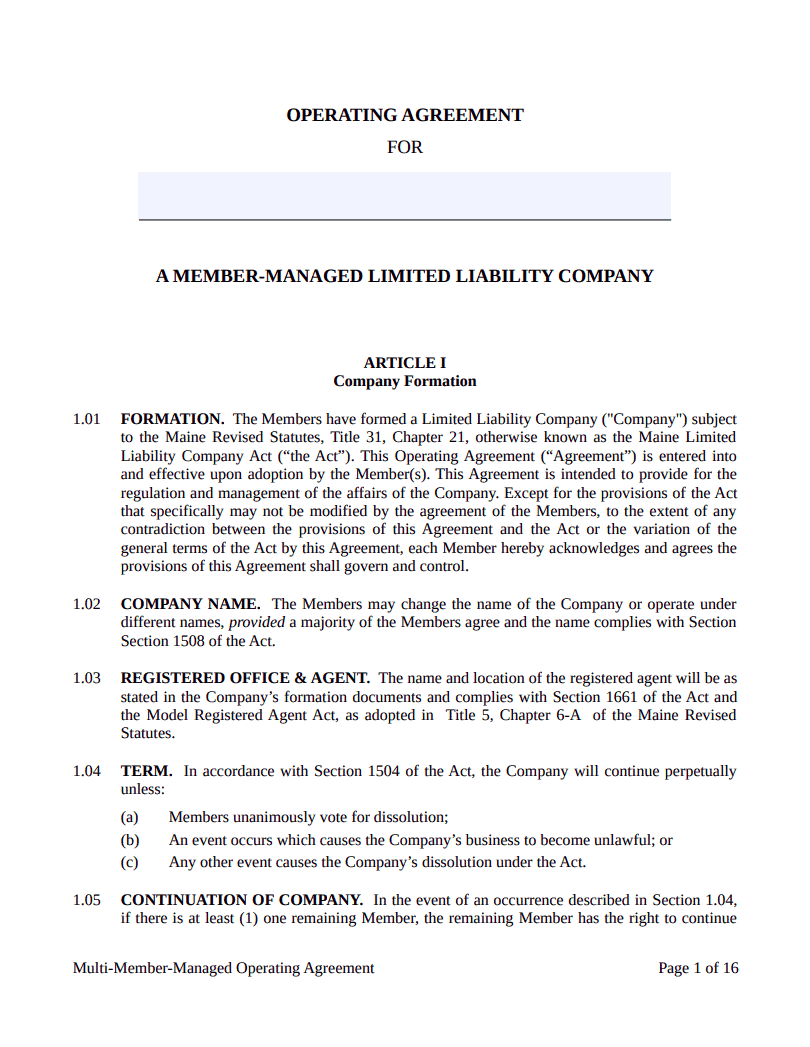
Maine does not legally require a Limited Liability Company (LLC) to have an operating agreement. However, while the state statutes (Title 31, Chapter 13) do not mandate it, creating one is strongly recommended to define internal rules and avoid conflicts. Without an operating agreement, Maine’s default LLC laws govern the business.
See AlsoNew Jersey LLC Operating Agreement- No statutory requirement for an operating agreement under Maine law.
- Recommended to establish ownership percentages, management structure, and profit-sharing.
- Default state rules apply if no agreement exists, which may not align with member intentions.
Benefits of Having an Operating Agreement in Maine
An operating agreement provides legal clarity and operational structure for Maine LLCs, even if not required. It helps avoid disputes by outlining roles, responsibilities, and procedures for critical decisions.
- Customization: Tailors governance to the LLC’s specific needs instead of relying on generic state laws.
- Dispute prevention: Clearly defines member rights, voting procedures, and conflict-resolution methods.
- Credibility: Enhances professionalism when dealing with banks, investors, or legal entities.
Key Components of an Effective Operating Agreement
A well-drafted operating agreement for a Maine LLC should include essential clauses to ensure smooth operations. These components protect members and align business practices with goals.
- Ownership structure: Details member contributions, profit/loss distribution, and capital accounts.
- Management roles: Specifies whether the LLC is member-managed or manager-managed.
- Dissolution terms: Outlines procedures for closing the business or transferring ownership.
How to Draft an Operating Agreement in Maine
While Maine does not require formal filing of an operating agreement, drafting one involves careful planning. Members can create it themselves or seek legal assistance for compliance and thoroughness.
- Collaborate with members: Discuss and agree on terms like voting rights and financial obligations.
- Use templates or attorneys: Leverage online resources or hire a business lawyer to ensure accuracy.
- Review and update: Revise the agreement as the LLC grows or circumstances change.
Consequences of Not Having an Operating Agreement
Operating without an agreement exposes a Maine LLC to potential risks, including disputes and unintended legal outcomes. State default rules may override member preferences.
- Default governance: Maine’s LLC statutes dictate management and profit distribution, which may not suit the business.
- Member conflicts: Ambiguity in roles or decision-making processes can lead to disagreements.
- Asset vulnerability: Personal liability protections may weaken without clear operational guidelines.
Can I write my own operating agreement for my LLC?
Legal Requirements for a DIY Operating Agreement
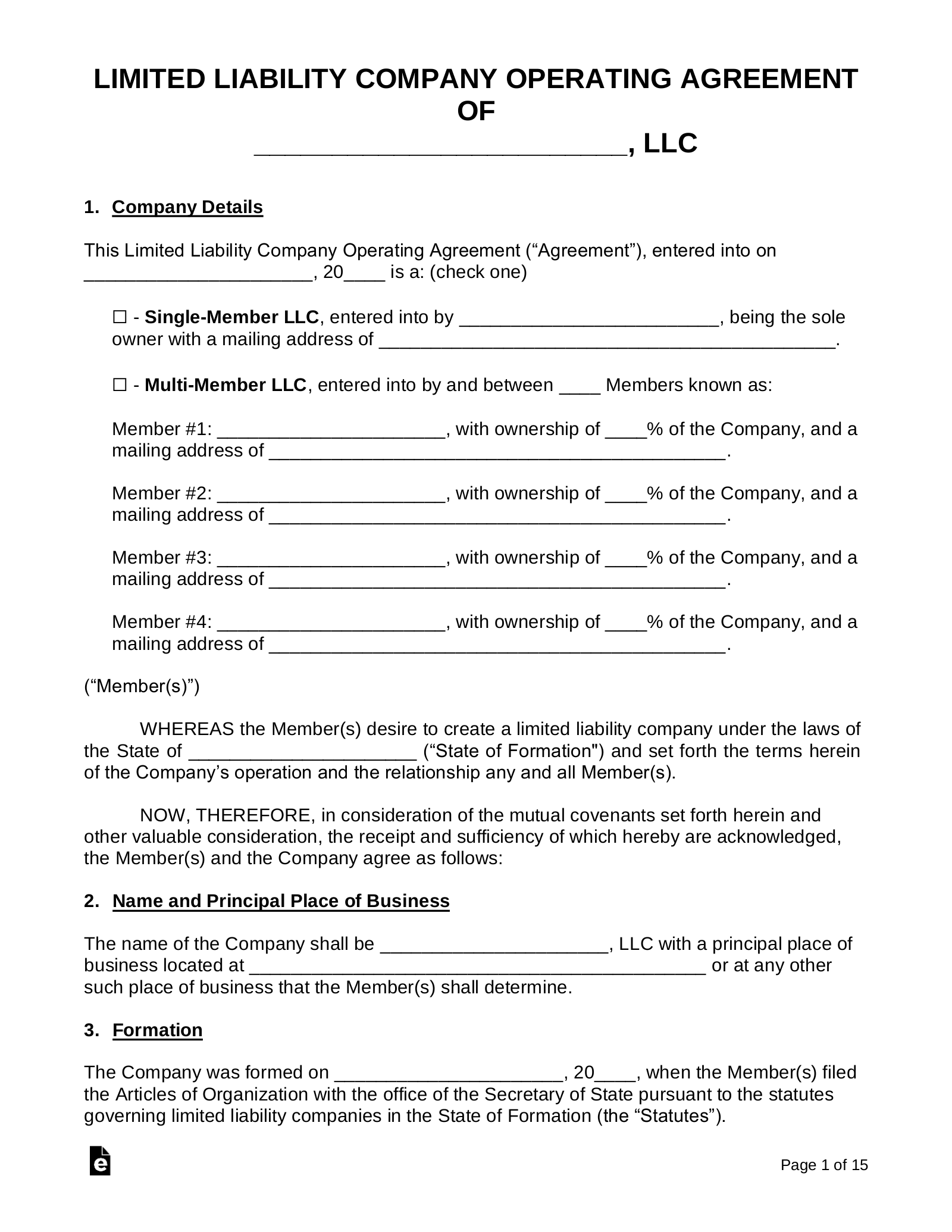
While you can draft your own operating agreement for an LLC, it must comply with your state’s LLC laws. Some states have minimal requirements, while others mandate specific clauses. Ensure your document includes:
- State-specific rules: Research your state’s statutes for required provisions.
- Mandatory clauses: Include management structure, profit distribution, and dissolution terms.
- Compliance: Avoid vague language to prevent disputes or legal challenges.
Advantages of Drafting Your Own Operating Agreement
Creating your own agreement offers flexibility and cost savings. Key benefits include:
- Customization: Tailor rules to your LLC’s unique needs and goals.
- Lower expenses: Avoid attorney fees for simple structures.
- Clarity: Define roles, voting rights, and decision-making processes upfront.
Risks of Creating an Operating Agreement Without Legal Assistance
Self-drafting carries risks, such as omissions or unenforceable terms. Potential pitfalls include:
- Missing critical clauses: Overlooking dispute resolution or buyout procedures.
- Legal vulnerabilities: Ambiguous language may fail in court.
- State noncompliance: Unintentionally violating statutory requirements.
Key Clauses to Include in a Self-Drafted Operating Agreement
A robust agreement should address core operational aspects. Essential clauses cover:
- Membership interests: Ownership percentages and capital contributions.
- Management structure: Member-managed vs. manager-managed roles.
- Profit/loss allocation: Rules for distributing financial outcomes.
When to Consult a Professional Despite Self-Drafting
Even if drafting independently, seek legal advice for complex scenarios:
- Multi-member LLCs: Mitigate conflicts with detailed governance terms.
- Industry-specific regulations: Ensure compliance in regulated fields like healthcare.
- Future planning: Address exit strategies or ownership transitions.
Should an LLC have an operating agreement?
Is an Operating Agreement Legally Required for an LLC?
While most states do not legally require an LLC to have an operating agreement, creating one is highly recommended. Without it, the LLC defaults to state-specific default rules, which may not align with the members’ intentions.
- Legal flexibility: Tailor rules to fit the business’s unique needs.
- Avoiding defaults: State laws may impose unwanted governance structures.
- Professional credibility: Banks or investors often request an operating agreement.
How Does an Operating Agreement Define Member Roles and Responsibilities?
An operating agreement clarifies member roles, profit-sharing ratios, and decision-making processes, reducing ambiguity.
- Ownership percentages: Clearly outlines each member’s stake.
- Voting rights: Establishes procedures for major decisions.
- Management structure: Defines if the LLC is member-managed or manager-managed.
Can an Operating Agreement Protect Limited Liability Status?
A well-drafted operating agreement strengthens the limited liability protection of an LLC by demonstrating a separation between personal and business affairs.
- Legal formality: Shows the LLC operates as a distinct entity.
- Asset protection: Reduces risk of piercing the corporate veil.
- Compliance documentation: Reinforces adherence to state regulations.
How Does an Operating Agreement Help Resolve Disputes?
The agreement serves as a binding roadmap to resolve conflicts, minimizing costly litigation.
- Dispute resolution clauses: Outlines mediation or arbitration processes.
- Exit strategies: Defines procedures for member buyouts or dissolution.
- Breach consequences: Specifies penalties for violating terms.
Why Is an Operating Agreement Important for Financial Clarity?
It ensures financial transparency by detailing profit distribution, tax obligations, and capital contributions.
- Profit allocation: Clarifies how profits/losses are divided.
- Tax structure: Supports IRS recognition of the LLC’s tax status.
- Funding protocols: Establishes rules for member contributions and loans.
What are the pitfalls of an LLC operating agreement?
Vague or Incomplete Terms in the Agreement
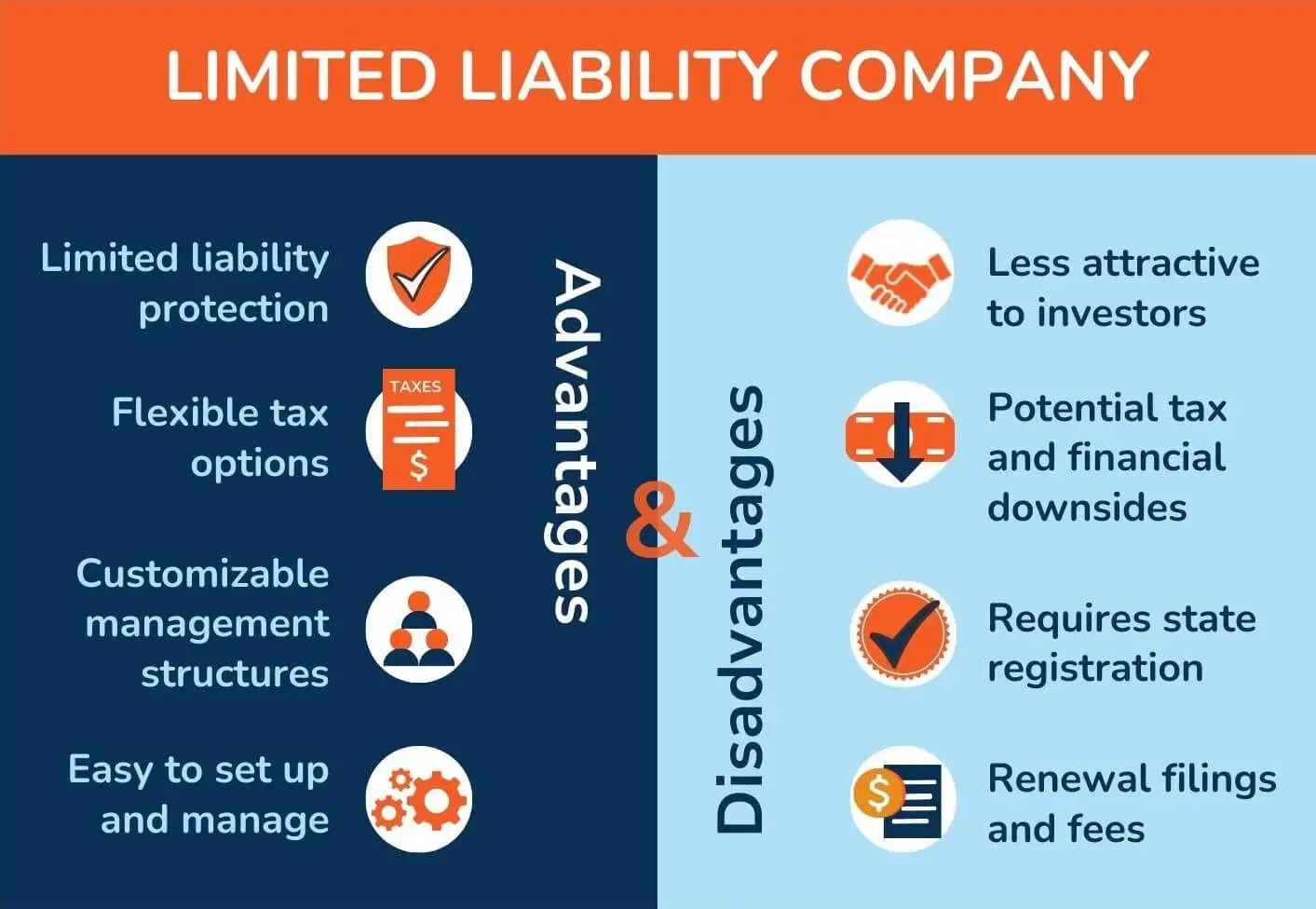
A poorly drafted LLC operating agreement often suffers from ambiguous language or omitted critical clauses, leading to disputes among members. Without clear terms, the document fails to provide a reliable framework for decision-making or conflict resolution.
- Undefined profit/loss distribution can cause disagreements over financial allocations.
- Missing management structure details may result in power struggles.
- Failure to outline exit strategies (e.g., member withdrawal or dissolution) creates uncertainty during transitions.
Failure to Define Member Roles and Responsibilities
An operating agreement that neglects to specify roles, duties, or voting rights can lead to operational inefficiencies and member conflicts.
- Unclear decision-making authority slows down critical business actions.
- Overlapping responsibilities may cause duplication of efforts or neglect of key tasks.
- Absence of accountability mechanisms allows members to avoid obligations without consequences.
Inadequate Provisions for Dispute Resolution
Many LLC agreements lack robust dispute resolution protocols, escalating minor disagreements into costly legal battles.
- No mediation or arbitration clauses force members into litigation.
- Unclear buyout terms during disputes can devalue the business.
- Failure to define voting thresholds for major decisions leads to deadlocks.
Ignoring State-Specific Legal Requirements
Operating agreements must align with state LLC laws, which vary significantly. Noncompliance risks legal vulnerabilities.
- Overlooking state-mandated clauses (e.g., dissolution procedures) may invalidate parts of the agreement.
- Mismanagement of annual reporting or fee obligations triggers penalties.
- Incorrect tax treatment specifications (e.g., pass-through taxation) lead to IRS issues.
Overlooking Flexibility for Future Changes
A rigid operating agreement may hinder adaptation to growth, market shifts, or member turnover.
- No amendment process complicates updates to reflect new goals.
- Failure to address new member admission rules limits expansion opportunities.
- Ignoring economic changes (e.g., recessions) leaves the LLC unprepared for crises.
Frequently Asked Questions About LLCs (FAQs)
Is an LLC Operating Agreement required for a Maine LLC?
Maine does not legally require LLCs to have an Operating Agreement, but it is highly recommended. While the state won’t ask for it during formation, a well-drafted Operating Agreement establishes ownership structure, management rules, profit distribution, and procedures for resolving disputes. Without one, your LLC defaults to Maine’s default LLC laws, which may not align with your business goals.
What key clauses should a Maine LLC Operating Agreement include?
A Maine LLC Operating Agreement should detail member roles, voting rights, profit/loss allocations, management structure (member-managed or manager-managed), and procedures for adding/removing members, dissolving the LLC, or transferring ownership. It should also outline dispute resolution methods and rules for amending the agreement. Tailoring these clauses ensures compliance with Maine Revised Statutes Title 31, Chapter 13 while protecting members’ interests.
Can a Maine LLC Operating Agreement be amended after formation?
Yes, a Maine LLC Operating Agreement can be amended if all members consent to the changes, unless the original agreement specifies a different amendment process. Amendments should be documented in writing and signed by members. Common reasons for amendments include adding new members, changing profit-sharing ratios, or updating management roles. Always keep updated copies with your business records.
What happens if a Maine LLC operates without an Operating Agreement?
Without an Operating Agreement, a Maine LLC defaults to the state’s default LLC rules under Title 31, which may lead to unintended outcomes. For example, profits and losses are split equally among members regardless of capital contributions, and critical decisions may require unanimous member approval. This lack of customization can create conflicts, weaken liability protection, and complicate dispute resolution. An Operating Agreement provides clarity and legal safeguards.
Leave a Reply
Our Recommended Articles