
What Are the Advantages and Disadvantages of Using Each of the Top Venture Capital Firms for Founders


Choosing the right venture capital (VC) firm is a critical decision for founders, as it can significantly influence the trajectory of their startup. The top VC firms offer unique advantages, such as access to extensive networks, industry expertise, and substantial funding. However, each firm also comes with its own set of challenges, including stringent terms, loss of control, and potential misalignment of goals. This article explores the pros and cons of partnering with leading venture capital firms, helping founders make informed decisions that align with their vision, growth strategy, and long-term objectives for their business.
- What Are the Advantages and Disadvantages of Using Each of the Top Venture Capital Firms for Founders?
- What are the advantages and disadvantages of venture capital?
- What are the advantages and disadvantages of using venture capital to finance a company's growth?
- What are the advantages and disadvantages of capital market?
- Who benefits most from venture capital?
-
Frequently Asked Questions (FAQs)
- What are the key advantages of partnering with top-tier venture capital firms?
- What are the potential disadvantages of working with well-known venture capital firms?
- How do smaller or niche venture capital firms compare to top-tier firms for founders?
- What should founders consider when evaluating venture capital firms for their startup?
What Are the Advantages and Disadvantages of Using Each of the Top Venture Capital Firms for Founders?
1. Access to Extensive Networks and Resources
One of the primary advantages of partnering with top venture capital firms is their extensive networks and resources. These firms often have connections with industry leaders, potential partners, and other startups, which can help founders scale their businesses more effectively. However, the disadvantage is that these networks might come with strings attached, such as pressure to meet specific milestones or expectations.
See Also What Are the Advantages and Disadvantages of Using Venture Capital as a Source of Financing Business
2. High Levels of Funding and Financial Support
Top venture capital firms can provide significant funding, enabling startups to grow rapidly. This financial support can be crucial for scaling operations, hiring talent, and entering new markets. On the flip side, the disadvantage is that such large investments often come with diluted equity, meaning founders may lose a substantial portion of ownership in their company.
3. Expertise and Mentorship
Many top venture capital firms offer mentorship and expertise in various industries, which can be invaluable for first-time founders. Their guidance can help avoid common pitfalls and accelerate growth. However, the disadvantage is that this mentorship might sometimes lead to micromanagement, where the VC firm exerts too much control over the startup's operations.
See Also What Are the Major Advantages of Being a Venture Capitalist?
4. Brand Credibility and Market Positioning
Being backed by a well-known venture capital firm can enhance a startup's brand credibility and market positioning. This can attract more customers, partners, and even future investors. The disadvantage, however, is that the association with a top VC firm can create unrealistic expectations from stakeholders, putting additional pressure on the startup to perform.
5. Exit Strategy and Long-Term Vision
Top venture capital firms often have a clear exit strategy and long-term vision, which can align with the founder's goals. This can lead to successful IPOs or acquisitions. The disadvantage is that these firms might prioritize their financial returns over the founder's vision, potentially leading to conflicts.
See Also What is a Major Drawback of Accepting Venture Capital?
| Advantages | Disadvantages |
|---|---|
| Access to extensive networks and resources | Potential pressure and strings attached |
| High levels of funding and financial support | Diluted equity and loss of ownership |
| Expertise and mentorship | Risk of micromanagement |
| Brand credibility and market positioning | Unrealistic expectations from stakeholders |
| Clear exit strategy and long-term vision | Potential conflicts over financial returns |
What are the advantages and disadvantages of venture capital?
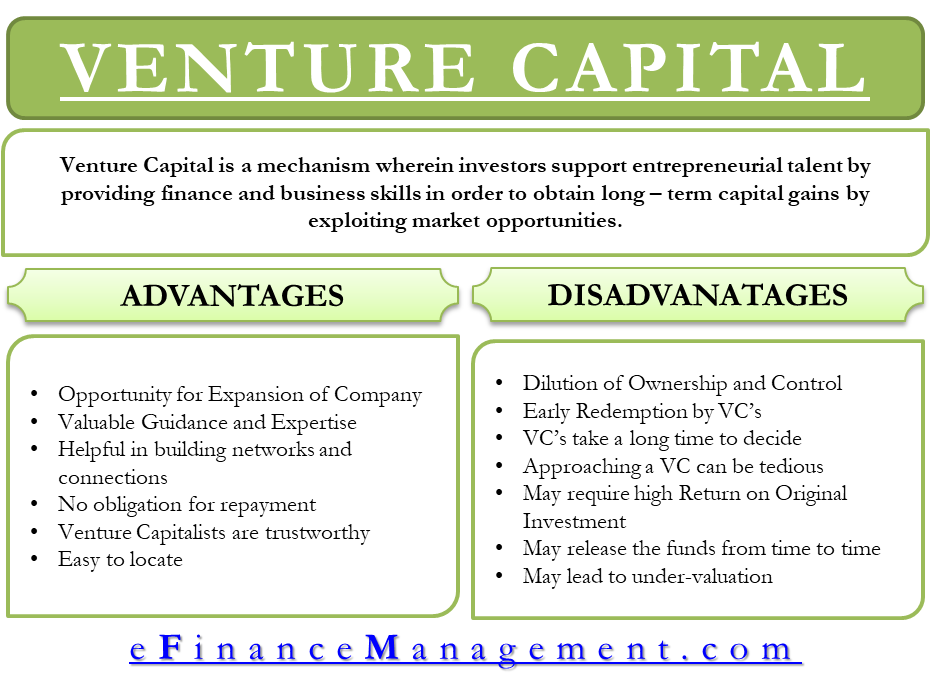
Advantages of Venture Capital
Venture capital offers several benefits for startups and growing businesses. Here are the key advantages:
- Access to Significant Funding: Venture capital provides startups with substantial financial resources that are often unavailable through traditional financing methods.
- Expert Guidance and Mentorship: Venture capitalists bring valuable industry expertise, strategic advice, and mentorship to help businesses grow and succeed.
- Networking Opportunities: Startups gain access to a vast network of industry contacts, potential partners, and customers through their venture capital investors.
- Credibility and Validation: Securing venture capital can enhance a company's reputation, making it easier to attract additional investors, customers, and talent.
- Flexible Repayment Terms: Unlike loans, venture capital does not require immediate repayment, reducing financial pressure on startups.
Disadvantages of Venture Capital
While venture capital has its benefits, it also comes with certain drawbacks. Here are the main disadvantages:
- Loss of Equity and Control: Startups must give up a portion of ownership and decision-making power to venture capitalists, which can limit their autonomy.
- High Expectations and Pressure: Venture capitalists often expect rapid growth and high returns, which can create significant pressure on startups to perform.
- Dilution of Ownership: As more funding rounds occur, the founders' ownership stake may be significantly diluted over time.
- Potential for Conflict: Differences in vision or strategy between founders and investors can lead to conflicts and hinder business operations.
- Long and Complex Process: Securing venture capital can be time-consuming and requires extensive due diligence, which may delay business plans.
Access to Expertise and Resources
One of the most significant advantages of venture capital is the access to expertise and resources. Here’s how it benefits startups:
- Strategic Guidance: Venture capitalists often have deep industry knowledge and can provide strategic insights to help businesses scale effectively.
- Operational Support: Many venture capital firms offer operational support, including marketing, HR, and financial management, to help startups streamline their processes.
- Market Insights: Investors can provide valuable market insights and trends, enabling startups to make informed decisions and stay competitive.
Impact on Company Culture
Venture capital can significantly influence a company’s culture. Here’s how:
- Increased Accountability: With venture capitalists on board, startups often adopt a more structured and accountable approach to business operations.
- Focus on Growth: The emphasis on rapid growth can lead to a high-pressure environment, which may impact employee morale and work-life balance.
- Cultural Shifts: The involvement of external investors may lead to changes in company culture, as new priorities and strategies are introduced.
Financial Risks and Rewards
Venture capital involves a unique balance of financial risks and rewards. Here’s a breakdown:
- High Potential Returns: Successful startups can generate substantial returns for both founders and investors, making venture capital an attractive option.
- Risk of Failure: Many startups fail, and venture capitalists are aware of the high risk involved, which can lead to significant financial losses.
- Shared Risk: Unlike traditional loans, the financial risk is shared between the startup and the venture capitalist, reducing the burden on the business.
Long-Term Implications for Startups
Venture capital can have lasting effects on a startup’s trajectory. Here’s what to consider:
- Scalability: Venture capital enables startups to scale quickly, but this rapid growth must be managed carefully to avoid operational challenges.
- Exit Strategies: Venture capitalists often focus on exit strategies, such as IPOs or acquisitions, which may not align with the founders' long-term vision.
- Brand Reputation: The association with reputable venture capital firms can enhance a startup’s brand, but negative experiences can harm its reputation.
What are the advantages and disadvantages of using venture capital to finance a company's growth?
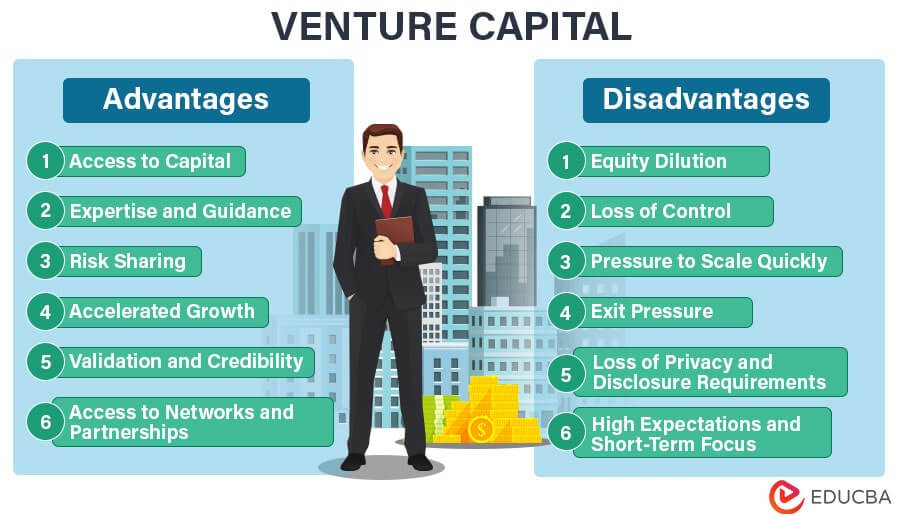
Advantages of Using Venture Capital for Growth
Venture capital offers several benefits for companies seeking to scale their operations. Here are the key advantages:
- Access to Significant Funding: Venture capitalists provide substantial financial resources, enabling companies to invest in research, development, and market expansion.
- Expertise and Mentorship: Venture capitalists often bring industry expertise, strategic guidance, and valuable networks to help the company grow.
- Credibility and Validation: Securing venture capital can enhance a company's reputation, making it easier to attract additional investors, partners, and customers.
- No Immediate Repayment Pressure: Unlike loans, venture capital does not require regular repayments, allowing companies to focus on growth without financial strain.
- Flexibility in Scaling: Venture capital can support rapid scaling, enabling companies to seize market opportunities quickly.
Disadvantages of Using Venture Capital for Growth
While venture capital has its benefits, it also comes with certain drawbacks. Here are the main disadvantages:
- Equity Dilution: Venture capitalists typically require equity in exchange for funding, which reduces the founders' ownership stake.
- Loss of Control: Investors may demand a say in decision-making, potentially leading to conflicts with the founders' vision.
- High Expectations: Venture capitalists expect high returns, which can create pressure to achieve rapid growth and profitability.
- Short-Term Focus: Investors may prioritize short-term gains over long-term sustainability, affecting the company's strategic direction.
- Exit Pressure: Venture capitalists often push for an exit strategy, such as an IPO or acquisition, which may not align with the founders' goals.
Impact on Company Culture
Venture capital can significantly influence a company's culture. Here’s how:
- Increased Accountability: The presence of investors often leads to stricter performance metrics and accountability measures.
- Shift in Priorities: The focus may shift from innovation and long-term goals to meeting investor expectations and financial targets.
- Cultural Integration Challenges: New investors may bring different values or working styles, potentially disrupting the existing company culture.
Financial Risks Associated with Venture Capital
Using venture capital involves certain financial risks. Consider the following:
- Valuation Challenges: Determining the company's valuation can be complex and may lead to disputes between founders and investors.
- Overvaluation Risks: High valuations can create unrealistic expectations, making it difficult to meet future funding or performance benchmarks.
- Dependency on Future Funding: Companies may become reliant on additional rounds of funding, which may not always be available.
Strategic Implications of Venture Capital
Venture capital can shape a company's strategic direction in various ways:
- Market Expansion: Funding can enable companies to enter new markets or develop new products, accelerating growth.
- Resource Allocation: Investors may influence how resources are allocated, potentially prioritizing high-growth areas over other initiatives.
- Partnership Opportunities: Venture capitalists often facilitate partnerships or collaborations that can drive strategic growth.
What are the advantages and disadvantages of capital market?

Advantages of Capital Market
The capital market offers several benefits that facilitate economic growth and financial stability. Below are some of the key advantages:
- Access to Long-Term Funding: Companies can raise capital for expansion, research, and development by issuing stocks or bonds.
- Investment Opportunities: Investors can diversify their portfolios by investing in a variety of financial instruments such as equities, bonds, and derivatives.
- Liquidity: Capital markets provide liquidity, allowing investors to buy and sell securities easily, which enhances market efficiency.
- Price Discovery: The interaction of buyers and sellers helps determine the fair value of securities, reflecting the true market sentiment.
- Economic Growth: By channeling savings into productive investments, capital markets contribute to overall economic development.
Disadvantages of Capital Market
Despite its benefits, the capital market also has certain drawbacks that can pose challenges for participants. Here are some of the main disadvantages:
- Market Volatility: Prices of securities can fluctuate significantly due to economic, political, or global events, leading to potential losses.
- Regulatory Risks: Changes in regulations or compliance requirements can impact market operations and investor confidence.
- Information Asymmetry: Not all investors have access to the same information, which can lead to unfair advantages for some participants.
- High Costs: Issuing securities involves substantial fees, including underwriting, legal, and listing expenses, which can be a barrier for smaller companies.
- Speculative Behavior: Excessive speculation can lead to asset bubbles, which may eventually burst and cause financial instability.
Role of Capital Market in Economic Development
The capital market plays a crucial role in fostering economic development by mobilizing resources and facilitating investments. Below are some key points:
- Resource Allocation: It directs savings towards productive investments, ensuring efficient allocation of resources.
- Infrastructure Financing: Governments and corporations use capital markets to fund large-scale infrastructure projects.
- Job Creation: By enabling business expansion, capital markets indirectly contribute to employment generation.
Types of Instruments in Capital Market
The capital market comprises various financial instruments that cater to different investor needs. Here are the primary types:
- Equity Instruments: Stocks represent ownership in a company and offer potential capital gains and dividends.
- Debt Instruments: Bonds provide fixed income and are considered safer than equities.
- Derivatives: Options and futures are used for hedging risks or speculative purposes.
Challenges Faced by Capital Markets
Capital markets encounter several challenges that can hinder their effectiveness. Below are some of the major issues:
- Global Economic Uncertainty: Events like recessions or geopolitical tensions can disrupt market stability.
- Technological Disruptions: Cybersecurity threats and rapid technological changes can pose risks to market infrastructure.
- Investor Protection: Ensuring fair practices and safeguarding investor interests remains a persistent challenge.
Who benefits most from venture capital?

Startups and Entrepreneurs
Startups and entrepreneurs are the primary beneficiaries of venture capital. This funding allows them to:
- Scale their operations quickly by investing in technology, talent, and infrastructure.
- Accelerate product development and bring innovative solutions to market faster.
- Access mentorship and networks provided by venture capitalists, which can be invaluable for growth.
Venture Capital Firms
Venture capital firms benefit significantly from their investments by:
- Earning substantial returns when startups they fund achieve success, such as through IPOs or acquisitions.
- Building a strong portfolio of high-growth companies, which enhances their reputation in the industry.
- Gaining equity stakes in promising startups, which can yield long-term financial rewards.
Economy and Job Creation
The economy as a whole benefits from venture capital through:
- Job creation as startups expand and hire more employees.
- Innovation-driven growth that leads to new industries and markets.
- Increased tax revenues generated by successful startups and their employees.
Investors and Limited Partners
Investors and limited partners who fund venture capital firms also benefit by:
- Diversifying their investment portfolios with high-risk, high-reward opportunities.
- Gaining access to exclusive deals in emerging markets and technologies.
- Earning significant returns if the venture capital firm achieves successful exits.
Consumers and Society
Consumers and society at large benefit from venture capital through:
- Access to innovative products and services that improve quality of life.
- Increased competition in markets, leading to better choices and lower prices.
- Technological advancements that address global challenges, such as healthcare and sustainability.
Frequently Asked Questions (FAQs)
What are the key advantages of partnering with top-tier venture capital firms?
Partnering with top-tier venture capital firms offers founders access to unparalleled resources, including industry expertise, extensive networks, and brand credibility. These firms often have a proven track record of supporting successful startups, which can attract additional investors and talent. Additionally, their mentorship and strategic guidance can help founders navigate complex challenges and scale their businesses more effectively. However, it's important to note that these firms may also demand significant equity and exert substantial control over decision-making.
What are the potential disadvantages of working with well-known venture capital firms?
While well-known venture capital firms bring many benefits, they also come with potential downsides. Founders may face high expectations for rapid growth and profitability, which can create pressure and limit flexibility. Additionally, these firms often require a larger equity stake, reducing the founder's ownership and control. The negotiation process can also be more rigorous, and the firm's focus on high returns might not align with the founder's long-term vision. It's crucial for founders to weigh these factors carefully before committing.
How do smaller or niche venture capital firms compare to top-tier firms for founders?
Smaller or niche venture capital firms can offer founders more personalized attention and a greater willingness to align with their vision. These firms may be more flexible in terms of equity stakes and decision-making, allowing founders to retain more control. They often specialize in specific industries, providing deep domain expertise and tailored support. However, they may lack the extensive networks and brand recognition of top-tier firms, which can make it harder to attract follow-on funding or high-profile partnerships. Founders should consider their specific needs and goals when choosing between these options.
What should founders consider when evaluating venture capital firms for their startup?
When evaluating venture capital firms, founders should consider factors such as the firm's investment thesis, track record, and cultural fit. It's important to assess whether the firm's goals align with the startup's vision and growth trajectory. Founders should also evaluate the firm's ability to provide strategic value, such as mentorship, industry connections, and operational support. Additionally, understanding the terms of the investment, including equity stakes and control provisions, is critical to ensuring a mutually beneficial partnership. Conducting thorough due diligence and seeking references from other founders can help make an informed decision.
Leave a Reply
Our Recommended Articles