
What Licenses and or Permits Do I Need for a Mobile Mechanic Business?

Starting a mobile mechanic business offers flexibility and the opportunity to serve customers directly at their location. However, navigating the legal requirements is essential to operate compliantly and avoid potential fines. Licensing and permit needs vary by location, but generally include a business license to legally conduct operations. Depending on your services, you may need automotive repair certifications or environmental permits for handling hazardous materials. Mobile businesses often require a commercial vehicle license or parking permits for work in public areas. Additionally, zoning laws and insurance coverage should be reviewed. Understanding these obligations ensures your business runs smoothly while building trust with clients.
What Licenses and Permits Do You Need for a Mobile Mechanic Business?
1. General Business License
To operate a mobile mechanic business, you’ll first need a general business license from your local city or county government. This license ensures your business complies with local regulations and zoning laws. Requirements vary by location, so check with your city clerk’s office or local licensing department. Some areas may require additional permits if you’re operating from a home-based location.
See Also What Are the Different Stages in Startup Funding?
| Requirement | Details |
| Business License Application | Submit to local government with fees (varies by jurisdiction). |
| Zoning Compliance | Ensure your mobile operation adheres to local zoning laws. |
| Home-Based Permit | Required if operating from a residential address in some areas. |
2. Automotive Repair License
Many states require an automotive repair license to perform mechanical services. This license verifies your technical competency and adherence to industry standards. For example, California mandates a Bureau of Automotive Repair (BAR) license, while Texas requires a Texas Department of Licensing and Regulation (TDLR) permit.
| Requirement | Details |
| State-Specific License | Check your state’s automotive regulatory agency. |
| Technician Certification | ASE certification or equivalent may be required. |
| Business Insurance Proof | Liability insurance is often mandatory. |
3. Environmental Permits
Handling automotive fluids (e.g., oil, coolant) requires environmental permits to comply with federal and state hazardous waste regulations. The EPA’s Resource Conservation and Recovery Act (RCRA) governs proper disposal. Mobile mechanics must also use spill containment systems to avoid fines.
See Also Where Can I Find a Comprehensive List of All Venture Capital Firms in the Us?
| Requirement | Details |
| EPA ID Number | Required for businesses generating hazardous waste. |
| Waste Disposal Plan | Document procedures for recycling/ disposing of fluids. |
| Spill Kits | Mandatory in most states to prevent environmental contamination. |
4. Commercial Vehicle Permits
If your mobile mechanic business uses a dedicated service vehicle, you may need commercial vehicle permits. These include a DOT number for interstate operations and state-specific commercial registrations. Vehicles carrying heavy tools or hazardous materials often require additional certifications.
| Requirement | Details |
| DOT Number | Required for vehicles over 10,000 lbs or interstate travel. |
| Commercial Plates | Register service vehicles as commercial in most states. |
| HAZMAT Endorsement | Needed if transporting flammable/ hazardous materials. |
5. Sales Tax Permit
If you sell parts or charge labor fees, a sales tax permit is essential. This allows you to collect and remit sales tax to your state’s revenue department. Some states, like Oregon, don’t levy sales tax, but most require this permit for retail transactions.
See AlsoWhich Law Firms in the San Francisco Bay Area Are Especially Well Known for Their Vc Fund Formation Practices| Requirement | Details |
| State Tax ID | Apply through your state’s Department of Revenue. |
| Tax Collection | Collect sales tax on parts and taxable services. |
| Filing Schedule | Monthly, quarterly, or annual tax filings based on revenue. |
Do I need a business license to be a mobile mechanic?
Do I Need a Business License to Operate as a Mobile Mechanic?
The requirement for a business license as a mobile mechanic depends on your location. Most jurisdictions mandate some form of licensing to operate legally. Here’s what to consider:
See Also Where Can I Find a List of Silicon Valley Venture Capital Firms?
- Check local regulations: City or county offices often require a general business license.
- State-level rules: Some states require specialized licenses for automotive services.
- Zoning laws: Mobile businesses may need permits if operating in residential areas.
What Are the Legal Requirements for Mobile Mechanics?
Operating legally as a mobile mechanic involves more than just technical skills. Key legal requirements include:
- Business license: Often mandatory for tax and operational compliance.
- Auto repair certification: States like California require a Bureau of Automotive Repair license.
- Insurance: Liability insurance is critical to protect against claims.
How Does Licensing Affect Your Mobile Mechanic Business?
Obtaining a license enhances credibility and ensures compliance. Benefits include:
See Also Can Founders of a Failed Startup Be Sued Individually by Their Angel or Vc Investors
- Customer trust: Clients prefer licensed, insured professionals.
- Legal protection: Avoid fines or shutdowns for non-compliance.
- Access to partnerships: Some suppliers or garages require proof of licensing.
What Happens If You Operate Without a Business License?
Skipping a license risks penalties and operational disruptions. Potential consequences:
- Fines: Municipalities may impose hefty penalties for unlicensed operations.
- Cease-and-desist orders: Authorities can halt your business activities.
- Reputation damage: Clients may avoid unlicensed services due to liability concerns.
How to Obtain a Business License for Mobile Mechanics?
The process varies by location but generally involves:
- Research local requirements: Contact city/county clerks or online portals.
- Submit applications: Provide business details, proof of insurance, and fees.
- Renewals: Track expiration dates to maintain compliance annually.
What kind of insurance does a mobile mechanic need?
General Liability Insurance for Mobile Mechanics
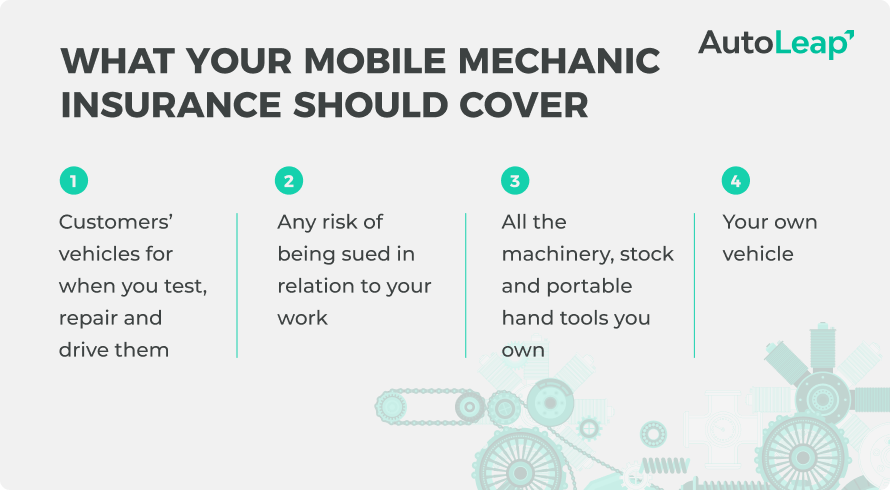
General liability insurance is essential for mobile mechanics to protect against third-party claims of bodily injury or property damage. For example, if a client trips over your tools or you accidentally damage their garage while working, this coverage helps pay for legal fees, medical bills, or repairs. Key aspects include:
- Third-party injuries: Covers medical costs if a client is hurt due to your work.
- Property damage: Addresses repair costs for accidental harm to a client’s property.
- Advertising injury: Protects against claims like slander or copyright infringement in your marketing.
Professional Liability Insurance (Errors & Omissions)
Professional liability insurance safeguards mobile mechanics against claims of negligence, mistakes, or incomplete work. If a client alleges your repair caused further damage to their vehicle, this policy covers legal defense and settlements. Key features include:
- Workmanship errors: Addresses costs from incorrect repairs or oversights.
- Breach of contract: Covers disputes over service agreements.
- Legal defense: Pays for attorney fees even if claims are unfounded.
Commercial Auto Insurance
Commercial auto insurance is critical for mobile mechanics who use a vehicle to travel to clients. Unlike personal auto policies, it covers accidents during business use and protects tools inside the vehicle. Key components include:
- Collision coverage: Repairs your vehicle after an accident.
- Tools and equipment protection: Reimburses stolen or damaged tools in transit.
- Liability for at-fault accidents: Covers third-party injury or property damage claims.
Tools and Equipment Insurance
Tools and equipment insurance protects the specialized tools mobile mechanics rely on. Whether stolen from your vehicle or damaged in a fire, this coverage ensures you can replace them without financial strain. Key benefits include:
- Replacement cost coverage: Pays for new tools, not depreciated value.
- Off-premises protection: Covers tools while at job sites or in transit.
- Theft and vandalism: Addresses losses from break-ins or intentional damage.
Workers’ Compensation Insurance
If you employ staff, workers’ compensation insurance is legally required in most states. It covers medical expenses and lost wages if an employee is injured on the job. Key elements include:
- Medical bills: Pays for treatment related to workplace injuries.
- Disability benefits: Provides income if an employee cannot work temporarily or permanently.
- Lawsuit protection: Shields your business from employee negligence lawsuits.
How much should a mobile mechanic charge per hour?
The hourly rate for a mobile mechanic typically ranges between $50 and $150, depending on factors like location, expertise, service type, and vehicle complexity. Urban areas often command higher rates due to increased demand and overhead costs, while rural regions may see lower pricing. Specialized services (e.g., electrical diagnostics) or emergency calls may incur premium charges. Mechanics should balance competitive pricing with fair compensation for travel, tools, and labor.
Factors Influencing a Mobile Mechanic's Hourly Rate
Multiple elements determine how a mobile mechanic sets their hourly fee. Key considerations include:
- Geographic location: Rates in cities like New York or Los Angeles often exceed those in smaller towns.
- Experience and certifications: ASE-certified mechanics or those with niche skills (e.g., hybrid vehicles) charge more.
- Service type: Basic tasks (oil changes) cost less than complex repairs (transmission rebuilds).
Average Hourly Rates by Region
Regional demand and cost of living significantly impact pricing:
- Urban areas: $80–$150/hour due to higher operational expenses.
- Suburban/rural areas: $50–$100/hour, reflecting lower competition and costs.
- Remote locations: May include travel surcharges beyond the base rate.
Mobile Mechanic vs. Traditional Shop Rates
Mobile services often differ from shop pricing:
- Convenience premium: Mobile mechanics may charge 10–20% more for on-site labor.
- Reduced overhead: No physical shop costs might lower rates for basic services.
- Travel time: Some include travel fees in hourly rates or bill them separately.
Additional Costs Beyond the Hourly Rate
Clients should anticipate potential extras:
- Travel fees: $20–$50 for distant locations.
- Parts markup: 15–30% above wholesale prices.
- Emergency services: After-hours calls may double standard rates.
How to Set Competitive Rates as a Mobile Mechanic
Mechanics can optimize pricing with these strategies:
- Market research: Analyze local competitors’ rates using platforms like Yelp or Thumbtack.
- Cost calculation: Factor in fuel, insurance, tools, and licensing fees.
- Transparency: Clearly outline rates and fees upfront to build client trust.
Are mobile mechanics ASE certified?

Are Mobile Mechanics Required to Be ASE Certified?
ASE certification is not a legal requirement for mobile mechanics. Unlike some professions that mandate licensure, automotive repair in most regions does not require ASE credentials. However, many mechanics voluntarily pursue ASE certification to demonstrate their expertise. Key points include:
- Voluntary credential: ASE certification is optional but widely respected in the industry.
- Employer preferences: Some mobile repair businesses or platforms may prioritize hiring ASE-certified technicians.
- Skill validation: Certification confirms a mechanic’s knowledge of diagnostic procedures, repairs, and safety standards.
How Do Mobile Mechanics Obtain ASE Certification?
Mobile mechanics follow the same process as traditional shop technicians to earn ASE certification. They must:
- Complete two years of relevant work experience (or one year plus formal training).
- Pass at least one of the ASE certification exams, which cover specific repair areas like engines, brakes, or electrical systems.
- Renew certification every five years through retesting or continuing education.
Benefits of Hiring an ASE-Certified Mobile Mechanic
Choosing an ASE-certified mobile mechanic offers advantages such as:
- Quality assurance: Certified mechanics adhere to industry-standard practices.
- Up-to-date knowledge: They stay informed about evolving automotive technologies.
- Trustworthiness: Certification reduces risks of improper repairs, as ASE tests are rigorous and scenario-based.
How to Verify a Mobile Mechanic’s ASE Certification
To confirm a mobile mechanic’s credentials:
- Ask for their ASE certification number and verify it on the ASE official website.
- Check for a physical or digital copy of their certification card.
- Look for ASE logos on their website or marketing materials (ensure they are current).
Do ASE-Certified Mobile Mechanics Charge More?
While rates vary, ASE-certified mobile mechanics might charge slightly higher fees due to:
- Proven expertise: Certification justifies premium pricing for specialized skills.
- Reduced error risk: Certified professionals are less likely to make costly repair mistakes.
- Insurance benefits: Some insurers offer discounts to businesses employing ASE-certified technicians, indirectly affecting pricing.
Frequently Asked Questions (FAQs)
What Are the Basic Licenses Required for a Mobile Mechanic Business?
To operate a mobile mechanic business, you typically need a general business license issued by your local city or county government. This license ensures your business complies with local regulations. Depending on your location, you may also require an auto repair license, which certifies that your services meet industry standards. Additionally, if you handle refrigerants (e.g., during AC repairs), the EPA Section 608 Certification is mandatory in the U.S. Always check state-specific requirements, as some states may require specialized permits for automotive services.
Do Mobile Mechanics Need a Garage or Dealer License?
Unlike traditional repair shops, mobile mechanics often don’t need a garage license since they don’t operate from a fixed commercial location. However, some states may require a dealer or repair facility license if you perform certain types of repairs or sell parts. For example, California mandates a Bureau of Automotive Repair (BAR) license for most automotive services. Verify your state’s laws to determine if your mobile business falls under these categories, as penalties for noncompliance can be severe.
Are There Specific Permits for Operating a Vehicle-Based Business?
Yes, operating a vehicle-based business like a mobile mechanic service may require a commercial vehicle permit, especially if your work van or truck is branded with business signage. Some cities also require a street use permit or parking permit to legally conduct repairs in public areas or residential neighborhoods. Additionally, if you dispose of hazardous materials (e.g., oil, batteries), you’ll need an EPA ID number or state-level hazardous waste permit to comply with environmental regulations.
Do I Need a Home-Based Business Permit for a Mobile Mechanic Operation?
If you manage your mobile mechanic business from home, you’ll likely need a home occupation permit to ensure your activities comply with zoning laws. Many municipalities restrict commercial operations in residential areas, particularly those involving customer visits or equipment storage. You may also need a storage permit if you keep tools, fluids, or hazardous materials at home. Always consult your local zoning office to avoid fines, and consider securing commercial auto insurance to cover business-related vehicle use.
Leave a Reply
Our Recommended Articles