
Wyoming Close LLC Operating Agreement

A Wyoming Close LLC Operating Agreement serves as the foundational document outlining the structure, governance, and operational guidelines for a Wyoming Close Limited Liability Company. Tailored specifically for small, closely held businesses, this agreement provides flexibility in management while maintaining the liability protections and tax advantages inherent to the LLC model. Unlike standard LLCs, a Close LLC is designed for smaller groups of members, often family-owned or tightly knit enterprises, with restrictions on member transfers to preserve control. The operating agreement details member roles, profit distribution, decision-making processes, and procedures for resolving disputes or dissolving the entity. By customizing this document, businesses can align operations with Wyoming’s favorable statutes, ensuring compliance while safeguarding member interests.
- Understanding the Wyoming Close LLC Operating Agreement: Key Features and Requirements
- How do I close my Wyoming LLC?
- Does Wyoming require an LLC operating agreement?
- How much does it cost to close an LLC in Wyoming?
- Why does someone open and close LLC in Wyoming?
- Frequently Asked Questions About LLCs (FAQs)
Understanding the Wyoming Close LLC Operating Agreement: Key Features and Requirements
A Wyoming Close LLC Operating Agreement is a legally binding document that outlines the ownership structure, management, and operational rules for a Wyoming Close Limited Liability Company (LLC). This agreement is tailored to meet the needs of small, closely-held businesses, offering flexibility and enhanced privacy protections under Wyoming state law. Unlike standard LLCs, a Wyoming Close LLC restricts membership transfers, ensuring control remains within a select group of owners. Key elements include provisions for profit distribution, voting rights, dissolution procedures, and dispute resolution. Wyoming’s business-friendly laws, such as asset protection and tax advantages, make this structure highly attractive for entrepreneurs prioritizing liability shielding and operational simplicity.
See AlsoWyoming Single Member LLC Operating AgreementKey Components of a Wyoming Close LLC Operating Agreement
The Wyoming Close LLC Operating Agreement must include several critical sections to ensure compliance and clarity. Membership rights and responsibilities define each owner’s contributions, voting power, and profit-sharing percentages. Management structure specifies whether the LLC is member-managed or manager-managed. Transfer restrictions prevent unwanted third-party ownership by requiring member approval for membership interest sales. Dissolution clauses outline procedures for winding down the business, while dispute resolution mechanisms provide steps for handling internal conflicts.
| Component | Description |
|---|---|
| Membership Rights | Defines ownership percentages, voting rights, and profit distribution. |
| Management Structure | Specifies roles (member-managed vs. manager-managed). |
| Transfer Restrictions | Limits membership transfers without unanimous consent. |
| Dissolution Process | Outlines steps to terminate the LLC. |
| Dispute Resolution | Includes mediation or arbitration requirements. |
Formation Requirements for a Wyoming Close LLC
To establish a Wyoming Close LLC, founders must file Articles of Organization with the Wyoming Secretary of State and pay the required fee. The Operating Agreement, though not filed publicly, is mandatory for internal governance. Wyoming requires a registered agent with a physical address in the state. Unlike some states, Wyoming does not mandate publishing notices in local newspapers, reducing formation costs.
See AlsoWyoming LLC Operating Agreement| Requirement | Details |
|---|---|
| Articles of Organization | Filed with the Wyoming SOS; includes LLC name and purpose. |
| Operating Agreement | Internal document signed by all members. |
| Registered Agent | Must have a Wyoming physical address. |
| Filing Fee | $100 (as of 2023). |
| Compliance | Annual report and $60 fee. |
Asset Protection Benefits of a Wyoming Close LLC
Wyoming Close LLCs offer robust asset protection through charging order protection, which limits creditors to claiming only distributions, not membership interests or company assets. Wyoming law also separates personal and business liabilities, shielding members’ private assets from business-related lawsuits. Additionally, the state’s privacy protections allow members to remain anonymous in public records.
| Benefit | Explanation |
|---|---|
| Charging Order Protection | Creditors cannot seize LLC assets or force dissolution. |
| Liability Separation | Personal assets are protected from business debts. |
| Privacy | No public disclosure of member names. |
| Statutory Protections | Wyoming law favors LLC asset shielding. |
Tax Advantages for Wyoming Close LLCs
Wyoming Close LLCs benefit from no state income tax, no franchise tax, and no taxes on out-of-state income. The IRS treats LLCs as pass-through entities, meaning profits and losses flow directly to members’ personal tax returns. Wyoming also avoids capital gains taxes and inheritance taxes, enhancing financial efficiency.
See AlsoSingle Member LLC: Wyoming| Tax Benefit | Details |
|---|---|
| No State Income Tax | Zero tax on LLC profits at the state level. |
| Pass-Through Taxation | Profits taxed only at the member level. |
| No Franchise Tax | No annual tax based on revenue or capital. |
| Federal Flexibility | Can elect S-Corp or C-Corp taxation. |
Transfer Restrictions in a Wyoming Close LLC Operating Agreement
A defining feature of a Wyoming Close LLC is its strict transfer restrictions, which prevent unwanted ownership changes. The Operating Agreement typically requires unanimous member consent for transfers and includes right of first refusal clauses. These provisions maintain control within the original membership group and protect against external interference.
| Restriction Type | Purpose |
|---|---|
| Buy-Sell Agreements | Pre-determined terms for buying out a member’s interest. |
| Right of First Refusal | Existing members can match third-party offers. |
| Approval Requirements | Transfers require majority or unanimous consent. |
| Valuation Methods | Specifies how membership interests are priced. |
How do I close my Wyoming LLC?

How to File Articles of Dissolution for a Wyoming LLC
To formally close your Wyoming LLC, you must file Articles of Dissolution with the Wyoming Secretary of State. This document legally terminates your LLC’s existence.
- Download the Articles of Dissolution form from the Wyoming Secretary of State website or create a compliant document.
- Include details like the LLC name, date of dissolution, and a statement confirming member approval (if required by the operating agreement).
- Pay the $60 filing fee and submit the form online, by mail, or in person.
Settling Outstanding Taxes and Fees
Before dissolving, ensure all state taxes, fees, and reports are finalized.
See AlsoWyoming LLC Filing Fee- File a final annual report with the Wyoming Secretary of State (if applicable).
- Pay any overdue state taxes, including sales tax or employer taxes, through the Wyoming Department of Revenue.
- Settle annual license tax fees ($60 minimum) for the year of dissolution.
Notifying Creditors and Settling Debts
Legally inform creditors and resolve outstanding obligations to avoid liability.
- Send written notices to all known creditors, specifying the dissolution and deadline for claims.
- Use LLC assets to pay off debts or negotiate settlements if funds are insufficient.
- Retain records of resolved claims to dispute invalid ones post-dissolution.
Distributing Remaining Assets to Members
After settling debts, distribute residual assets according to the LLC operating agreement.
- Follow the ownership percentages outlined in the operating agreement for distributions.
- If no agreement exists, follow Wyoming’s default LLC laws for proportional asset division.
- Document all distributions to prevent future disputes among members.
Closing Business Accounts and Licenses
Terminate all business-related accounts and licenses tied to the LLC.
- Close business bank accounts and credit lines to prevent unauthorized use.
- Cancel state and local licenses, permits, or registrations (e.g., sales tax permits).
- Notify the IRS to close your EIN and file a final federal tax return (Form 1065 or 1120-S).
Does Wyoming require an LLC operating agreement?
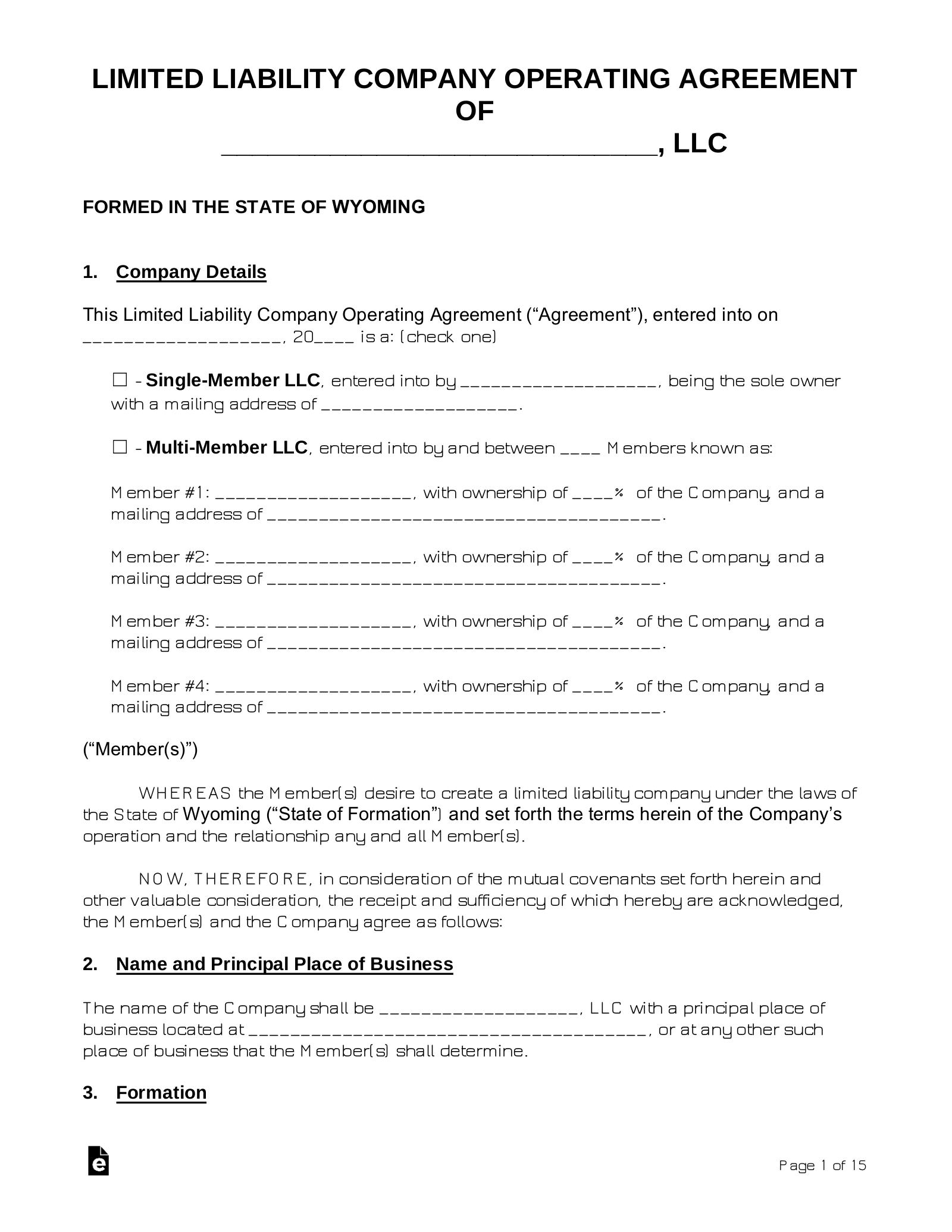
Is an LLC Operating Agreement Required by Wyoming Law?
Wyoming does not legally require LLCs to have an operating agreement. However, while the state does not mandate it, creating one is strongly recommended. An operating agreement helps:
- Clarify ownership structure and member responsibilities.
- Protect limited liability status by separating personal and business assets.
- Establish rules for profit distribution, management, and dispute resolution.
Why Should Wyoming LLCs Consider an Operating Agreement?
Even though Wyoming doesn’t require an operating agreement, having one provides critical advantages:
- Legal credibility: Demonstrates professionalism and compliance with internal governance.
- Customizable rules: Overrides default state laws that may not align with members’ preferences.
- Dispute prevention: Outlines procedures for resolving conflicts between members.
Key Clauses to Include in a Wyoming LLC Operating Agreement
A well-drafted operating agreement for a Wyoming LLC should address:
- Membership interests: Ownership percentages and capital contributions.
- Management structure: Roles of members vs. managers in decision-making.
- Dissolution terms: Conditions for winding down the LLC.
Risks of Not Having an Operating Agreement in Wyoming
Operating without an agreement exposes Wyoming LLCs to risks such as:
- State default rules: Wyoming’s LLC Act governs the business, which may not suit member needs.
- Personal liability: Courts may disregard the LLC’s liability protection if governance is unclear.
- Internal conflicts: Disputes over profit splits or management roles may escalate without guidelines.
How to Create an Operating Agreement for a Wyoming LLC
To draft a compliant and effective operating agreement in Wyoming:
- Define member roles and voting rights explicitly.
- Outline financial protocols, including profit distributions and tax obligations.
- Consult a business attorney to ensure alignment with Wyoming statutes and federal laws.
How much does it cost to close an LLC in Wyoming?

State Filing Fees for Closing an LLC in Wyoming
To formally dissolve an LLC in Wyoming, you must file Articles of Dissolution with the Wyoming Secretary of State. The filing fee for this document is $60. Additional costs may arise if expedited processing is requested.
- Standard filing fee: $60 (mandatory for dissolution).
- Expedited processing: $50–$100 extra for faster approval.
- Online vs. mail: No fee difference, but online submissions are processed faster.
Outstanding Taxes and Penalties
Before dissolving an LLC, ensure all state taxes and annual report fees are paid. Wyoming requires LLCs to be in good standing to avoid penalties.
- Annual report fee: $60 (due annually; must be settled before dissolution).
- Franchise tax: Wyoming has no franchise tax, simplifying the process.
- Penalties: Unpaid fees may incur late charges or block dissolution.
Registered Agent Termination Fees
If your LLC used a registered agent service, check if termination fees apply. Some providers charge to formally end their representation.
- Contract terms: Review agreements for early termination clauses.
- Average fees: $0–$50, depending on the provider.
- Notification: Inform the agent in writing to avoid recurring charges.
Legal and Professional Service Costs
Hiring an attorney or business service provider to handle dissolution adds to the total cost but ensures compliance.
- Attorney fees: $200–$500+ for legal guidance.
- Business service providers: $100–$300 for document preparation.
- Complex cases: Higher fees if resolving debts or lawsuits.
Reinstatement Fees for Unintended Lapses
Failing to properly dissolve an LLC may result in reinstatement fees if the state administratively dissolves it later.
- Reinstatement cost: $60 (same as dissolution fee) plus back taxes.
- Compliance proof: May require updated annual reports.
- Ongoing liabilities: Risks personal liability for unresolved debts.
Why does someone open and close LLC in Wyoming?
Tax Advantages and Flexibility in Wyoming LLCs
Wyoming is a popular choice for forming LLCs due to its favorable tax environment. The state imposes no corporate income tax, no personal income tax, and no franchise tax on LLCs, reducing overall financial burdens. Additionally, Wyoming allows pass-through taxation, where profits and losses flow directly to members’ personal tax returns. This flexibility attracts businesses aiming to minimize tax liabilities while maintaining operational simplicity.
- No corporate or personal income tax reduces operational costs.
- Pass-through taxation simplifies federal tax filings.
- Exemptions from state-level sales tax for certain transactions.
Privacy and Anonymity Protections
Wyoming offers robust privacy protections for LLC owners. Unlike many states, it does not require disclosing member or manager names in public filings. This anonymity is appealing to individuals or entities seeking to shield their identities for personal or strategic reasons. A registered agent can further obscure ownership details, ensuring confidentiality.
- No public disclosure of member identities.
- Use of a registered agent to maintain privacy.
- Protection from unsolicited inquiries or litigation targeting owners.
Asset Protection and Legal Safeguards
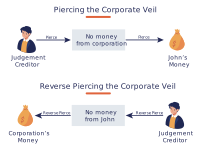
Wyoming’s LLC laws prioritize asset protection, making it difficult for creditors to claim business assets. The state’s charging order protection ensures that creditors can only access distributions owed to a debtor-member, not the LLC’s assets or operations. This structure safeguards personal and business wealth from legal disputes.
- Charging order protection limits creditor claims.
- Separation of personal and business assets.
- Strong legal precedents favoring LLCs in litigation.
Short-Term Business Ventures and Projects
Some entrepreneurs establish Wyoming LLCs for short-term projects or specific ventures. The ease of formation and dissolution allows businesses to operate temporarily while benefiting from Wyoming’s advantages. Closing the LLC after project completion avoids long-term compliance costs.
- Quick formation and dissolution processes.
- Ideal for time-bound ventures like real estate deals.
- Avoids ongoing fees after project completion.
Changing Business Needs or Relocation
Businesses may close Wyoming LLCs due to evolving strategies or relocation. If a company moves operations to another state, it might dissolve the Wyoming LLC to avoid dual-state compliance. Similarly, restructuring or mergers could prompt dissolution to streamline entities.
- Relocation to states with different tax laws.
- Restructuring after mergers or acquisitions.
- Simplifying compliance by consolidating entities.
Frequently Asked Questions About LLCs (FAQs)
What is a Wyoming Close LLC Operating Agreement?
A Wyoming Close LLC Operating Agreement is a legally binding document that outlines the ownership structure, management rules, and operational procedures for a Wyoming Close Limited Liability Company (LLC). Unlike standard LLCs, Close LLCs in Wyoming are specifically designed for small businesses with a limited number of members, offering additional flexibility in governance and restrictions on member transfers. This agreement defines member roles, profit distribution, voting rights, and procedures for resolving disputes or dissolving the company. It is tailored to comply with Wyoming state laws, including the Wyoming Limited Liability Company Act (§ 17-29-101 et seq.).
Is a Written Operating Agreement Required for a Wyoming Close LLC?
While Wyoming law does not legally mandate a written Operating Agreement for LLCs, having one is strongly recommended for Close LLCs. The agreement serves as a critical safeguard to protect the company’s limited liability status, prevent internal conflicts, and override default state statutes that may not align with members’ intentions. Without a written agreement, the LLC would default to Wyoming’s standard LLC regulations, which may not accommodate the unique needs of a Close LLC, such as restrictions on membership transfers or customized management structures.
Can Members Modify the Wyoming Close LLC Operating Agreement After Formation?
Yes, members of a Wyoming Close LLC can amend the Operating Agreement after formation, provided the changes comply with the original agreement’s amendment procedures and Wyoming law. Most agreements require a majority or unanimous member vote to approve modifications. Amendments should be documented in writing and filed with the company’s records. Common reasons for changes include adding/removing members, altering profit-sharing ratios, or updating management roles. Legal counsel is advised to ensure amendments do not violate state statutes or jeopardize the LLC’s compliance status.
What Happens If a Wyoming Close LLC Operates Without an Operating Agreement?
Operating without an agreement exposes the LLC to Wyoming’s default LLC rules, which may conflict with members’ expectations. For example, state law could impose equal profit distribution regardless of capital contributions or allow unrestricted member transfers, undermining the “close” nature of the LLC. Additionally, the absence of a formal agreement may weaken the company’s liability protection, as courts could disregard the LLC’s separate legal entity status in disputes. Drafting a customized Operating Agreement ensures clarity, control, and legal compliance for all members.
Leave a Reply
Our Recommended Articles